

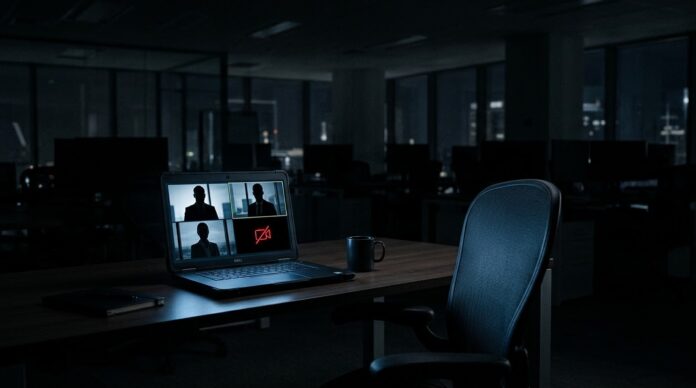

A Russian prank duo has fooled three of OpenAI’s most senior national security staff into a candid video call about selling AI to Ukraine’s military. The OpenAI prank call, first reported by The Intercept, was set up by Vovan and Lexus, who posed as Rustem Umerov, a senior Ukrainian security official. They later posted a 17-minute recording of the meeting online.
OpenAI does not dispute that the call took place. “Weeks ago, we launched a thorough investigation into the call’s authenticity,” spokesperson Nate Evans told The Intercept. “We acted internally and with the relevant authorities to conclude that it was a prank conducted by individuals with a history of targeting officials and other companies. We took action to prevent similar situations from happening in the future.”
Who was on the call
According to The Intercept, the three OpenAI staff were Sasha Baker, who runs national security policy at the company; Caroline Zier, its lead for strategic initiatives; and Ben Crampton, who handles European national security matters. Baker and Zier previously held senior posts at the US Department of Defense, and Crampton worked at the European Union and the United Nations. These are people who know what a foreign intelligence approach looks like.
That is what makes the story uncomfortable for OpenAI. Both Baker and Zier said on the call that they had met Umerov before and were glad to speak with him again. The fake Umerov reportedly kept his camera off for the entire meeting.
How the prank was set up
The pranksters did not need any hacking. Vladimir Kuznetsov, the “Vovan” half of the duo, told The Intercept they first contacted a senior Ukrainian official in San Francisco while posing as Umerov. That official was already trying to build ties with OpenAI through the Ukrainian community in California and knew Baker. Believing he was helping his own government, he arranged the meeting.
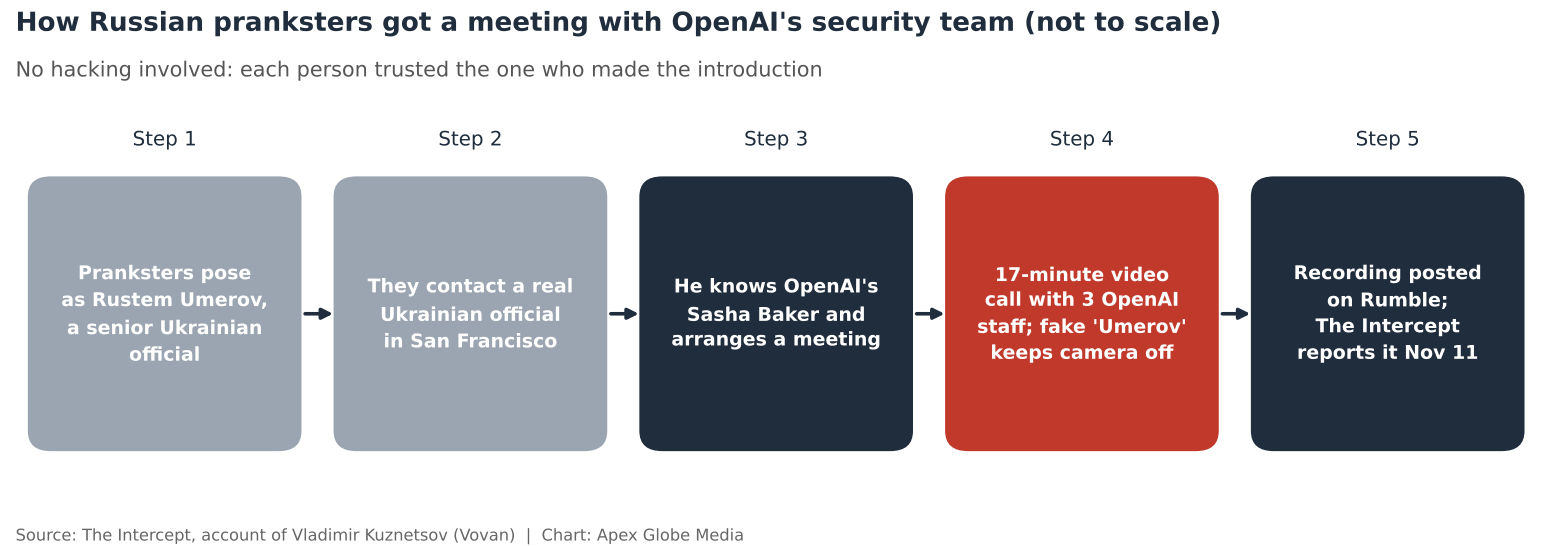
This is a classic social engineering chain. Each person trusted the one who introduced the next. Nobody asked the “official” to turn on his camera or confirmed the meeting through Ukraine’s embassy or ministry channels. It is the same weakness behind the North Korean FaceStealer fake video calls that the FBI says stole more than $400 million in crypto: a convincing introduction matters more than any technical trick.
What OpenAI staff said
The conversation covered OpenAI’s possible military support for Ukraine, including offensive uses of AI. Asked about selling such services, Crampton said: “There’s no question, I think, from our perspective that we want to have as deep a relationship as we possibly can with Ukraine. But it may not be possible to get to where we want to be straight away.”
He added: “There’s a general reluctance on the part of many people who are senior in the company to get too involved in offensive uses of our technology in a military context. Part of our job is to explain that offense and defense are not necessarily distinguishable from each other under certain circumstances.”
The staff also mentioned work with the Ukrainian government around Daybreak Blue, an OpenAI system for fixing software vulnerabilities, and early contact with Ukraine’s Ministry of Defense. Baker said the company had been in contact with the Pentagon about aiding Ukraine. OpenAI already holds a $200 million contract with the US Department of War to provide AI tools for “warfighters”, according to contract documents cited by The Intercept.
Some remarks were more political. Asked whether OpenAI could help counter Elon Musk’s influence, Baker replied: “I’m afraid we probably can’t help you with Elon Musk. He’s not a fan of our CEO either, if it helps you at all. So, we’re in the same boat.” On President Trump’s cooling stance toward Ukraine, she said, “It’s unfortunate.”
Not just comedians
Vovan and Lexus, real names Vladimir Kuznetsov and Alexei Stolyarov, have pranked public figures since 2011, from Elton John to the late Senator John McCain. They call themselves comedians and deny working for the Russian state. Security firm Proofpoint, which tracks the pair as TA499, has warned that “multiple governments and officials deem the pair to be Russian, state-funded bad actors”, and says their targets include company CEOs as well as politicians.
The Umerov disguise is not new either. In July, the duo used the same persona to call Davidas Matulionis, a senior adviser to Lithuania’s president, who later described the incident as the work of Russian intelligence services, LIGA.net reported. Ukrainian media noted that the voice in that recording appeared to be imitated with AI.
The timing is awkward for OpenAI. On November 12 it launched two new security products, Daybreak Red Team and Daybreak Defense Factory, and its president Greg Brockman told customers that companies “will be secure only to the extent of the frontier model that they use to defend themselves,” The Register reported. A prank that needed only an email, a middleman and a switched-off camera shows that the human side of security still matters.
Our take
Nothing secret appears to have leaked, and OpenAI says it investigated and changed its procedures. But the call gave a Kremlin-friendly outlet a recording of OpenAI’s defense team discussing offensive AI for Ukraine and joking about Elon Musk. As AI labs move deeper into military work, they become intelligence targets in the same way defense contractors are. A basic rule, confirming any foreign official through an official channel and insisting on video, would have stopped this. Labs that sell security to others should hold their own policy teams to that standard first.