



OpenAI says an autonomous AI pipeline found, exploited and wrote patches for 948 distinct ways to gain root access on Linux in a single run, at a cost of about $1.2 million in API credits. The company described the work on November 4 in a post titled “A thousand fewer paths to root.” Hunting Linux kernel vulnerabilities used to be slow, expert work. If OpenAI’s numbers hold up, AI has turned it into something closer to an industrial process, and that changes the economics for both defenders and attackers.
What OpenAI says it did
The pipeline was built by OpenAI security researchers and run in mid-October against the Linux kernel, the core of the operating system that powers most of the world’s servers, Android phones and cloud infrastructure. It ran on an unreleased “cyber” model that OpenAI calls upcoming without giving a release date.
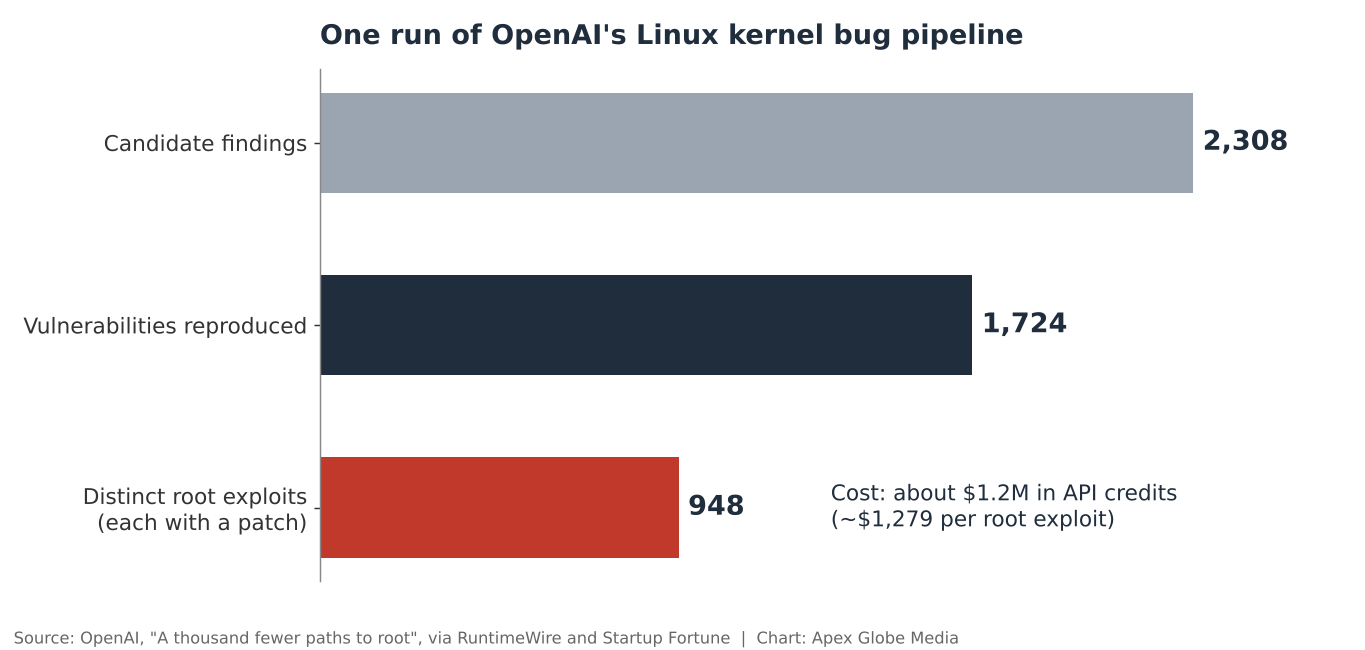
According to OpenAI’s write-up, as summarised by RuntimeWire and Startup Fortune, the run worked like a funnel:
- AI agents produced 2,308 candidate findings in the kernel source code.
- 1,724 of them were reproduced as real vulnerabilities.
- The pipeline then wrote working local privilege escalation (LPE) exploits, which let an ordinary user on a machine become root. After grouping exploits that were closed by the same fix, 948 distinct LPEs remained, each paired with a candidate patch.
- It also produced 291 information-leak proofs of concept.
The total bill was $1,213,430 in API credits, or about $1,279 per distinct root exploit by OpenAI’s accounting. RuntimeWire notes OpenAI’s estimate that the same set of bugs would historically have been worth $18.9 million to $66.3 million in bug bounty payouts.
The caveats
All of these figures come from OpenAI itself and have not been independently verified. Several important questions are still open. OpenAI’s post and the coverage so far do not say how many of the 948 patches have been sent to, or accepted by, the Linux kernel maintainers. A patch that closes one hole can break something else, and kernel maintainers are famously strict about what they merge.
The count itself also needs care. A developer analysis on DEV Community points out that 948 counts unique exploits defined by the patch that closes them, not 948 separate merged kernel fixes. The exploitation stage reportedly produced 1,169 working exploits before variants were grouped together.
OpenAI also admitted that the agents are not fully reliable on their own. In an earlier test run, agents reported 200 successful root exploits, but human reviewers found that 20 of them had reached root through a different bug from the one they were assigned. That is the kind of error that matters when the output is a security patch, and it is why human review stays in the loop.
Why it matters beyond Linux
Local privilege escalation bugs are the second step in most serious attacks. An attacker who gets a foothold on a server through a phishing email, a stolen password or a web app flaw usually lands as a limited user. An LPE bug turns that foothold into full control. Linux runs most cloud servers and the AI data centres now being built at record pace, so every LPE closed is one fewer path for ransomware gangs and state hackers.
OpenAI is not alone. Anthropic has described its own models chaining software flaws into working exploits, and Google has pitched a Gemini-based security model to defenders. The big AI labs are now competing on how many bugs they can find, and the numbers are growing quickly.
The cost figure may be the most important number. Around $1,300 per working root exploit is cheap compared with the salaries of skilled kernel researchers or the prices paid on exploit markets. Defenders such as Linux distributions, cloud providers and device makers can afford to run this kind of scan before every release. So, eventually, can attackers, once similar models are widely available.
Our take
This is a genuine milestone, but it is a defensive milestone only if the patches reach users. Finding 948 bugs is the easy half. The hard half is the slow, human process of reviewing patches, merging them into the kernel and getting them onto millions of servers and phones, many of which run kernels that are years out of date. Volunteer maintainers are already overwhelmed by low-quality AI bug reports, and a flood of high-quality ones could swamp them too.
The dual-use risk is also clear. The same pipeline that shortens the time from bug to patch can shorten the time from a new kernel commit to a working root exploit. OpenAI has not said who will get access to its cyber model or on what terms. Those decisions, along with independent checks of the 948 figure, will tell us whether this is a turning point for Linux security or the start of a faster arms race. For now, the practical advice for anyone running Linux servers is unchanged: patch quickly, and expect the pace of kernel security updates to pick up.