



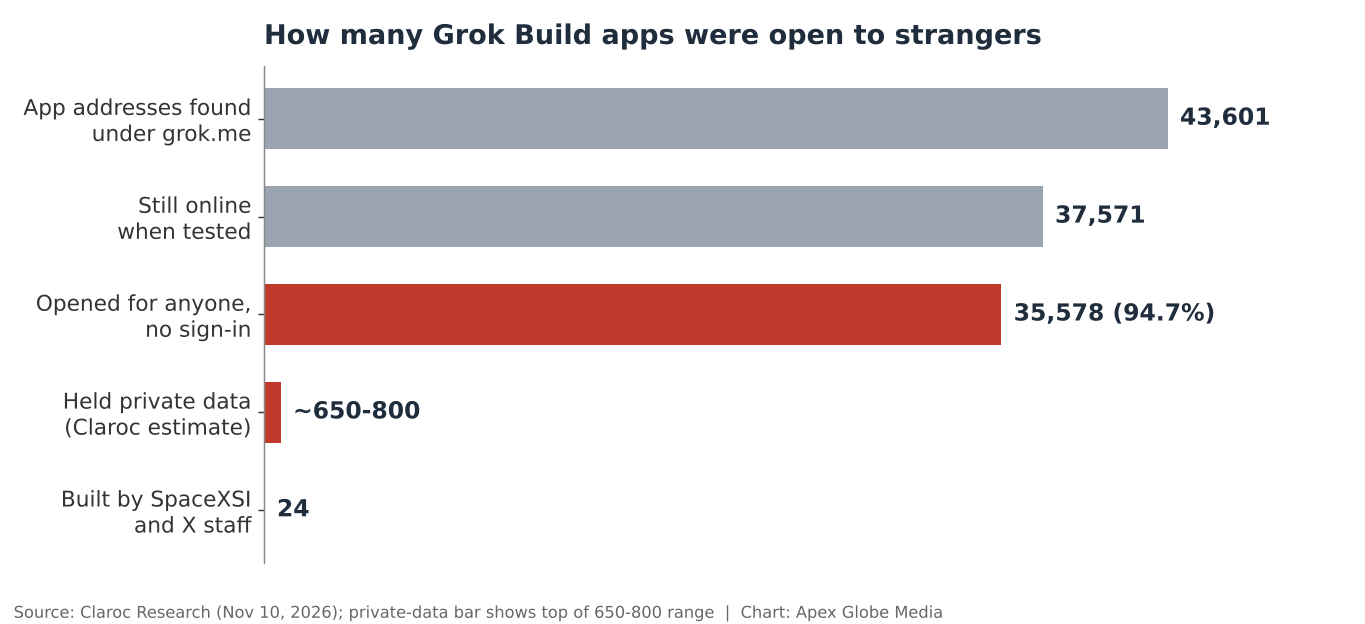
More than 35,000 apps made with Elon Musk’s AI chatbot could be opened by anyone who found the address, and the addresses were easy to find. Security firm Claroc says in a report published on November 10 that the Grok Build apps it tested held hospital staff lists, an intensive care patient’s lab results, plain-text passwords and 24 internal apps built by staff at SpaceXSI, the company that makes Grok. Ars Technica, which put questions to the company, reports that SpaceXSI removed its own 24 apps within hours, while the apps of other users stayed online.
Grok Build is the mode in which you describe an app in plain words and Grok writes it. A working web page can be ready in minutes. SpaceXSI is the name of the merged SpaceX and xAI.
What was left open
Claroc says it found 43,601 app addresses under grok.me, the domain where Grok publishes apps. It loaded the first page of 43,551 of them once, without signing in. Of the 37,571 apps still online, 35,578, or 94.7%, opened for anyone. Only 1,993 answered with the “unauthorized” error that a private app returns.
Most were games, landing pages and calculators, but Claroc estimates that roughly 650 to 800 held private data. Among the cases it says it confirmed by hand:
- a hospital group’s event app with a searchable list of more than 3,500 employees;
- an intensive care briefing on a single patient, with lab results, scans and ventilator status;
- a fire department’s live shift board with names, badge numbers and duty hours;
- a contractor’s timesheet whose code contained every employee’s password in plain text.
Besides SpaceXSI and X, Claroc says it could identify 30 organizations by name, among them six Fortune 500 companies and two defense businesses. It does not name them.
The most awkward finds belonged to the platform’s owner. The 24 apps built by SpaceXSI and X staff included a confidential onboarding plan for a new member of the enterprise sales team, a sales territory map of 594 accounts and eight advertising proposals, one of them to a U.S. federal agency and marked confidential.
How a secret link ends up in a public list
The flaw is in where the secret part of the address sits. Grok gives each app its own hostname, made of random words, such as cinder-crane-sand-frost.grok.me. Nobody would guess four random words. Nobody has to.
When someone opens a web address, their computer first asks the DNS system, the internet’s address book, where that name lives. Passive DNS services record these lookups and sell search access to them. So the first time an invited colleague opens a new Grok app, its name can land in a searchable database. One pattern search for “grok.me” then lists them all.
Links built the other way round do not leak like this. Google Docs, ChatGPT’s shared chats and Claude’s published artifacts keep the random part in the path after the domain, which DNS never sees.
“Anyone with the link” was the default
A random address alone would not have exposed so much. The bigger problem, Claroc says, is the access setting. When it published apps from a paid account, the panel offered three options, “Anyone with the link”, “Invited users” and “Only you”, with the first one already selected.
A representative of Cursor, the coding company SpaceXSI recently bought, told Ars that Grok Build “apps are private by default and nothing goes public unless the creator chooses to share it.” According to Claroc, SpaceXSI also said that publishing takes several confirmation steps and that employee accounts start as “Only you”. Claroc’s answer is that the people behind the 35,578 open apps went through every one of those steps, and the setting still ended up as “everyone”.
The researchers also built two test apps of their own and tested only those. A contact list Grok made “so every visitor sees them” had a database and no login at all: a stranger could add rows. A customer list “for my company’s sales team of 4 people” got Google and X sign-in, but the code Grok wrote added anyone who signed in to the team before checking if they belonged. An outside Google account could read, change and delete records.
Not the first Grok leak, and not only Grok
The report is part of a pattern. In July, SpaceXSI said it was deleting retained data after the Grok Build command-line tool was found uploading whole code repositories to company cloud storage. In October, Meta paused sharing in its Muse assistant after the same researchers found more than 6,800 shared chats through a single DNS search. Grok’s app builder, which reached Android in September, now faces the same question.
Claroc says Lovable, Replit, Bolt, v0, Base44 and Google AI Studio also give each app its own hostname, so their names land in DNS data the same way. ChatGPT does too, but its sharing panel starts at “Only me”, which leaves a found address useless to a stranger. Claroc sells security tools for AI-built apps, which is worth keeping in mind.
Claroc asked SpaceXSI to make “Only you” the default, add a company-only sharing option and move the secret into the link’s path. If you have published a Grok app, open it in a private browser window. If it loads without asking you to sign in, switch it to “Invited users” or unpublish it.
Our take
The interesting part is not a clever hack. Nobody broke in. A tool that lets anyone build software in minutes also let them publish it to the world in minutes, with the most open setting pre-selected. SpaceXSI’s own sales team fell into the same trap as hospital staff and firefighters, which says the default is the problem, not careless users. A company racing to sell AI coding to enterprises should make “private” the starting point for everyone, not only for its own employees, and it should help reach the owners of the 35,000 open apps instead of leaving that to a security startup.