



Fake “only 1 left” warnings, subscriptions you cannot cancel and loot boxes sold to children are the targets of a new European law. On November 11 the European Commission presented its proposal for a Digital Fairness Act, which Justice Commissioner Michael McGrath called “the most significant reform of EU consumer protection rules in more than 20 years.” It would also let users switch off endless scrolling and autoplay, and give Brussels the power to fine companies up to 6% of their worldwide turnover.
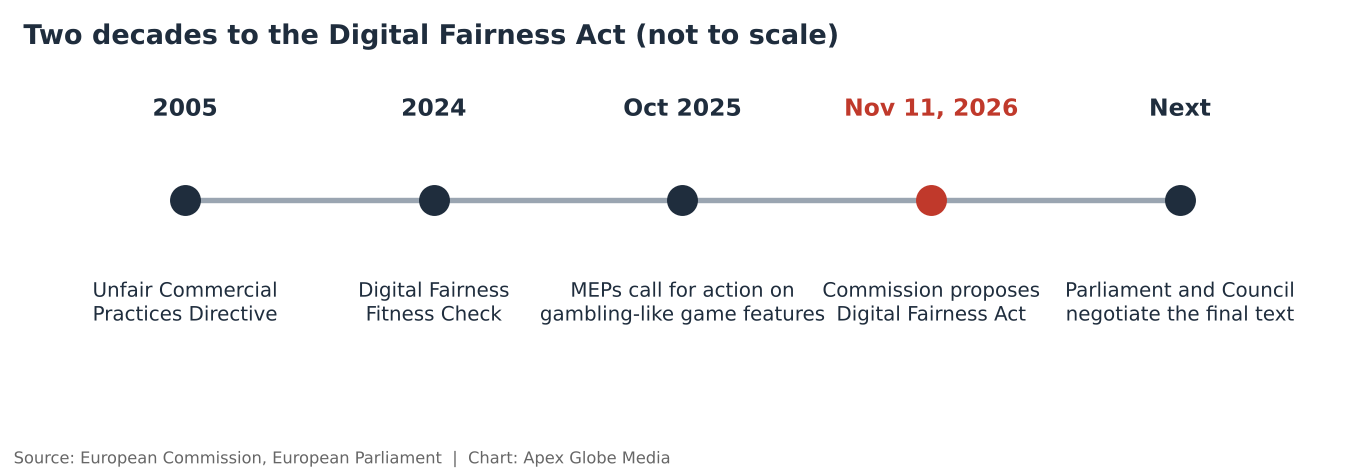
The proposal is not law yet. The European Parliament and the member states in the Council now have to agree on a final text, and as The Next Web notes, years of negotiation may lie ahead. But it shows clearly how the EU wants apps, games and online shops to be built.
Dark patterns go on a blacklist
“Dark patterns” are interface tricks that push people into choices they would not otherwise make. EU law already bans misleading practices in general, but the new act updates the list of practices that are banned in all circumstances. The Commission’s questions and answers give three examples:
- fake scarcity claims such as “Only 1 left” or “5 other customers are interested in this!”;
- “confirmshaming”, like “We’re sad to see you go” or a button that reads “I don’t like good deals”;
- pre-ticked boxes and extra items added to a shopping basket automatically.
The act would also turn the 2005 Unfair Commercial Practices Directive into a regulation, which applies directly in all 27 countries instead of being copied into 27 national laws. It covers any trader that sells to EU consumers, wherever the trader is based, and non-EU companies would have to appoint a legal representative in the EU.
Loot boxes, in-game coins and endless scroll
The gaming rules are the ones likely to cause the loudest fight. For minors, the proposal bans “features that encourage gambling-like behaviour”, including loot boxes, which are paid items with a random reward, and pay-to-win or pay-to-progress mechanics. Virtual currencies, the gems and coins bought with real money, would have to show their price in real euros, and for minors they would be switched off by default.
The European Parliament asked for this. In October 2025 MEPs called on the Commission to act against gambling-like mechanics in games that children can play.
For addictive design, the Commission chose control over bans. Users of all ages would get the option to turn off features such as endless scrolling, video autoplay and notifications that are not related to their own activity. Stricter rules for children sit in a separate proposal, the EU KIDS Act. This fits a wider European push against attention-grabbing design: the Commission recently said that TikTok’s “rabbit hole” algorithm breaks the Digital Services Act, and Greece has banned social media for under-15s.
Subscriptions, prices and AI shopping agents
The rest of the package reads like a list of everyday online annoyances. Companies would have to offer a simple cancellation option for digital contracts, remind users before a free trial turns into a paid plan and get active confirmation before charging. Customers would get a right to reach a human in customer service when other channels fail. “Not be left with a chatbot,” as McGrath put it.
On prices, the full cost including fees and taxes would have to be shown from the start, which in effect bans “drip pricing” for hotels and tickets. In virtual queues for concerts and sports events, sellers would have to show the current price in real time and the highest possible price. Higher personalised prices for minors or vulnerable consumers would be banned, and the ban on ads targeted with sensitive data, which today applies only to online platforms under the Digital Services Act, would extend to all websites and apps.
One line looks to the near future: consumers would have “clear rights when using an AI agent to buy products on their behalf.” The Commission has not given details in its summary documents, but it is one of the first attempts to write rules for AI shopping bots into consumer law.
Brussels wants its own fining power
Today the Commission cannot enforce consumer law directly. It can only coordinate the 27 national authorities, which have run more than 30 joint actions since 2020. A parallel revision of the Consumer Protection Cooperation Regulation would change that. The Commission could step in when a breach is likely to affect consumers in at least two-thirds of member states, covering at least two-thirds of the EU population, and when the company is not a small or medium business. National regulators would then have to stop their own investigations, and the Commission could fine up to 6% of global annual turnover.
The Commission says the changes could save EU consumers up to €13.7 billion a year. McGrath said manipulative practices now cost consumers €10.3 billion a year.
Our take
Most of this act is overdue. Nobody will defend fake countdown timers or a cancel button hidden five menus deep, and putting them on a blacklist is simpler than fighting each case in court. The real test will be games. Loot boxes and pay-to-progress are core to how many free mobile games make money, and the industry will push hard to narrow the definitions during the negotiations. We also think the Commission was right to give adults an off switch for endless scroll instead of banning it, but the switch only matters if it is easy to find. Brussels should check that the “fairness by design” rule is not itself buried behind a dark pattern.