

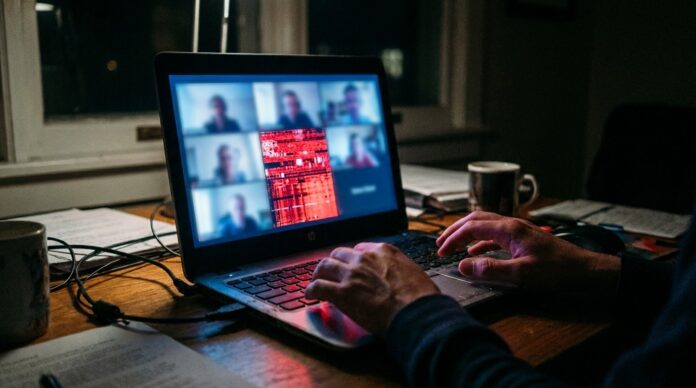

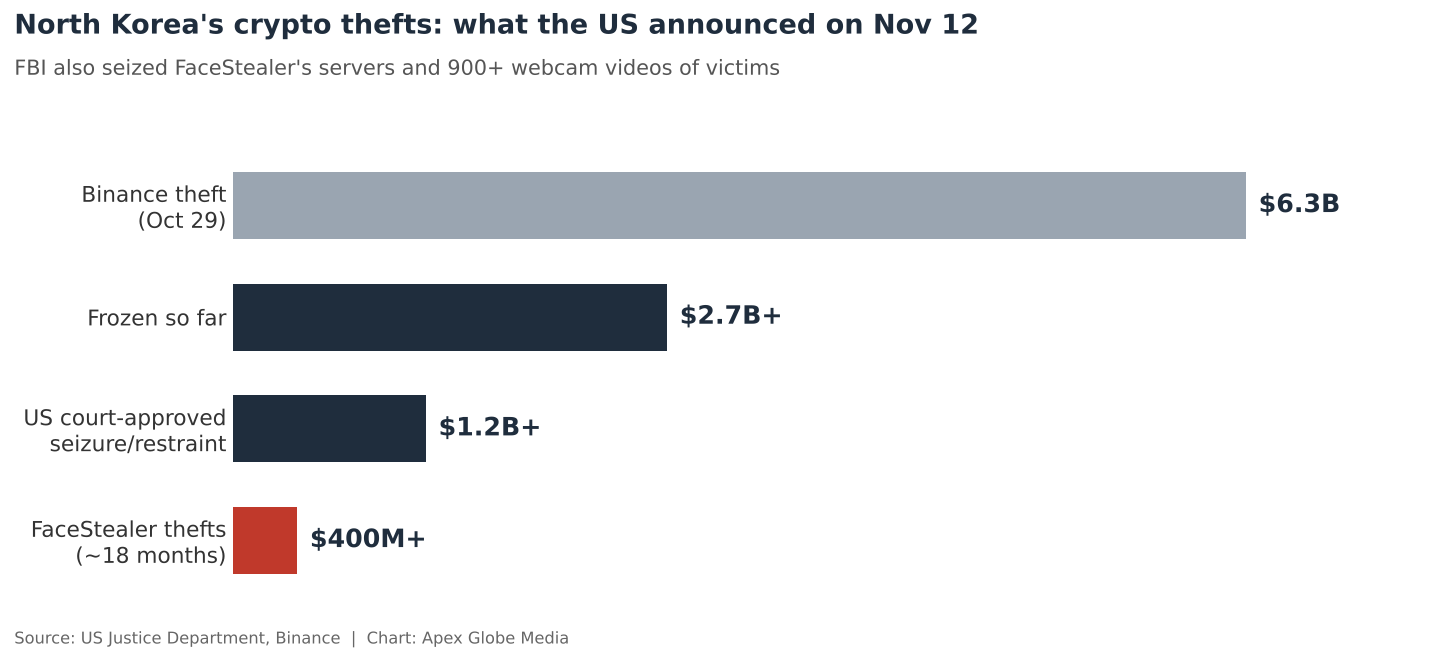
The meeting invite comes from someone you know. You click it, join what looks like a Zoom or Teams call, and see a familiar face on screen. Then a box pops up: nobody can hear you, please update your software. That update is how North Korea has stolen more than $400 million in about 18 months, the FBI and Justice Department said on Thursday. The scheme, which the FBI calls FaceStealer, is now partly offline: federal agents seized the cloud servers behind it and more than 900 webcam videos recorded from its victims.
The department also said it had won court approval to seize or restrain more than $1.2 billion of the money stolen from the Binance exchange on October 29, a theft the FBI blames on another North Korean unit it calls TraderTraitor.
How a fake call turns into a theft
FaceStealer is not a clever exploit. It is a con built on trust, and each victim is used to reach the next one. Based on the descriptions from the Justice Department, The Record and The Register, it works like this:
- The invite. The target gets a meeting invitation, often through Calendly, from a real account the hackers already hijacked. The link uses a lookalike (typosquatted) web address that leads to a fake Zoom or Teams page. In some cases malware is installed before the person even joins.
- The show. On the call, the hackers play prerecorded videos of earlier victims, so the meeting looks busy and the “sender” appears on camera. Some calls used deepfakes of well-known figures in the crypto world.
- The recording. While the target sits in the meeting, the hackers record the target’s webcam. That footage becomes the bait for the target’s own colleagues and friends.
- The fake error. The target sees the other person but hears nothing, or is told nobody can hear them. A message offers a “fix.” The fix installs malware that, according to the FBI, typically includes a browser cookie stealer, keyloggers, screen capture tools and a backdoor.
- The next round. The attackers take over the victim’s Telegram, LinkedIn, Slack or Discord accounts, read old chats and invite the victim’s contacts to new meetings, sometimes months later.
“Targets think it’s real,” FBI Los Angeles special agent Jeremy Robertson told The Register, because the lures draw on past conversations and shared interests. Patrick Grandy, who runs the FBI’s Los Angeles field office, put it more bluntly to The Record: “If you can’t imagine a scenario where you might fall prey to it, you are not thinking creatively enough.”
Who is behind it
The FBI ties FaceStealer to a group that security companies track under several names: Sapphire Sleet, UNC1069, Stardust Chollima, BlueNoroff and APT38. It is widely seen as part of the Lazarus network, the North Korean hacking operation behind the 2016 theft from Bangladesh’s central bank. Michael Barnhart, a researcher at the security firm DTEX, told The Record that APT38 was later split into several units, and one of them is TraderTraitor, the group blamed for the Binance theft.
An FBI agent told The Record it is still unclear whether FaceStealer played any part in the Binance breach. Officials said they have interviewed many victims but still cannot identify the first one.
The bigger worry: open-source code
Crypto and Web3 workers are the main targets, because one infected laptop can unlock a wallet. But the FBI says the group also goes after developers who maintain popular open-source software, including packages on npm (the main library store for JavaScript) and Rust’s crate registry. One hijacked maintainer account can push malicious code into thousands of apps, a so-called supply chain attack.
That threat is not theoretical. According to The Record, the FBI links APT38 to the compromise of the npm packages debug and chalk and of the axios package in March, and North Korean hackers earlier this year nearly lured the maintainer of a major JavaScript library into a fake Teams call. Brett Leatherman of the FBI’s Cyber Division told The Register that North Korea combines hacking, social engineering and deepfakes “to make impersonation more persuasive and easier to scale.”
What the Binance seizure means
Binance put its losses at $6.3 billion. So far government and industry efforts have frozen more than $2.7 billion of it, and the US now has court permission to seize or restrain $1.2 billion of that. Assistant Attorney General A. Tysen Duva said the Criminal Division helped “immediately halt about half of this historic breach.” The rest is still moving through bridges, mixers and exchanges. As we reported earlier this week, a lot of it flowed through THORChain even after the FBI asked for help. North Korea denies any role.
How to protect yourself
Given how the scheme works, a few habits go a long way. Treat any meeting that suddenly asks you to install an update, a plug-in or a “fix” as hostile, and close it. Join calls by typing the official Zoom or Teams address yourself or using the installed app, not a link in an invite. If a contact’s invite feels slightly off, confirm through a different channel, such as a phone call. And keep crypto keys off the computer you use for meetings. The FBI has more guidance on its FaceStealer page and asks victims to report to ic3.gov.
Our take
FaceStealer is scarier than a deepfake of a CEO, the trick we covered in a $129 million voice-cloning case last week, because it does not need to fool you for long. It only needs one familiar face for a few seconds and one believable glitch. The 900 seized videos are a reminder that every victim was turned into a weapon against the next person. Seizing servers helps, but new ones are cheap. The real defense is a simple rule that every company should teach: no meeting ever needs you to install anything.