



For most of Monday, visitors to Zoom, the BBC, CNN, HSBC, IKEA, Equifax and well over a hundred other big websites were served malware, and none of those companies had been hacked themselves. The code came through the Optimizely malware injection that security researcher Scott Helme of Report URI documented on November 16: an attacker slipped a script into the Optimizely Web accounts of 178 organisations, and the trusted Optimizely file each site already loaded delivered it to every visitor.
The script swapped cryptocurrency wallet addresses for the attacker’s, skimmed payment cards typed into ordinary web forms, stole cookies and page screenshots, and on older iPhones and iPads tried to load two known iOS exploit kits. Report URI says crypto had already been stolen, with transactions it could verify on the blockchain.
How a testing tool became a delivery system
Optimizely Web is an experimentation platform. Marketing and product teams use it to run A/B tests, showing different versions of a page to different visitors to see which one sells better. To make that work, each customer site loads a JavaScript “snippet” from Optimizely’s content delivery network, cdn.optimizely.com. The snippet contains Optimizely’s own code, the customer’s experiments and an optional field called Project JavaScript: custom code that the customer writes in the Optimizely dashboard and that runs on every page of the site.
That field is where the attacker went. According to Report URI, the rest of each snippet was untouched. The file was still served from Optimizely’s servers, with Optimizely’s security certificate, from a host every affected site had already decided to trust. In Zoom’s snippet, the added code simply created a new script tag pointing to a domain called 1688360.cc. Other versions hid the same address in base64 encoding so that a simple text search would not find it, and a third version carried the whole malicious program inline, so it would still run if the attacker’s domain was blocked.
Report URI stresses that this was not a cache-poisoning trick on Optimizely’s network. “Optimizely’s CDN served exactly what it was given,” Helme writes. The open question is how the attacker got write access to so many unrelated customer projects at once. Report URI lists the possibilities as a compromised Optimizely system, a stolen credential with access across customers, or something else, and says it is for Optimizely to explain. Optimizely’s own websites, including its login page, carried the code too. Helme says his team tried several channels to reach the company and had no response when the report was published. We found no public statement from Optimizely on Monday.
What the code did to visitors
Every visitor received the same file, track.js, and all of its functions were active at once. What happened depended on the device and on what the visitor did:
- Wallet address swapping. The script searched the page, form fields and links for valid cryptocurrency addresses (Bitcoin, Ethereum and other EVM chains, TRON, Solana, TON, Litecoin, Bitcoin Cash and Dogecoin), checked that they were real, and replaced them with the attacker’s. It also rewrote the clipboard. Copy an address from an affected tab and you might paste someone else’s.
- Card skimming. Added at 13:43 UTC, this part watched form submissions for a card number, expiry date and security code, and sent the set to the attacker’s server. Cards typed into hosted payment frames from providers such as Stripe and Adyen were out of its reach. Cards typed into a site’s own form fields were not.
- Cookies and screenshots. When it swapped an address near payment or wallet wording, the script sent the page address, any cookies not protected by the HttpOnly flag and a rendered screenshot of the page.
- iPhone exploits. On iPhones and iPads, the script loaded a hidden frame that chose an exploit chain by iOS version: Coruna for iOS 13 to 17 and DarkSword for iOS 18. Google’s Threat Intelligence Group described both kits in March as tools that moved from spying operations into financial crime. Report URI says pages on iOS 18.6 or older reloaded every 60 seconds to retry the attack, and that iOS 18.7.3 and later, and iOS 26.3 and later, are patched.
A second team reached similar conclusions on its own. Hudson Rock, the threat-intelligence firm behind Infostealers.com, recovered eight poisoned Optimizely project files and found the address-swapping and card-skimming logic in a 29,882-byte copy of track.js. It is more cautious about the iPhone part. Its samples show delivery of the exploit kits, it writes, but “these are delivery observations, not demonstrated iPhone compromises.”
A 17-hour timeline
Report URI’s timeline, all in UTC, shows how fast the operation grew. The last clean capture of the BBC’s Optimizely snippet dates from 02:21 on November 16. The first injection appeared at 04:21. By 08:28 the attacker’s track.js was running on bbc.com, at 13:03 stolen crypto was being moved to exchanges, and by early evening a second iPhone exploit server had been added. The payload was rebuilt 26 times during the day.
Report URI checked 1,611 distinct Optimizely snippets it could find and counted 188 infected snippets belonging to 178 organisations, so the real number is probably higher. A mass clean-up started around 20:40 UTC. At 21:52 UTC only one infected snippet remained, TalkTalk’s. The same actor had used a different injector, through Kissmetrics, StorifyMe and Minute Media scripts, against other sites from November 13, which is not included in the 178.
The list reads like a who’s who of the web. The biggest group is banking and finance with 32 organisations, including HSBC in more than a dozen countries, Equifax and ABN AMRO. Then come technology companies such as Zoom, Salesforce, GitLab and Bitly, retailers such as IKEA, ASOS and Levi’s local sites, streaming services such as Peacock and NOW TV, news sites including CNN, Fox News and NPR, and airlines including Air France-KLM and Alaska Airlines. The hardware wallet maker Ledger was on it too. Its snippet was cleaned at 20:41 UTC.
The money taken so far looks small. As of 19:25 UTC, the attacker’s known wallets had received about $7,040. Report URI cannot see how many card numbers or cookies reached the attacker’s server, and Hudson Rock says the number of successful thefts and compromised devices “remains unknown.”
Why most security settings did not help
The most useful part of the research for website owners is a test of Content Security Policy, or CSP, a browser rule that tells a page which outside servers it may load code from and send data to. Report URI crawled 256 web hosts belonging to affected organisations and checked their policies against what this payload needed. It got results for 159 organisations.
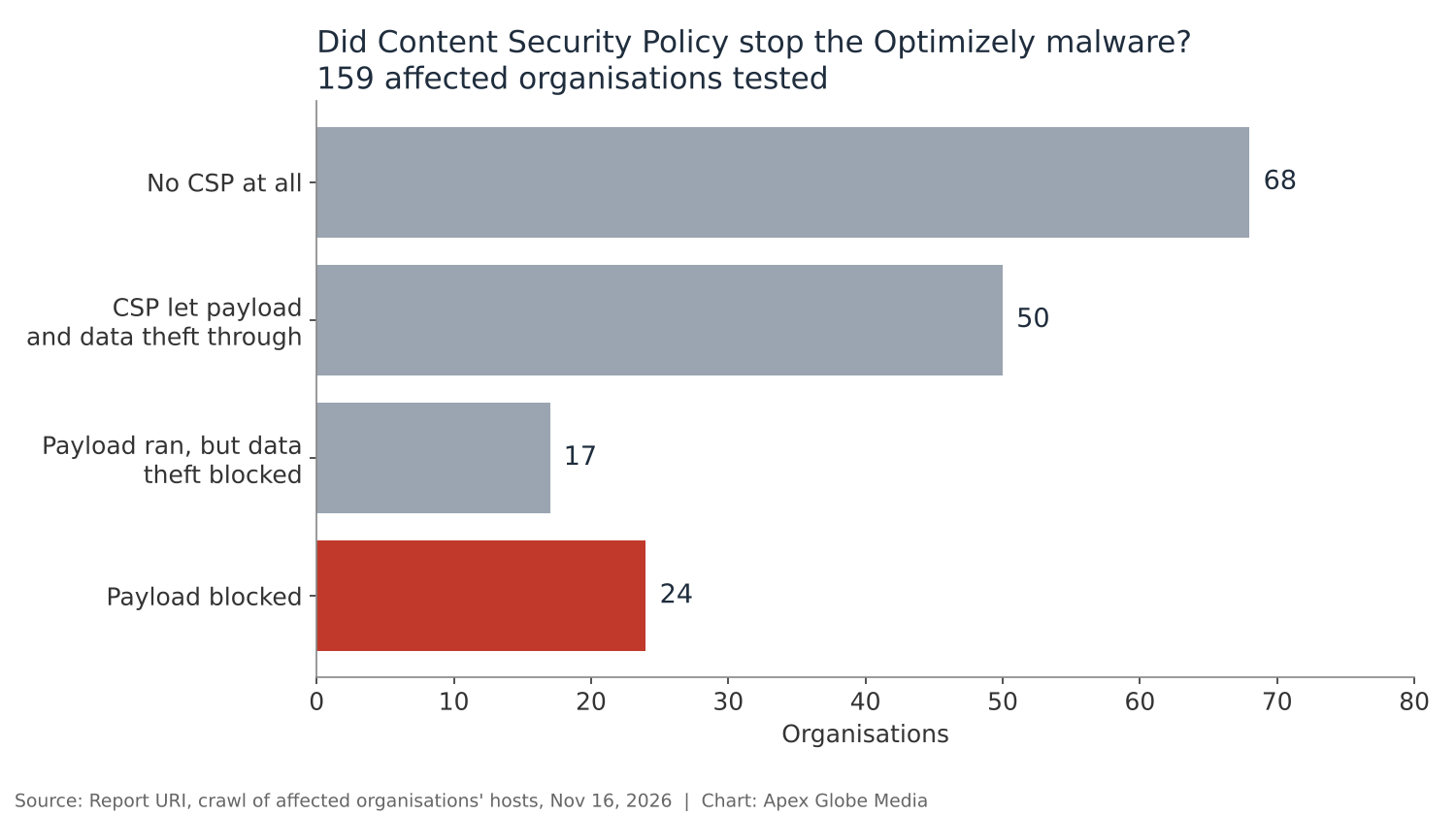
Sixty-eight had no policy at all. Fifty had one that let both the malware and the data theft through. Seventeen stopped the data from leaving but not the address swapping, which happens inside the page. Only 24, or 15%, blocked the payload. Allowing cdn.optimizely.com in a policy could never have helped, because the bad code arrived from that trusted host. Two common settings let it through: “strict-dynamic,” which trusts any script a trusted script adds, and “unsafe-eval,” which Optimizely’s own documentation tells customers to allow. That second setting is what caught HSBC, Report URI says: its policy blocked track.js and the data theft, but the inline copy still ran.
What to do now
For anyone who visited an affected site on November 16, Report URI’s advice is short: update an iPhone or iPad to iOS 18.7.3 or iOS 26.3 or later, check any crypto transfer made that day against the address you meant to pay, and watch card statements if you paid by card on one of the listed sites. Site owners using Optimizely Web are told to review every project’s custom code for unfamiliar scripts, check who and what has write access to their account, rotate credentials and exposed session tokens, and consider telling customers that they were served malware.
This is the second time in a day that the security industry has been reminded how attackers now work at scale. Earlier on Monday Google described an AI framework that turns security patches into attacks with no human involved. The Optimizely case needed no AI at all, just one point of access to a supplier that hundreds of companies trust.
Our take
This attack did not break into Zoom, the BBC or HSBC. It walked in through a marketing tool that their own security teams had approved, which is exactly why it is so worrying. Every third-party script on a website is a standing invitation, and an A/B testing platform with the right to run custom code on every page is one of the most powerful invitations a company can give. Optimizely now owes its customers a clear account of how one attacker could edit 178 separate accounts, and its advice to allow “unsafe-eval” deserves a hard second look. For everyone else, the lesson is simple and unglamorous: keep phones updated, double-check any crypto address before you send money, and do not assume a famous website is safe just because the company behind it is.