

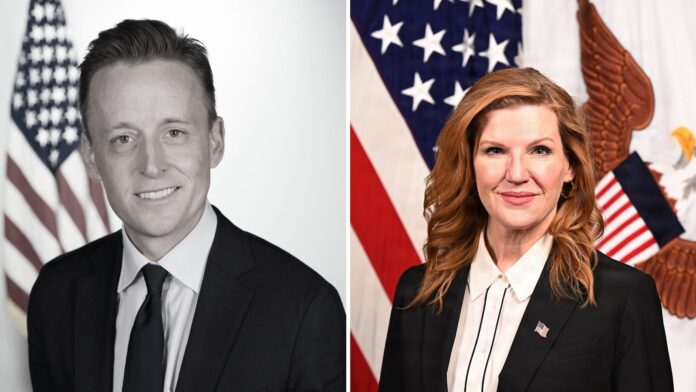

The White House has removed Sean Cairncross, the national cyber director, in the middle of the worst run of technology outages the United States has seen in years. A White House official and two people familiar with the matter told Defense One on November 19 that he had been fired. His acting replacement is Kirsten Davies, the Pentagon’s chief information officer. The timing has convinced many Americans that the government knows more about the outages than it is saying. So far, though, every official statement points the other way: the people in charge say these were not cyberattacks.
Below is what is confirmed, what the government says caused the outages, and why the firing has made the public’s doubts louder rather than quieter.
Fired or resigned?
The accounts differ slightly. Defense One’s headline says the White House “fires cyber director”, and CNBC cites a source saying President Trump “fully supported firing Sean Cairncross from his position because he lacked the strong cyber credentials to perform the job.” According to CNBC, Axios first reported the change, citing two White House officials who said Trump’s chief of staff, Stephen Miller, pushed for the departure. NBC News wrote more neutrally that Cairncross “is leaving his post”, and said the White House gave no details about the staffing change.
The Information, by contrast, reported that a person close to Cairncross disputed the “fired” version and said he resigned. Cairncross himself has not commented publicly, and his office did not respond to CNBC.
The official reason, then, is not the outages but his résumé. Cairncross is a lawyer and political operative, not a security engineer. In Trump’s first term he ran the Millennium Challenge Corporation, a foreign aid agency, and was a senior adviser to the White House chief of staff. The Senate confirmed him as national cyber director in August 2025. This year his office worked on an AI security framework with the White House science office and pushed companies to share more threat information under the national cyber strategy released in March, Defense One reports.
His job was a coordinating one. The Office of the National Cyber Director advises the president and lines up the work of agencies such as CISA, the NSA and the FBI. It does not run any of the networks that failed. That is worth remembering when people read his removal as an admission of something.
What the government says caused the outages
The wave started on November 12 and has hit Microsoft 365, the FAA’s air traffic control network, JPMorgan Chase and other banks, Apple’s online services and even the NSA’s classified internal network. We covered each failure as it happened, including the router swap that triggered the FAA ground stop and the day the NSA’s network and Apple went down together.
On November 18 the heads of the security agencies testified before the House Homeland Security Committee. Their message was the same, according to coverage of the hearing:
- Jay Clayton, Director of National Intelligence, called them “separate service outages associated with maintenance and technical changes,” adding: “They are not a coordinated or state-sponsored attack.” He said the pace of patching and upgrades across systems has been increasing.
- Christopher Raia, FBI Deputy Director: “At this point, there is no indication whatsoever that there is any cyber malicious activity related to any of those incidents.”
- Markwayne Mullin, Homeland Security Secretary, said he was “98% confident” that foreign adversaries played no malicious role, and said he had never seen so many outages in such a short time.
Secretary of State Marco Rubio said separately that there is “zero” information that the failures are related to each other or to a malign actor, AP reported. The specific causes that are on the record are mundane. Transportation Secretary Sean Duffy blamed one faulty router installed by a contractor for the FAA failure. Chase blamed a software bug. Clayton told Fox Business that the NSA outage was linked to patching work on PHP, a widely used programming language. And we reported on November 18 that bank executives and the NSA privately told Congress the failures came from rushing to fix security holes found by AI, so many at once that systems could not cope.
None of that has been contradicted by any official, by the companies involved, or by independent investigators. There is no admission anywhere that a cyberattack took place.
Why so many people do not believe it
The doubts do not come only from the internet. AP noted that even staunch Trump allies have accused the administration of lying or hiding the real cause of the disruptions. At the hearing, Rep. Dan Goldman pressed Clayton on which internal software updates went wrong and told him: “You’re a very smart person, and you’re clearly not answering my direct questions.” The committee’s top Democrat, Bennie Thompson, criticised Mullin for relying on “hunches based on conversations with people he would not name.” Clayton did not identify the exact change that brought down the NSA network.
Several things feed the suspicion at once. The outages came in rapid succession across unrelated companies and agencies. Two genuine cyberattacks, unrelated to the outages, hit in the same weeks, including the 10-day attack on the European Commission. Official explanations arrived piece by piece, often through anonymous sources. And now the government’s top cyber official has been removed days later, with only a vague explanation about “credentials”.
It is easy to see how that adds up to a cover-up story. But the firing does not prove one. If the White House believed hackers were behind the failures, removing the person who coordinates the federal cyber response in the middle of an investigation would be an odd way to handle it, and the agencies that would detect an attack, the FBI, NSA and CISA, are the ones saying they found none.
Who is Kirsten Davies
Davies is the Pentagon’s chief information officer, responsible for the Defense Department’s networks and IT, and has been Senate-confirmed for that role, CNBC reports. She will serve as acting national cyber director; a permanent appointment needs a new nomination and Senate confirmation. Defense Secretary Pete Hegseth and Rubio both praised her on X. Unlike Cairncross, she comes from running large technical systems, which matches the White House’s stated reason for the change.
Our take
On the evidence available today, Cairncross’s exit looks like a political response to a bad few weeks, not a confession. The White House needed to show it was doing something, and the cyber director was the most visible name with the least technical background. That said, the administration has made its own credibility problem. When officials refuse to say what exactly failed and fire a top official with a one-line explanation, they should not be surprised that people fill the gaps with theories. The fastest way to end the cyberattack rumours is a full, public technical account of each outage, and nobody in Washington has promised one yet.