


On Tuesday the wave of American tech failures reached two places almost nobody expected: Apple and the National Security Agency. An internal update knocked out iCloud sign-in, the App Store and Apple’s own store checkouts and disrupted Apple Pay, and the NSA’s classified internal network, known as NSA Net, went down during what the agency called “scheduled routine maintenance,” CBS News reports. Officials insist this tech outage wave is not a cyberattack. Homeland Security Secretary Markwayne Mullin says the cause is simpler and, in its own way, more worrying: new technology bolted onto very old systems.
That makes at least seven separate failures at big organisations in six days, starting with Microsoft 365 last Thursday. Two genuine cyberattacks landed in the same window, which is part of why the public conversation has been so confused.
The NSA network that went dark
NSA Net is the system the agency uses to store and share classified information internally. When it went offline on Tuesday, the NSA staggered arrival times for non-emergency staff at its headquarters at Fort Meade, Maryland, according to CBS. Sources told CBS the agency wanted to avoid large numbers of employees logging on at once while the network was unstable, and that some work was moved to other NSA sites around the country. Internally, the modified schedule was called “Code Gray.”
The NSA’s statement said the agency “experienced temporary degradation during scheduled routine maintenance” and that “while some internal systems were affected, mission/critical capabilities remain fully operational and our ability to defend National Security continues.” Two sources told CBS the trigger was routine system patching. NBC News quoted Director of National Intelligence Jay Clayton: “This is not a cyber attack, and this is not a coordinated effort by a nation state. We’ve looked very closely.”
James Lewis, a former senior government official and cybersecurity expert, told NBC that this kind of failure is “a little unusual” for the NSA but “fairly common” across government. “It’s because the software is so complicated; it’s not always up to date,” he said. “When people try to patch it, they break it.”
Apple’s “internal update”
Apple’s trouble started around 11:45 a.m. Eastern, according to MacRumors. Users could not sign in to their Apple Accounts, and Apple’s retail systems went down, so customers in stores could not complete purchases. Apple’s status page showed full outages for Apple Music, the App Store and AppleCare, plus problems with iCloud sign-in, iCloud Mail and iCloud web apps, the Associated Press reports. Downdetector also showed a spike in complaints about Apple Pay.
“Many of our systems are back up and running after an internal update caused some outages this morning,” Apple said. “We’re working to get the remaining systems online as soon as possible.” By the afternoon its status page showed the problems resolved. Apple did not say what the update was meant to do. Marriott had its own sign-in failure the same day and said a review found no sign the problem “was cybersecurity-related,” according to the AP.
Six days, one explanation
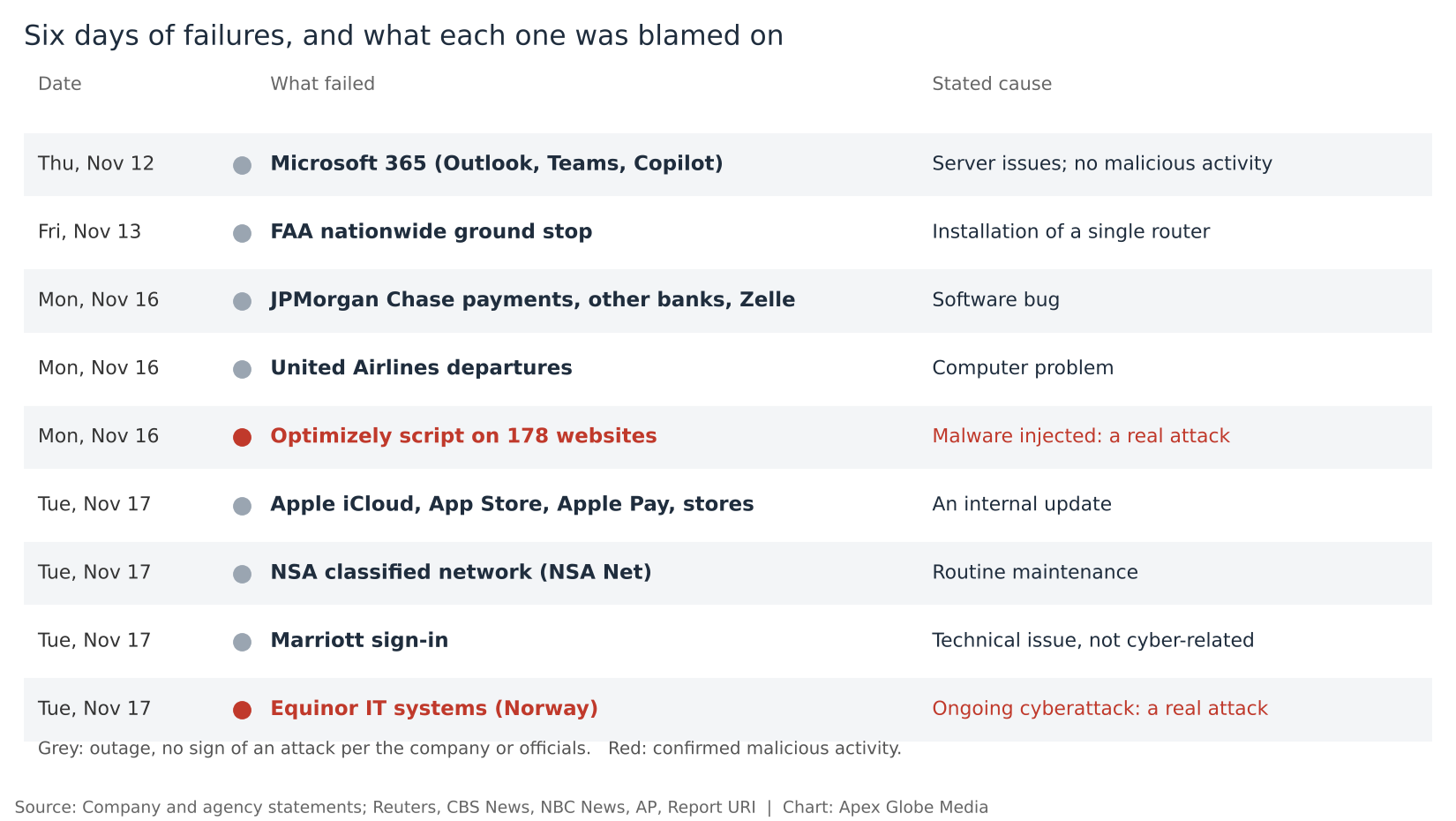
Here is how the week has gone. Microsoft 365 went down on Thursday, November 12, taking Outlook and Teams with it for more than a day; Microsoft blamed server issues and said it saw no malicious activity (we explained who is owed a refund and how to claim it). On Friday the FAA stopped every departure in the country for nearly five hours, and airlines cancelled more than 18,000 flights over three days; the cause was the installation of a single router at a remote facility in Arkansas, as we covered in our report on the router. On Monday a software bug at JPMorgan Chase disrupted payments at several banks and Zelle, and a computer problem at United Airlines held departures for more than 90 minutes. On Tuesday came Apple, the NSA and Marriott.
Mullin’s explanation covers most of the list. “Some of the technology that they’re pushing out there, they’re pushing new technology on top of really old computer systems, and it just seems to overwhelm the system,” he told CNBC, Reuters reported. “But it has nothing to do with cyberattacks, and I believe we’re going to see more of this as new technology rolls out.” He added: “I can tell you 98% certainty this isn’t a cyberattack.” He also suggested companies warn customers before scheduled upgrades. In a separate interview, the Washington Times reports, Mullin floated AI-driven upgrades as a possible factor, though he offered no evidence for it.
Vice President JD Vance put it more bluntly to Fox News, CNN reports: “The problem is we are dealing with 50-year-old technology. It works most of the time.” He said a full overhaul would need more money from Congress. President Trump, asked about the outages during his Asia trip, was less concerned: “It’s life, it’s life. When you’re big and powerful and you have all the money, things like that happen. It’s fine.”
What real attacks looked like this week
The “no attack” message is easier to believe when you compare it with the two incidents that actually were attacks. On Monday, malicious code was slipped into a script from Optimizely, a web optimisation service, and served to visitors of 178 major websites, including Zoom, the BBC and HSBC. We covered that supply-chain attack on the day. On Tuesday, Norwegian energy giant Equinor said it had “detected an ongoing cyber-attack against certain IT systems,” adding that there were “no indications that data has been stolen” and that operations and production were unaffected, according to its statement.
Neither looked like the week’s other failures: a sudden, total shutdown that the owner blamed on its own change and fixed within hours. That difference fits what network analysts told WIRED this week. Doug Madory of Infoblox, who tracks up to a dozen outages a day, said only around “one in a thousand” turns out to be caused by hackers. João Tomé of IPinfo gave a simple test: “A rollback takes minutes or hours. Ransomware takes days or sometimes even weeks.” Most of this week’s failures were fixed in hours, which is what you would expect from a bad update.
Why “not an attack” is not good news
Ruling out hackers answers the scariest question, but it leaves a harder one. If a single router, a software bug or one internal update can halt national air traffic, freeze bank transfers or take a classified intelligence network offline, then the weak point is not an enemy. It is the normal work of keeping systems running. Every one of these organisations patches and upgrades constantly, and will keep doing so.
The redundancy story is also mixed. Emily Harding, a former CIA analyst at the Center for Strategic and International Studies, told NBC that government systems “are highly redundant, so an outage like this won’t stop the work of national security.” Yet the NSA still had to tell staff to arrive at different times so the network would not buckle under logins. Redundancy kept the mission going. It did not stop the outage.
Our take
Officials are probably right that this was not a coordinated attack, and the way the real attacks of the week played out supports them. But “old systems plus new updates” is not a reassuring explanation, it is an admission that critical infrastructure in the US has become fragile enough that routine maintenance can break it. Mullin’s idea that companies should simply warn customers before upgrades misses the point: nobody planned for these updates to fail. What would help is boring and expensive: staged rollouts, tested rollback plans and real money for replacing decades-old equipment, starting with the systems that ground planes and move money. Until then, expect more weeks like this one.