



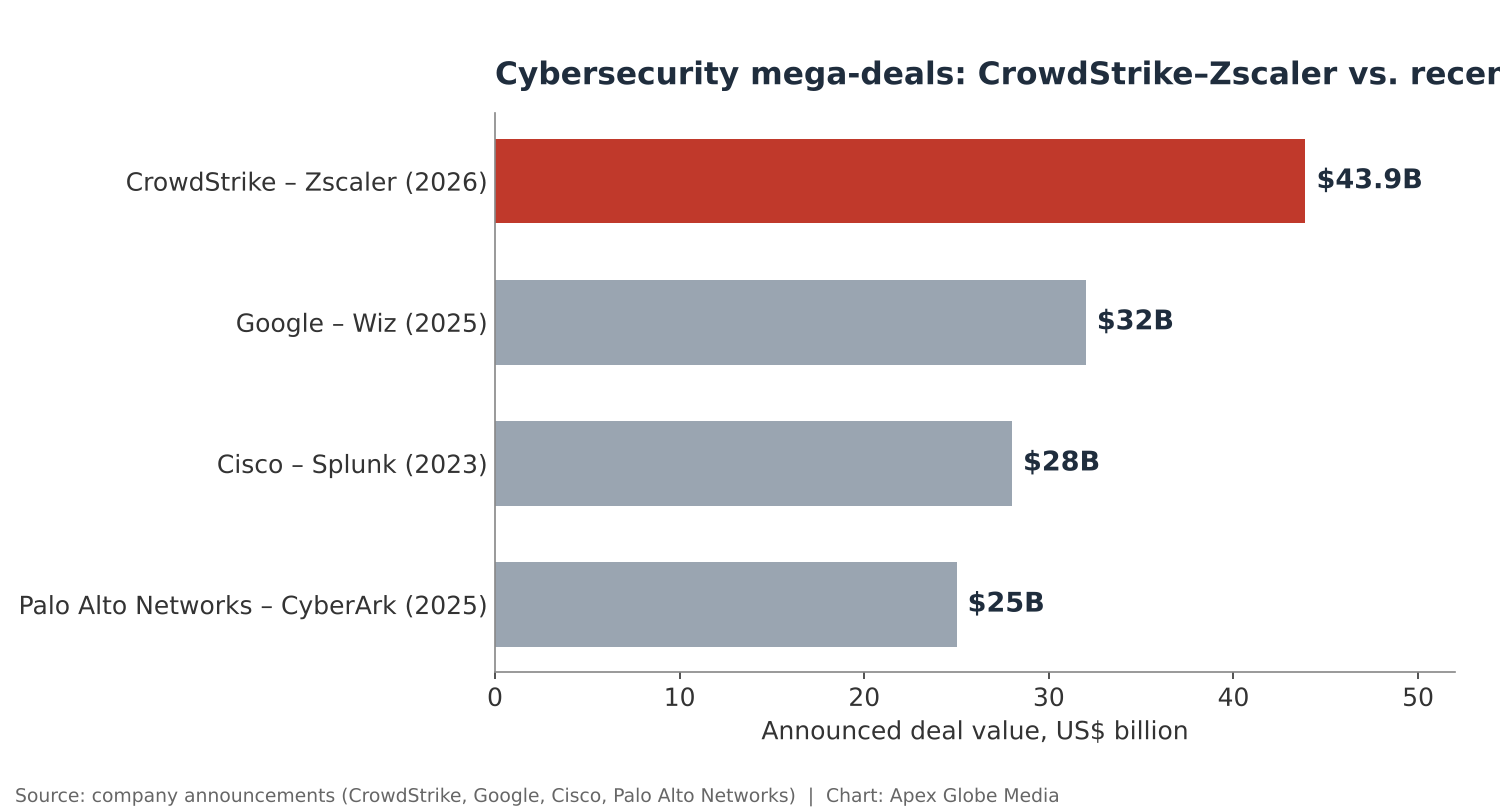
The cybersecurity industry got its biggest deal in years on Monday. Under the CrowdStrike Zscaler deal, CrowdStrike will buy its longtime partner in an all-stock transaction that values Zscaler at about $43.9 billion, the two companies said in a joint announcement filed with the SEC on November 23. Zscaler shareholders will get 1.135 CrowdStrike shares for each Zscaler share, worth about $260.41 at Friday’s close and a 34% premium. Investors split the verdict straight away: Zscaler jumped more than 13% before the market opened while CrowdStrike fell more than 8%, according to Reuters.
The deal joins two companies that protect different halves of a corporate network. CrowdStrike guards the devices. Zscaler guards the connections between them. Both say AI agents, which now log in, move data and call other software on their own, are the reason to put the two under one roof.
What each company actually does
CrowdStrike is best known for Falcon, a small program (a “sensor”) that runs on laptops, servers and cloud machines and watches for signs of attack. This kind of product is called endpoint security. Most people outside the industry heard of CrowdStrike for the wrong reason in July 2024, when a faulty Falcon update crashed millions of Windows computers and grounded flights around the world.
Zscaler sits somewhere else. Instead of letting staff connect through an office firewall or a VPN, companies send their internet and app traffic through Zscaler’s cloud, which checks who is connecting, to what, and what data is leaving. The industry calls this zero trust: no user or device is trusted just because it is inside the network. The product category has its own acronyms, SSE (security service edge) and SASE (secure access service edge), which adds the networking part on top. According to the announcement, Zscaler protects half of the Fortune 500 and its cloud handles more than 750 billion transactions a day across more than 200 locations.
“The endpoint is where the agent runs. The network is where it goes,” the companies wrote. CrowdStrike’s argument is that if it can see both the device and the traffic, its tools and its own security AI models can follow an attacker along the whole path instead of half of it.
The deal in numbers
After closing, existing CrowdStrike shareholders will own about 84.1% of the combined company and Zscaler holders about 15.9%. Zscaler founder Jay Chaudhry and his affiliates, who hold about 34% of Zscaler’s shares, have already signed agreements to vote for the deal. Chaudhry will keep running the Zscaler business and join CrowdStrike’s board, while CrowdStrike founder George Kurtz leads the combined company.
The companies say the combined business will start with more than $10 billion in annual recurring revenue (ARR, the yearly value of subscription contracts). CrowdStrike reported $6.26 billion of ARR at the end of October, up 27% from a year earlier, in its third-quarter results released the same morning, and Zscaler reported $3.9 billion. CrowdStrike is promising about $1 billion a year in extra revenue within 30 months of closing, mostly from selling its products to the roughly 8,000 Zscaler customers that do not use CrowdStrike yet, and $500 million a year in cost savings within 18 to 24 months, mainly from data centers and vendors. It also claims the deal adds more than $185 billion to its potential market by 2029. These are the company’s own targets, not independent estimates.
Both companies also reported results on Monday. CrowdStrike’s quarterly revenue rose 28% to $1.58 billion, and its forecast for the next quarter, $1.638 billion to $1.644 billion, came in above analysts’ average estimate, Reuters said. Zscaler’s revenue grew 20% to $949.3 million. Neither company is buying the other out of weakness, which makes the deal look more like a bet on where the market is going than a rescue.
Why CrowdStrike is paying now
Big security buyers have been asking for fewer vendors for years, and the largest players have been answering with acquisitions. Google agreed to buy cloud security firm Wiz for $32 billion in 2025, and Palo Alto Networks agreed the same year to buy identity specialist CyberArk for about $25 billion. Palo Alto already sells both endpoint protection and SASE, which left CrowdStrike without a network product in head-to-head contests for large contracts. Buying the market leader in that segment closes the gap in one step. The two companies were already partners, with more than 2,000 shared customers and 16 product integrations.
The timing is also about AI. “Security used to be about keeping the adversary out. Today, safety is required to let AI in,” Kurtz said. Chaudhry said “AI agents are rapidly becoming the new weakest link.” That fits what we have been reporting: attackers are already using AI agents to hit hundreds of organizations in days, and our timeline of AI hacking cases in 2026 shows how quickly the attacks have grown. Reuters also noted that the recent wave of US outages and newly found flaws in widely used Java and PHP software has made companies more nervous.
What could still go wrong
The deal is not expected to close until the second half of CrowdStrike’s fiscal year 2028, which runs from August 2027 to January 2028, so the two companies will stay separate for at least nine more months. It needs approval from Zscaler shareholders and from regulators. The two firms mostly sell different products, which usually makes antitrust review easier than in a merger of direct rivals, but a single company holding both the device and the network position at many of the world’s largest firms is exactly the kind of concentration regulators now look at more closely.
Integration is the other risk. Zscaler runs one of the largest security clouds in the world, and merging two big platforms is slow work. CrowdStrike’s falling share price on Monday suggests some investors worry about dilution, since they are paying with their own stock, and about how much of the promised $1 billion in extra sales will actually arrive.
Our take
This is a logical deal at a very high price. CrowdStrike gets the one piece it was missing, and customers who already run both products will probably welcome a single contract and a single console. The AI-agent framing is partly marketing, but the underlying point is real: agents move between devices, apps and data faster than any human, and seeing only one side of that is a weak position. What should make customers think twice is concentration. The July 2024 crash showed what happens when one vendor’s code sits on millions of machines; after this deal, the same vendor would also sit on the network path for many of those companies. Buyers should ask how CrowdStrike plans to keep a failure in one half from taking down the other.