



Oracle has cancelled a deal worth about $7 billion to rent AI computing power to Tencent, after U.S. officials raised concerns about one of China’s largest tech companies tapping American chips through data centers abroad, the Financial Times reported on November 4. The collapse of the Oracle Tencent deal shows that Washington is now policing not only where advanced AI chips are shipped, but also who is allowed to rent them, and that Beijing is pulling its own companies in the opposite direction.
What was agreed, and what changed
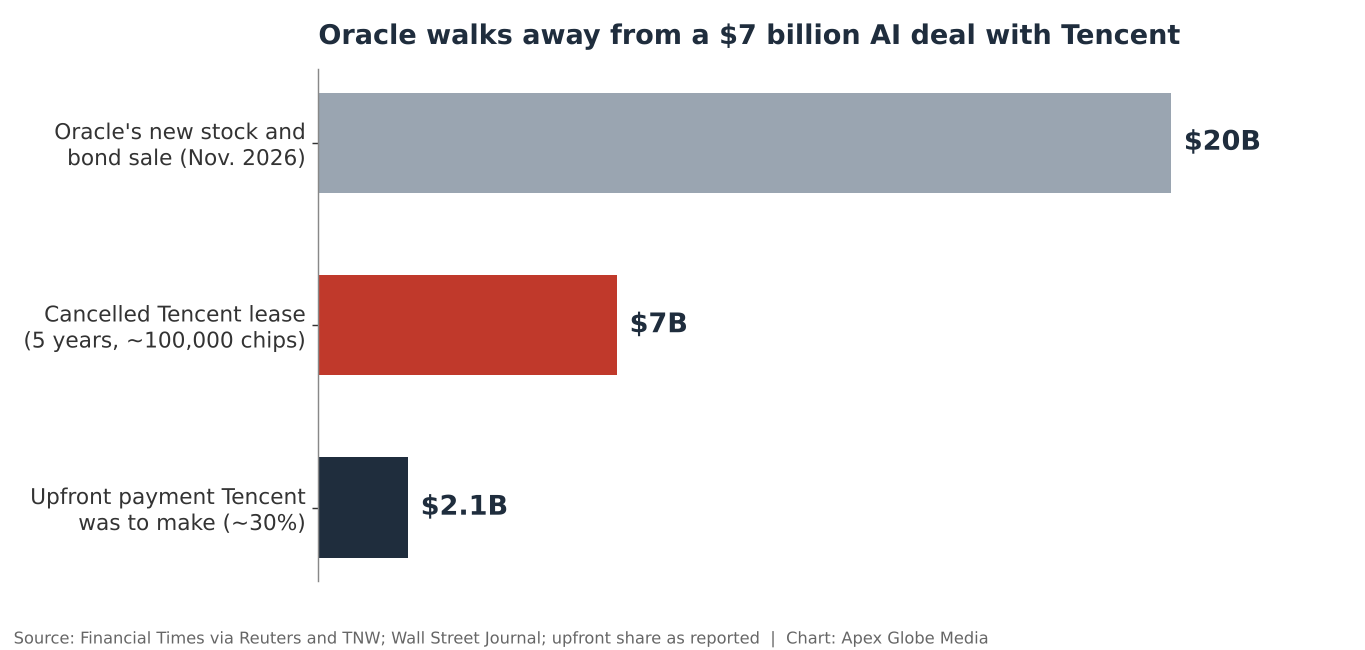
Under the five-year agreement, reported by the FT last month, Tencent would have rented capacity in several Oracle data centers in Southeast Asia running about 100,000 advanced AI chips, and was to pay about 30% of the value upfront. It was described as Tencent’s largest overseas computing deal. According to the FT, which cited two people familiar with the matter, U.S. officials told Oracle of their concerns, and Oracle walked away, TNW reported. Oracle, Tencent and the White House did not respond to requests for comment from Reuters.
The deal did not break any rule. Leasing AI chips located outside China to Chinese companies is still permitted under current U.S. export controls, which restrict where the most advanced chips can be shipped rather than who can use them remotely. That loophole has allowed Chinese tech groups to train and run AI models on Nvidia hardware in places such as Malaysia, where Oracle is reported to operate several data centers that serve ByteDance, according to Yahoo Finance.
Pressure from both sides
Washington’s pressure is growing quickly. On November 3, the FT reported that Nvidia had verbally told its cloud computing customers that they must sell more than half of their capacity to companies outside China. Bloomberg reported on November 4 that Alibaba, Tencent, ByteDance and other Chinese firms had ordered about 6 million Nvidia RTX Pro 5500 chips, worth about $70 billion, but are likely to receive only a small fraction of them. And last week, reports about Megaspeed, a firm under investigation over alleged smuggling of Nvidia chips to China, showed how hard it is to control where those chips end up.
Beijing is pushing too. Senior officials from Guangdong, the province where Tencent is based, visited the company and urged it to support domestically made chips, the FT reported. China wants its tech giants to buy from Huawei and other local suppliers rather than depend on American hardware, even as those suppliers struggle to make enough high-end chips. Tencent, which is racing to catch up with domestic rivals in AI and is adding AI agents across WeChat, now has fewer options for buying the computing power it needs.
What it means for Oracle
For Oracle, losing a $7 billion contract comes at a sensitive moment. The company is spending heavily on AI data centers, much of it with borrowed money, and this month launched a $10 billion share sale and a $10 billion bond sale to fund its expansion. Its shares have roughly halved over the past year as investors weigh its AI growth against its debt and spending, as part of a broader reality check for the data center gold rush. Chinese customers offered a large, ready market for spare capacity; that market is now closing.
Our take
This is how technology controls work in practice now: not only through formal rules, but through quiet phone calls that make a legal deal too risky to keep. The result is a sharper split in global AI infrastructure. American cloud companies will find it harder to sell computing power to Chinese customers anywhere in the world, and Chinese companies will be pushed, by both governments, toward domestic chips that are still less capable. In the short term, that slows Chinese AI development and costs U.S. cloud providers revenue. In the long term, it gives China every reason to build a complete AI supply chain of its own, which is exactly the outcome Washington says it wants to prevent. Clear, written rules on remote access would serve both U.S. security and U.S. companies better than deal-by-deal pressure.