


The contest between the US and China over artificial intelligence has turned into a competition for allies. Washington’s Pax Silica initiative and Beijing’s new World Artificial Intelligence Cooperation Organization (WAICO) both ask countries to commit to a side, and the choice is starting to shape which chips, cloud services and AI models companies in those countries can use. For businesses that operate globally, these AI alliances mean more compliance work and, increasingly, two separate technology markets.
The American bloc: Pax Silica
The US State Department launched Pax Silica in December 2025 under Jacob Helberg, under secretary for economic affairs. Its declaration focuses on secure supply chains for semiconductors, critical minerals and AI infrastructure among trusted partners. Early signatories included Australia, Greece, Israel, Japan, Qatar, Singapore, South Korea, the United Arab Emirates and the United Kingdom. India formally signed on February 20, 2026, at a ceremony in New Delhi, Bloomberg reported.
In practice, membership is linked to access to US advanced chips and computing and to cooperation on export controls, the rules that restrict sales of sensitive technology to rivals.
The Chinese bloc: WAICO
On July 16, 2026, 29 countries signed an agreement in Shanghai to establish WAICO, an intergovernmental organisation headquartered in the city, The Standard reported. Founding members include Russia, Pakistan, Indonesia, Kazakhstan and Laos, and Reuters also listed Belarus, Serbia, Cuba, Brazil and Venezuela among the signatories. Chinese Foreign Minister Wang Yi signed for China, and UN Secretary-General António Guterres attended the ceremony. The organisation says it is guided by the UN Charter and aims to promote cooperation and global governance in AI.
China’s pitch is access rather than restriction: open-weight models, which anyone can download and run on their own servers, plus technical help to deploy them. For countries without the money or computing power to build frontier AI, that offer is easier to accept than Washington’s conditions.
Why export controls are the lever
The most advanced AI chips are designed by US companies and depend on US software and equipment, which gives Washington legal power over where they are sold, even when they are made abroad. Countries that cooperate with US controls get easier access; others face licence requirements or outright bans. China cannot offer equivalent chips at scale, so it competes with software and services instead. That asymmetry explains why one bloc is organised around hardware supply chains and the other around open models and training.
How the two sides compare
A June 2026 Boston Consulting Group analysis shows why both strategies can work:
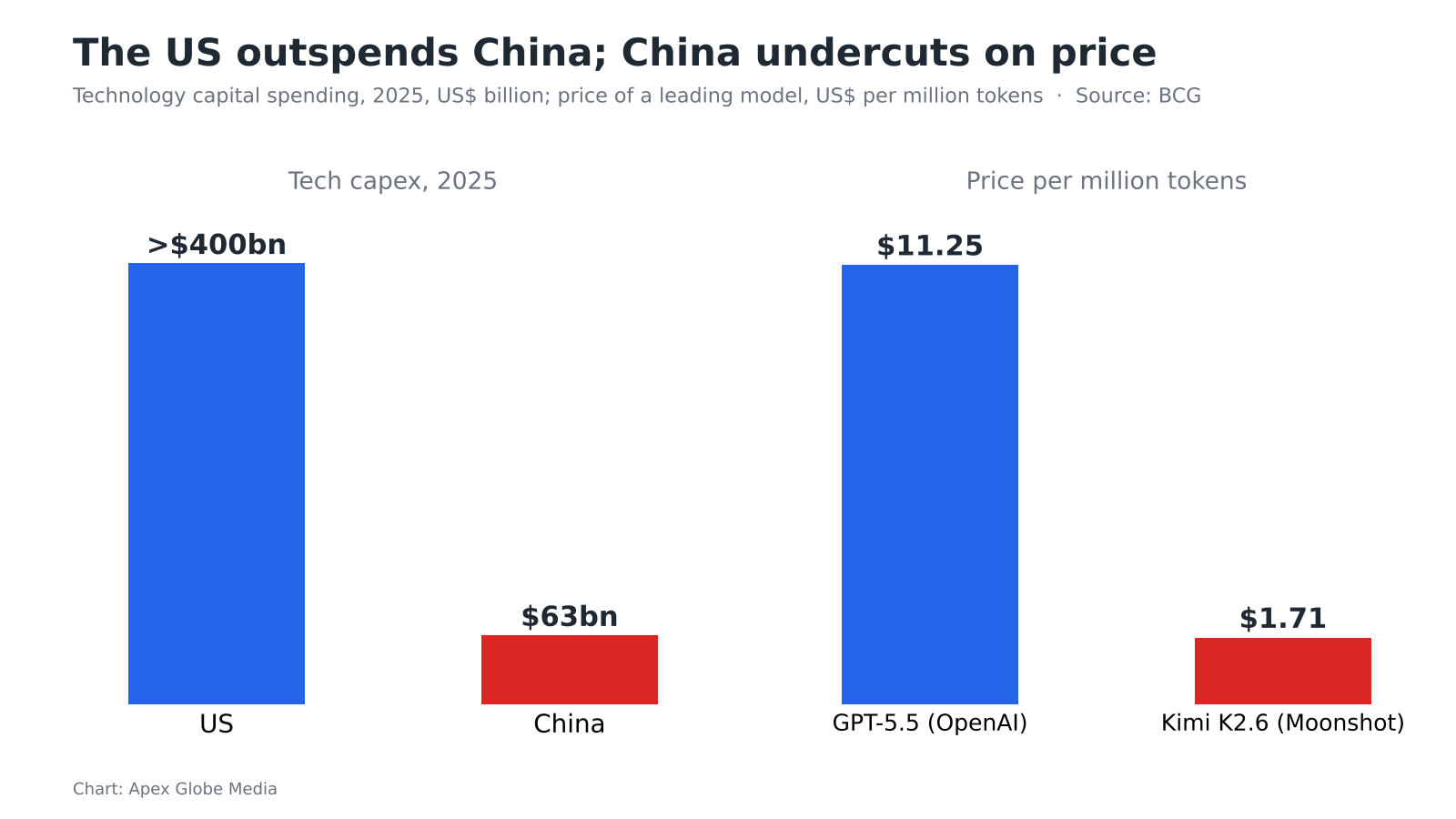
- US technology capital spending exceeded $400 billion in 2025, against $63 billion in China;
- the US has roughly eight times China’s AI-optimised computing power;
- but Chinese models are far cheaper: BCG cites Moonshot’s Kimi K2.6 at $1.71 per million tokens against $11.25 for OpenAI’s GPT-5.5;
- China is the main trading partner of 78 Global South countries.
The US leads on frontier capability and capital; China competes on price, openness and existing trade ties.
What it means for companies
For a chipmaker, cloud provider or AI start-up, the split creates practical choices:
- Supply: access to advanced US chips increasingly depends on the customer’s country and its alignment with export controls; our report on the AI memory chip shortage shows how tight supply already is.
- Compliance: companies operating in both blocs may need separate infrastructure, data storage and model choices to meet different rules.
- Government contracts: which foundation models are acceptable for public-sector use may differ by bloc.
- Costs: duplicated systems raise costs and make it harder to enter new markets.
Neither alliance has yet proven how much real technology sharing it will deliver. Pax Silica is a declaration, not a treaty, and WAICO is still setting up its structures.
Our take
The world is not splitting cleanly in two, but it is sorting into camps, and many governments are keeping their options open. That hedging is rational, and companies should do the same where they can: avoid locking critical systems into a single bloc’s chips or models. The US offer is stronger on technology, the Chinese one on price and conditions, and the outcome will depend on which side delivers concrete compute and tools rather than declarations. For now, the most reliable forecast is higher compliance costs for anyone doing business across both.