

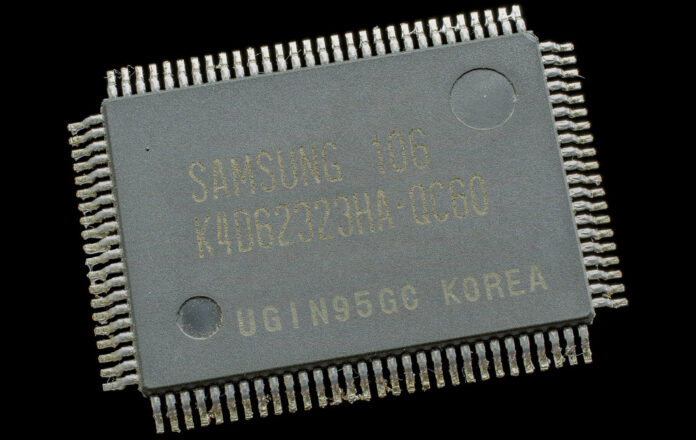

Samsung Electronics expects the AI memory chip shortage to get worse next year and last into 2028. The company gave the forecast on July 30, the same day it reported a more than 250-fold jump in quarterly chip profit, Reuters reported.
“The supply shortage in 2027 is expected to worsen compared to this year, and it is expected to continue in 2028,” Jaejune Kim, executive vice president of Samsung’s memory business, told analysts on the earnings call.
Long-term contracts replace short-term buying
The most important change is in how memory is sold. Kim said Samsung has signed long-term supply agreements with the five largest global data center companies and is close to deals with five more large customers. He did not name them.
The contracts last at least five years and are expected to cover 60% to 70% of Samsung’s capacity over the longer term. They include upfront payments and floor prices, meaning a minimum price the buyer pays even if the market falls. Samsung said these terms are meant to hedge the risk of its capital investments.
This is unusual for the memory business. Memory chips have traditionally been sold in a volatile market where prices swing sharply between shortage and oversupply. Long contracts with prepayments make Samsung’s income more predictable. For customers such as cloud providers, they guarantee supply at a time when it is scarce.
Record profit in chips, a loss in phones
Samsung’s semiconductor division made an operating profit of 89.2 trillion won ($61.7 billion) in the second quarter, according to Reuters. The whole company reported 89.5 trillion won, up from 4.68 trillion won a year earlier, on revenue of 171.5 trillion won, up 130%. The quarterly profit was larger than Samsung’s combined earnings over the previous three years.
The main driver is high-bandwidth memory, or HBM. HBM stacks memory chips vertically next to an AI processor so that data can move between them very quickly. It is essential for AI accelerators, and Samsung counts Nvidia and AMD among its HBM customers. Samsung said it expects revenue from its latest generation, HBM4, to more than triple in the third quarter.
Prices for ordinary memory have also soared. The price of a benchmark DRAM chip was $21 at the end of June, compared with $2.60 a year earlier, according to DRAMeXchange data cited by Implicator.
Those prices hurt Samsung’s own phone business. The mobile division lost 700 billion won, its first quarter in the red, as memory became more expensive. “The chips enriching one side of Samsung are now hurting the other, leaving the group more exposed than ever to memory pricing and the durability of hyperscaler demand,” said Josh Gilbert, an analyst at eToro.
Why supply cannot catch up quickly
Samsung told investors that a new chip factory takes more than three and a half years to start producing wafers. That is why the company expects the shortage to intensify in 2027 even as it invests. Kim said demand growth is outpacing Samsung’s increases in production.
Samsung said it is on track to start operations at its factory in Taylor, Texas, this year and aims to break ground on a second factory there, which could begin mass production in 2030. It also expects its contract manufacturing business, which competes with TSMC and Intel, to turn around “in the near future.”
The strong forecast eased some investor worries. Chip stocks had fallen in recent months on concerns about how the AI buildout will be funded and about competition from China. Samsung shares rose as much as 8% after the results before ending slightly lower. “It was one of the more reassuring calls we’ve heard in quite some time,” said Ryu Young-ho, a senior analyst at NH Investment & Securities.
Why it matters for businesses
For companies outside the chip industry, the shortage shows up as higher prices. Memory is in phones, laptops, servers and cars, so when AI data centers absorb most of the supply, everyone else pays more or waits longer. Businesses planning hardware purchases for 2027 should expect memory costs to remain high.
The shift to multi-year contracts also favours the biggest buyers. Cloud giants that can prepay for five years of supply lock in capacity; smaller companies buying on the spot market take what is left. This is part of the wider wave of AI capital spending that is reshaping the technology industry.
Our take
Samsung’s results show where the money in AI is flowing right now: to the companies that make the physical parts. The long-term contracts are the real story, because they turn a cyclical business into something closer to a utility, at least for a few years. But they also lock in the assumption that AI demand will keep growing. If the largest buyers slow their spending, floor prices and prepayments will protect Samsung more than its customers, and the rest of the electronics industry will have paid high memory prices along the way.