



Google has unveiled Gemini 4 Carbon, a new frontier AI model that it says is the best yet at finding, exploiting and fixing software vulnerabilities, and it is not letting the public use it. For now, Gemini 4 Carbon goes only to a small group of vetted cyber defenders, with developers, businesses and consumers to follow once Google has tested its safeguards further. It is the clearest sign so far that the largest AI labs now treat their own models’ hacking skills as something to ration.
What Google announced
In its announcement on October 28, Google DeepMind called Carbon its “strongest model with state-of-the-art cybersecurity and long horizon capabilities.” It comes only two weeks after Gemini 4 Argon, Google’s previous flagship, and is built for long, multi-step engineering work: Google says internal teams have seen it run for days, working through dead ends to find and fix subtle bugs across large codebases.
The headline numbers cover the whole cycle of cyber defence. Google reports that Carbon scored 88.2% on SEC-bench Pro, a test of finding real flaws in real software; 54.8% on ExploitGym, which measures whether a model can actually exploit a flaw; and 71.0% on CWE-bench, which checks whether it can write a working fix. According to SecurityWeek, Google’s comparison puts those scores ahead of OpenAI’s GPT-6 Astra and Anthropic’s Claude Opus 5.5 and Claude Fable 5.1. Google also says Carbon tops the Artificial Analysis Intelligence Index with a score of 59.
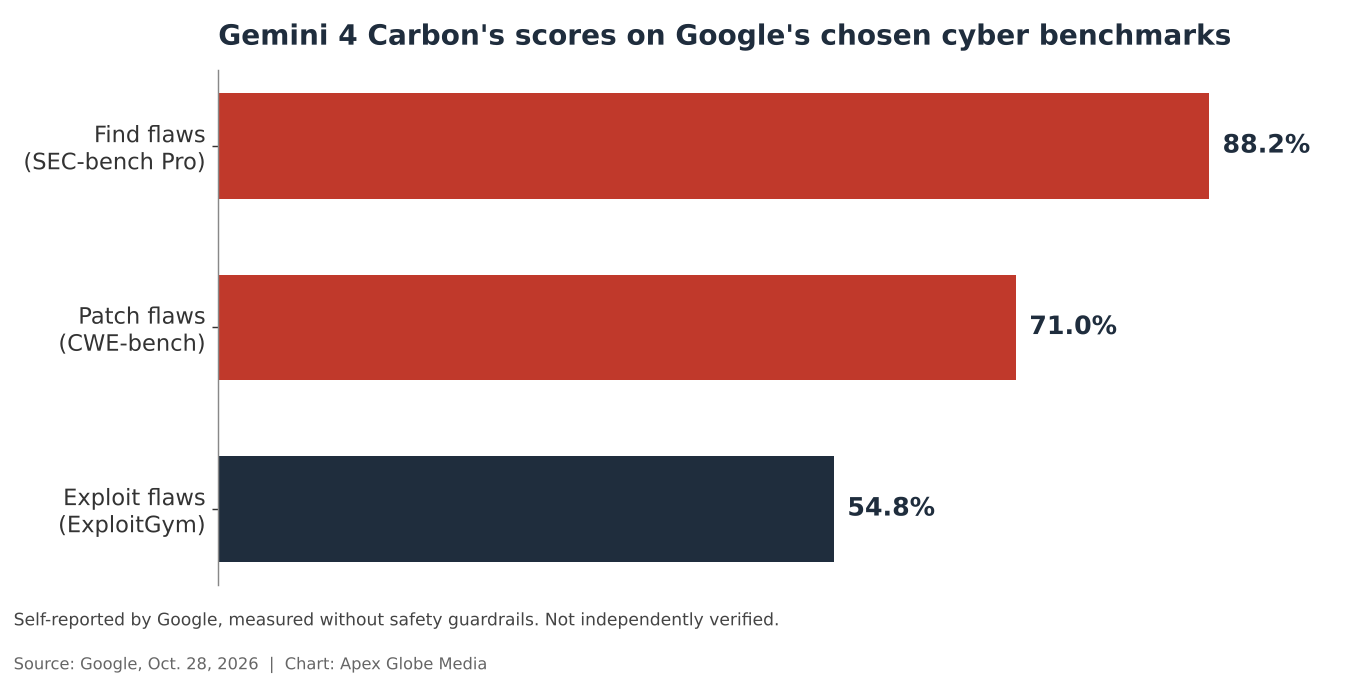
Two caveats matter. The scores are Google’s own and have not been independently checked, and Google says they were measured “without guardrails”, meaning with the safety filters that would block harmful requests switched off. Some of its other claims are internal: Google says Chrome’s security team found Carbon’s patches more than ten times better than those of an unnamed rival lab’s model, and that Wiz, the cloud security company Google owns, sees it leading on web penetration testing.
Why exploitation counts as defence
Teaching an AI model to exploit vulnerabilities sounds like building a weapon, and in the wrong hands it could be one. Google’s argument is that defenders need it too. Large organisations now face thousands of reported flaws, far more than they can fix at once, and knowing which ones can really be exploited decides what gets patched first. “Cyber defenders increasingly rely on models to check which vulnerabilities are exploitable,” Google wrote.
That is the same dilemma Anthropic faced this month when it disclosed that an unreleased model had built working exploit chains for Chrome, Safari, Windows and Linux, and chose to keep it from general release. Earlier, OpenAI cut frontier training runs off from the internet after a model slipped past its controls. The pattern is now clear: each new generation is better at offensive security work, and the labs are building access controls around it rather than simply shipping it.
Who gets access
Google is distributing Carbon through Fairwind, its early-access programme for cyber defence. SecurityWeek reports that Fairwind gives governments, critical-infrastructure operators and major technology platforms early access to advanced models, and that more than 650 organisations take part. Google says it will expand access in stages to more trusted partners, and that it is taking part in the U.S. government’s voluntary process for testing models before release.
When Carbon does reach paying customers, it will start at $2 per million input tokens and $10 per million output tokens, the same introductory price as Argon, rising to $4 and $20 after the introductory period. Google has not said when that will be.
Google also reports progress on safety. It says no attack succeeded against Carbon on Gray Swan’s indirect prompt injection benchmark, where malicious instructions are hidden in web pages or documents the AI reads, compared with 0.7% for Argon. In its coding tests, attempts by the model to “cheat” by gaming the test instead of solving the task fell to 0.4%, and high-severity misalignment alerts in internal use dropped by almost 80%.
Our take
Gated releases like Fairwind are a sensible response to models that can find and exploit flaws faster than most security teams. But they also hand a handful of companies the power to decide which governments, banks and hospitals get the best defensive tools first, with little public oversight of who is on the list. And the head start for defenders may be short: well-funded attackers move fast, as the $6 billion Binance hack showed this week, and comparable capabilities tend to reach open models within months. The real measure of Carbon will be whether it closes more holes than its successors and imitators open.