

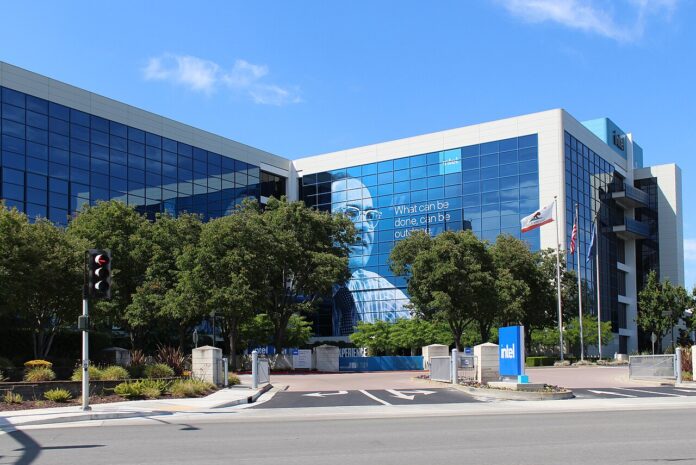

Intel stock fell 29% on Friday, October 30, its worst day since 1974, after the chipmaker warned that the AI boom is hurting the business it still depends on most: processors for personal computers. The Intel stock crash wiped out nearly $150 billion in market value in a single session and about $11 billion to $12 billion from the stake the U.S. government bought last year. The odd part is that Intel’s AI business has never looked better.
A good quarter, a terrible forecast
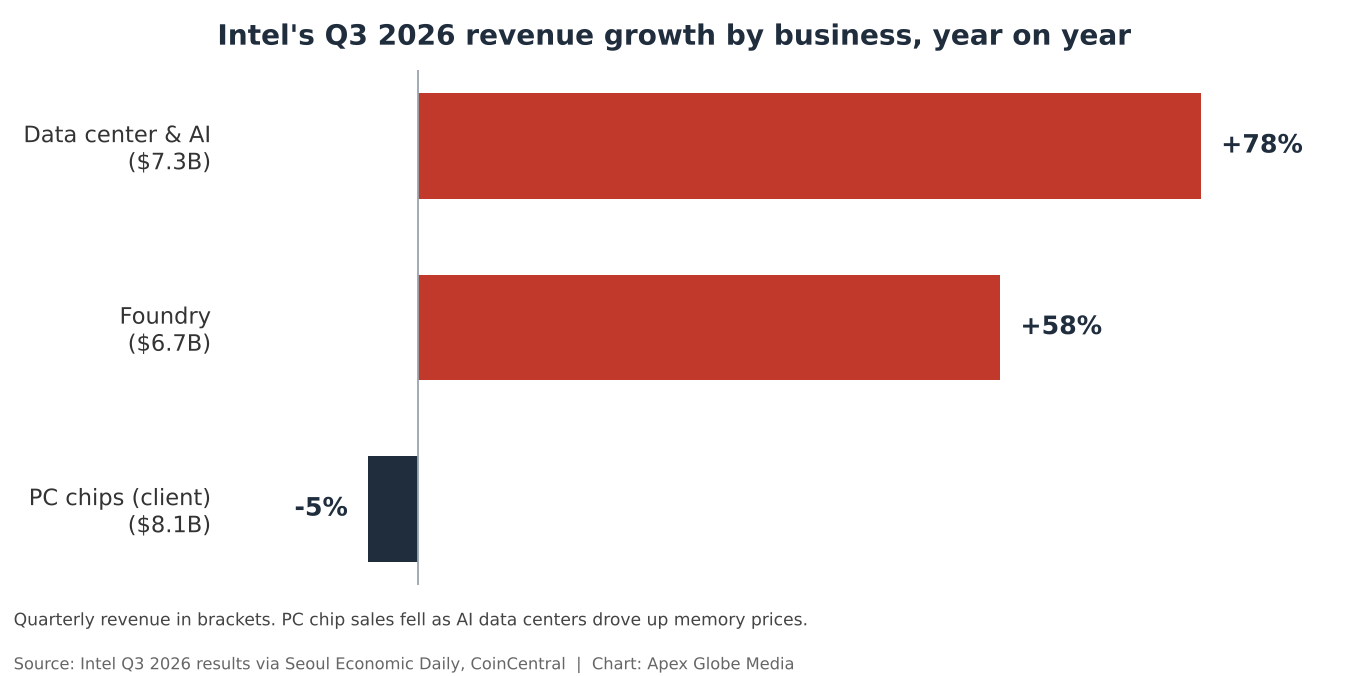
Intel’s third-quarter numbers, released on October 29, were solid. Revenue rose 21% from a year earlier to $16.5 billion, and adjusted earnings of 52 cents per share beat the 41 cents analysts expected. Sales in the data center and AI division jumped 78% to $7.3 billion, and the foundry business, which makes chips for Intel and outside customers, grew 58% to $6.7 billion, according to the Seoul Economic Daily, citing Intel’s results.
The forecast is what broke the stock. Intel expects fourth-quarter revenue of $15 billion to $16 billion, against about $17.1 billion expected, and adjusted earnings of 25 cents a share, against 43 cents. Shares closed at $65.76, down from $92.07 the day before, on more than four times the usual trading volume, CoinCentral reported. According to Yahoo Finance, only one day in Intel’s history was worse: July 5, 1974, during the oil shock. Bernstein analyst Stacy Rasgon called the outlook “(in a word) terrible.”
How AI is squeezing the PC
The client computing unit, which sells PC processors, is still Intel’s largest business, and its revenue fell 5% to $8.1 billion. The reason is memory. The big memory makers, Samsung, SK hynix and Micron, have shifted production toward high-bandwidth memory for AI servers, so ordinary memory for laptops and desktops has become scarce and expensive. When a PC costs more because of its memory, companies buy fewer of them, and fewer Intel processors go with them.
Chief executive Lip-Bu Tan said rising memory costs are straining corporate IT budgets, and chief financial officer David Zinsner said the PC slowdown should last “at least through the first half of next year.” Intel now expects PC shipments to fall about 12% this year and another 10% in 2027, Yahoo Finance reported. An accident at Intel’s factory in Israel, which caused an extended shutdown, will also cut about $300 million from fourth-quarter revenue.
The same shortage is producing spectacular results elsewhere. In the same week, Sandisk reported quarterly revenue up 378%, and China’s memory maker CXMT reported revenue up more than 600%, both lifted by AI-driven memory prices. Money is flowing to the companies that supply AI data centers and away from those that depend on consumer and office hardware.
Washington’s stake
The crash also hit the U.S. government. In August 2025 the Trump administration took a 9.9% stake in Intel, about 433 million shares at $20.47 each, roughly $8.9 billion, as part of its push to rebuild American chip manufacturing. That stake was worth about $39.9 billion at Thursday’s close and roughly $28.5 billion after Friday’s fall, a paper loss of more than $11 billion in a day. It is still worth about three times what the government paid, and Nvidia, which also owns Intel shares, lost about $6 billion on its holding.
The government’s stake makes Intel more than an ordinary stock. Its factories in Arizona and Ohio are central to the plan to make advanced chips in the U.S. instead of relying on Taiwan, a concern that runs through the industry, from U.S. restrictions on Chinese technology to suspected chip diversion through Southeast Asia. A weaker Intel has less cash to spend on those factories.
The fall came during a broader tech selloff. The Nasdaq dropped 2.9% on the day as investors questioned whether giant AI budgets will pay off, after a week in which Alphabet’s free cash flow turned negative and Amazon reported a $42 billion free cash outflow over twelve months.
Our take
Intel’s crash is a clear example of how AI is reshaping the hardware industry rather than simply lifting it. The same data center boom that is growing Intel’s server business by almost 80% is draining memory supply from the PCs that pay most of its bills. Even after Friday, Intel stock is still up about 80% this year, so this is a reset of expectations rather than a collapse. But it shows that “AI winner” and “AI victim” can be the same company, and that the cost of the AI build-out is now showing up in the price of an ordinary laptop.