


Google Cloud doubled its revenue in a single year, and Alphabet’s shares still fell about 10% after hours on October 28. Microsoft, reporting the same evening with slower cloud growth, saw its stock rise. The difference between the two Alphabet and Microsoft earnings reports comes down to one number that investors now watch more closely than growth: how much cash is left after paying for AI data centers.
Alphabet: record cloud growth, negative cash flow
According to Alphabet’s earnings release, revenue for the July to September quarter rose 25% to $127.6 billion. Google Cloud was the star: revenue up 103% to $30.7 billion, and operating income up from $3.6 billion to $11.1 billion. Chief executive Sundar Pichai said Google’s own models now process “nearly 32 billion tokens per minute” through its APIs and that the Gemini app has reached one billion users.
The rest of the report was weaker. Total revenue came in slightly below the roughly $128.2 billion analysts expected, and advertising revenue of about $82 billion missed forecasts, investingLive reported. Chief business officer Philipp Schindler linked slower search ad growth to more people using AI Mode, Google’s chatbot-style search. Earnings per share fell to $2.12 from $2.87 a year earlier, weighed down by an unrealised loss of about $8.2 billion on Alphabet’s stake in SpaceX.
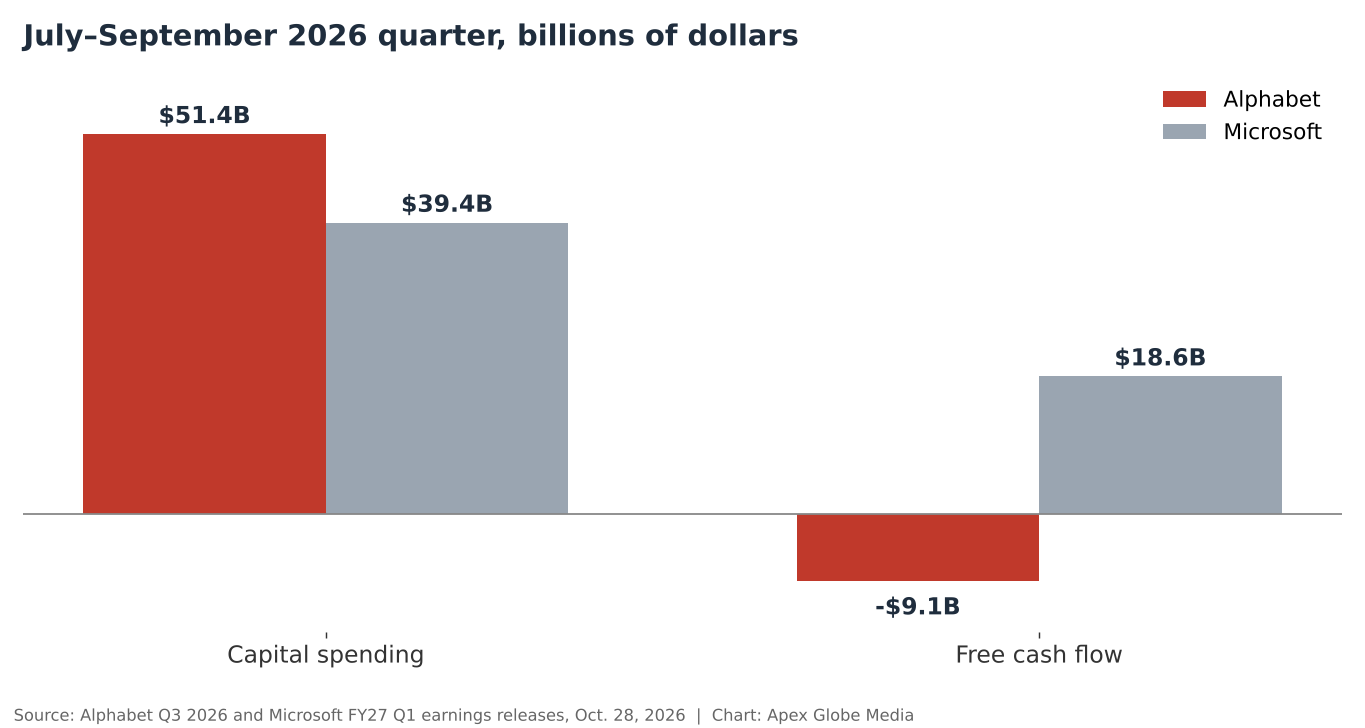
The figure that moved the stock was free cash flow, the cash a company generates after paying for its equipment and buildings. Alphabet spent $51.4 billion on capital expenditure in the quarter, mostly servers and data centers, and ended with free cash flow of minus $9.1 billion. It was the second negative quarter in a row. Chief financial officer Anat Ashkenazi kept the 2026 spending forecast at $195 billion to $205 billion and said spending would rise “significantly in 2027,” warning of further pressure on cash flow as Google builds up an inventory of its TPU AI chips.
Microsoft: lower spending, still profitable cash flow
Microsoft’s results for its fiscal first quarter showed revenue up 19% to $92.3 billion and Azure, its cloud platform, up 48%. Revenue from the wider Microsoft Cloud business rose 30% to $63.9 billion. Chief financial officer Amy Hood said results “exceeded expectations across revenue, operating income, and earnings per share.”
Microsoft spent $39.4 billion on property and equipment, below what many analysts had expected, and still produced about $18.6 billion of free cash flow. Its filings also show how dependent it has become on one customer. TechCrunch found that Microsoft recorded $10 billion of revenue from OpenAI in the quarter, about 11% of the total, and that OpenAI owed it $7.2 billion at the end of September, up from $6 billion three months earlier.
Why investors reacted so differently
For two years, markets rewarded tech companies for spending on AI, on the assumption that the money would turn into revenue. Google Cloud’s results suggest that it is: Alphabet says its cloud backlog, contracted revenue not yet recognised, is about $560 billion. But the bill is arriving faster than the income. Building data centers takes years, and chips and power are paid for up front, so even a fast-growing business can burn cash while it expands.
Investors appear more patient with Microsoft because its spending is still covered by its existing businesses, and because part of its AI demand comes from a single, well-funded tenant. Alphabet is funding its own models, its own chips and a cloud business serving rivals, all at once, while its core search business adjusts to AI answers that may carry fewer ads. Meta faces the same squeeze: this week it announced plans to raise up to $95 billion by selling stock because AI costs now exceed what its business earns.
Our take
Alphabet’s quarter is not a failure: a cloud business that doubles in a year while turning profitable is exactly what AI optimists promised. The sell-off is a sign that investors have changed the test. They no longer ask only whether AI demand is real, but whether companies can pay for it without running out of cash, and a negative free cash flow from one of the most profitable companies in history is a warning that the spending race has reached its limits. Microsoft passed this quarter’s test, but its growing reliance on OpenAI means its numbers carry a risk of their own.