



Google DeepMind’s Genie 4 generates a world you can walk through, hear and talk to, one frame at a time, as you move. Announced on October 27 as a research preview, the new world model adds sound, speaking characters and an AI agent that plans what happens next. It is also the latest move in a fast-growing race among tech companies to build simulators that could one day train robots, prototype films and replace parts of game development.
What Genie 4 does
A world model is an AI system that predicts how an environment changes in response to actions. Instead of producing a fixed video clip, it generates each new frame based on what the user does, so the scene reacts to a keypress or a typed instruction. According to DeepMind’s announcement, users move through Genie 4’s scenes with a keyboard and can change them with text prompts, for example to alter the weather, switch the camera angle or add people and objects.
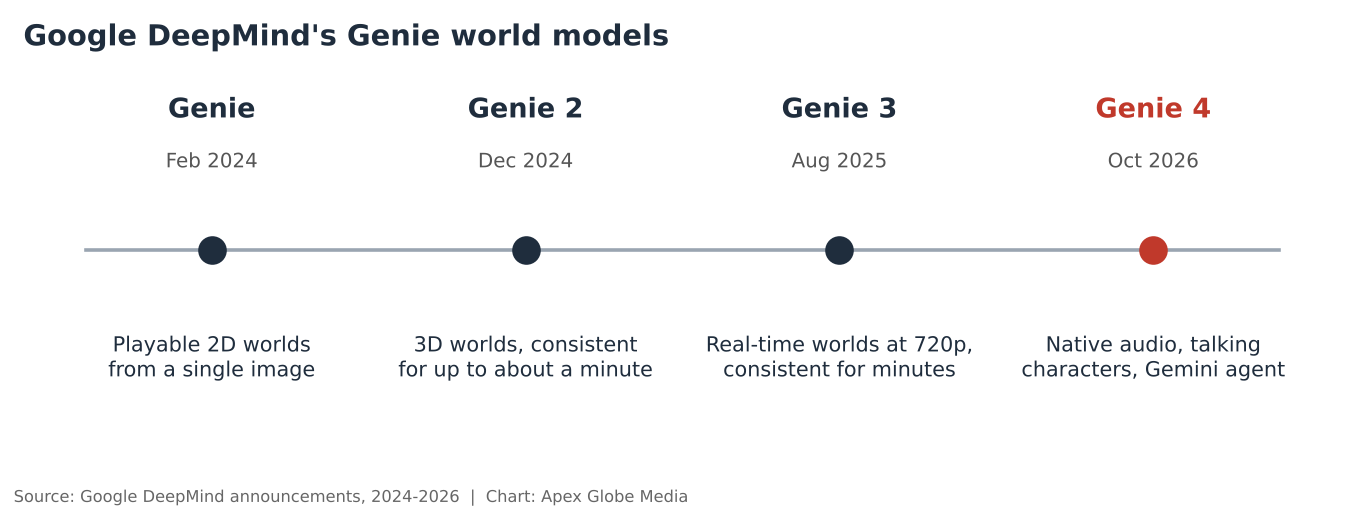
The headline addition is sound. DeepMind says Genie 4 is “our first real-time world model to generate audio natively,” producing ambient noise, music and dialogue. Characters can talk to each other and respond to the user, and DeepMind says the biggest gain in realism is in how people move and react. Physics such as collisions and aerodynamics are also simulated.
Gemini as the director
The more interesting change is architectural. As The Decoder explains, Genie 4 no longer works alone. It builds on Gemini Omni, Google’s video model, while other Gemini models keep the simulation coherent. Gemini 3.8 Flash acts as what DeepMind calls “a guiding agent in the loop”: it watches the generated frames, breaks a goal into steps, checks whether each step worked and changes the plan if the world or the user does something unexpected.
That split, with a language model doing the reasoning and a world model doing the simulating, is what DeepMind sees as the path to robotics. In one experiment, a model called Gemini 4 Argon broke a game of checkers into steps, and Genie 4 simulated Apptronik’s Apollo humanoid robot carrying them out. No real robot was involved. The idea is that robots could practise in simulated worlds before acting in real ones, where mistakes are slow and expensive. According to Dataconomy, Google research director Tejas Kulkarni said such hybrid world models could combine Gemini’s text and code generation with Genie’s real-time simulation.
Still an early model
DeepMind is unusually direct about the limits. Worlds stay consistent over short sessions, but details drift in longer runs, objects do not always persist and text inside scenes may be unreadable. Realistic sound and complex physical interactions are still being researched. Dataconomy reports that scenes stay consistent for up to two minutes, but DeepMind’s own post gives no figure.
Access is narrow for now. Trusted testers in creative industries, journalism, education, gaming and engineering have the preview, and Google says it will come to Google AI Ultra subscribers through its Project Genie app and to early-access partners of the Gemini API. All generated video and audio carries SynthID, Google’s invisible watermark for AI content.
A crowded race
Genie 4 lands in a market that has suddenly become expensive. In September, AMD agreed to buy Fei-Fei Li’s World Labs, which builds models that generate 3D environments, for about $8.2 billion in stock. Runway released its second world model, GWM Worlds 2, a couple of months ago, and Dataconomy notes reports that Amazon is in talks to buy the startup Decart, while Rivian bought Third Dimension to bring self-driving simulation in house. Nvidia, for its part, offers its Cosmos models for robot and car simulation.
The money follows a simple bet: whoever can simulate the physical world cheaply will have an advantage in training machines to act in it. Chips matter here too, since real-time generation is computationally heavy, which helps explain why a chipmaker was willing to pay billions for a world-model lab. We looked at the cost of that computing in our report on Meta’s $95 billion stock offering.
Our take
Genie 4 is impressive as a research demo, and pairing it with Gemini as a planner is a smart design that addresses the main weakness of world models: they generate plausible frames without understanding goals. But a two-minute world that drifts is still far from a training ground a robot company can rely on, and DeepMind has published no numbers that would let anyone compare it with rivals. Until testers can measure how long its worlds hold together and how faithfully its physics behave, Genie 4 is best seen as a strong signal of direction rather than a finished tool.