

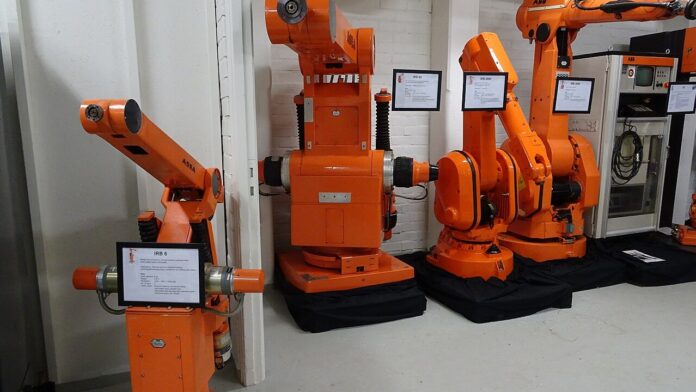

China has blocked SoftBank’s $5.4 billion purchase of ABB’s robotics business, dealing a major setback to Masayoshi Son’s plan to make robots the centrepiece of his push into “physical AI.” ABB said on November 5 that China’s foreign investment security review office had prohibited the deal. The SoftBank ABB robotics deal is the second large foreign technology acquisition China has stopped this year, and it shows that Beijing now treats industrial robots and the data they generate as strategic assets, much as Washington treats advanced chips.
What happened
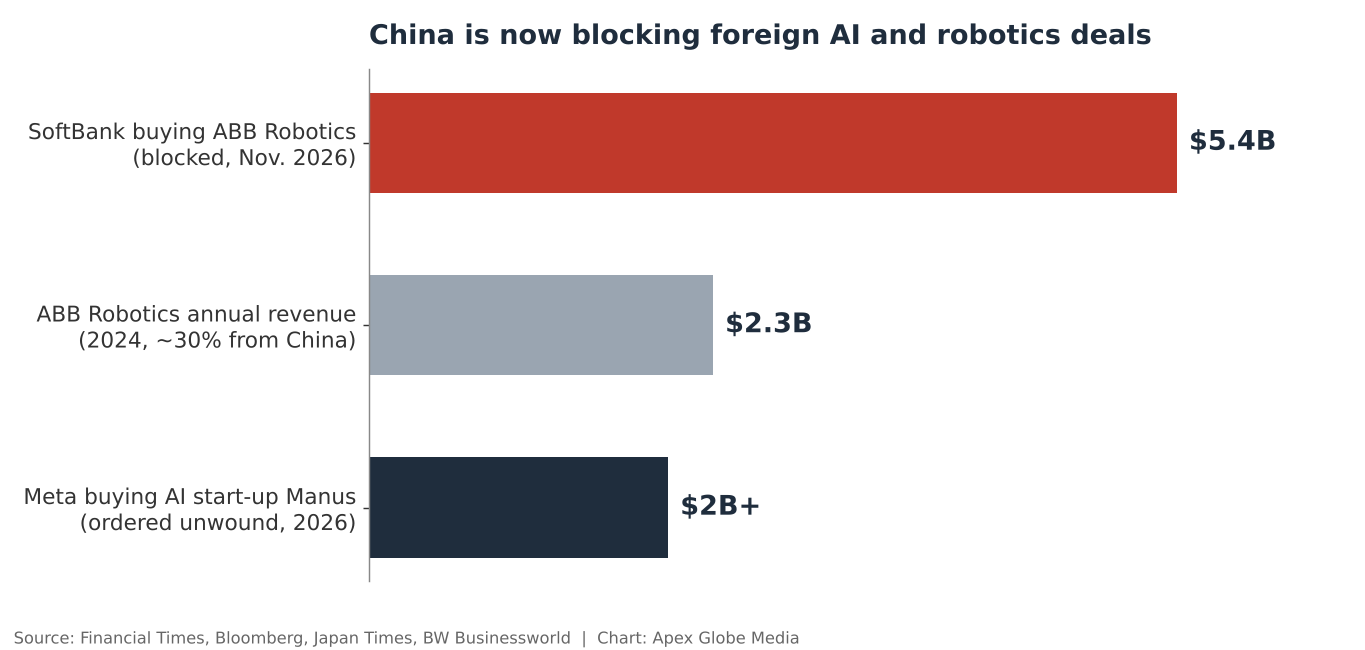
SoftBank agreed in October 2025 to buy ABB’s robotics division, one of the world’s biggest makers of industrial robot arms, for about $5.4 billion. ABB said the deal had been prohibited by China’s Office of the Working Mechanism for Foreign Investment Security Review, while the Financial Times reported that the National Development and Reform Commission, China’s state planner, informed SoftBank directly. SoftBank is now trying to work out what went wrong and whether it can seek approval again, according to the FT, as summarised by Yahoo Finance. Its shares fell several percent in Tokyo on Thursday.
China’s leverage comes from its importance to ABB. China is the robotics unit’s largest market, accounting for about 30% of its business. The division had about $2.3 billion in revenue in 2024, roughly 7% of ABB’s total, and employs about 7,000 people, according to BW Businessworld. A deal that loses approval in its biggest market is hard to complete.
Why robots, and why data
The stated concern, according to the FT, is the possible transfer of sensitive robotics-related data out of China, where it could be used to train artificial intelligence models. That is a new kind of argument in merger reviews. Industrial robots in Chinese factories record how parts are welded, painted, picked and assembled. For a company like SoftBank, which wants to build AI systems that control machines in the real world, that operational data is exactly what is needed to train “physical AI” models. For Beijing, it is information about the inner workings of the world’s largest manufacturing base.
The decision follows China’s order earlier this year that Meta unwind its purchase of Manus, an AI agent start-up with Chinese roots, for more than $2 billion, as the South China Morning Post noted. Together, the two cases suggest that China is building its own version of the U.S. national security reviews that have long blocked Chinese purchases of American tech firms. The timing also matters: this week Oracle cancelled a $7 billion AI chip deal with Tencent under U.S. pressure. Both sides are now policing AI deals that cross the divide.
A setback for Son’s AI empire
For SoftBank, robotics was meant to connect its many AI bets. Son has invested heavily in OpenAI, owns the chip designer Arm, and has spoken of combining AI models, chips and robots into machines that can work in factories and warehouses. ABB’s robotics unit would have given SoftBank an established business with factories, customers and engineering talent, rather than another start-up. Without it, SoftBank must either reapply on new terms, for example by ring-fencing the China business and its data, or find another way into industrial robotics.
ABB, meanwhile, had planned to use the proceeds for acquisitions in its core electrification and automation businesses. It now has to decide whether to keep the robotics unit, look for another buyer acceptable to Beijing, or return to its earlier plan to list the division separately.
Our take
This decision is less about SoftBank than about a new rule of the AI era: data generated by machines is now treated as a national resource. China has the world’s largest fleet of industrial robots, and it does not want the data from those factories to train foreign AI. Expect more deals involving robots, sensors, cars and connected equipment to face this test, in both directions. For companies, that means planning from the start for data to stay where it is generated, through separate local entities, local data storage and limits on model training. The global market for physical AI is likely to split along the same lines as the market for chips.