

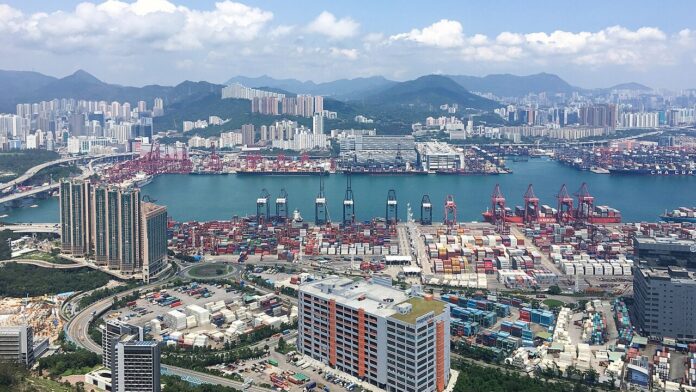

About 600,000 Nvidia H200 AI chips are sitting in Hong Kong warehouses, waiting for permission to cross into mainland China. Reuters reported on November 5 that Beijing has still not approved large-scale imports of the chips, even though Washington cleared their sale months ago and Chinese tech companies want them. The Nvidia H200 China stockpile has become a symbol of a strange new phase in the chip war: the main barrier to American AI chips reaching China is now China itself.
What is stuck, and why
According to the Reuters report, summarised by Investing.com, the backlog had not been disclosed before. China has let some H200s in. Several large Chinese internet companies have each received about 10,000 chips, and three people told Reuters that small quantities have moved through intermediaries and indirect routes. But the bulk of the supply is stuck.
Beijing has not explained the hold. Reporting compiled by Benzinga and others says Chinese authorities want companies such as Alibaba, ByteDance, Tencent and DeepSeek to use domestic processors for AI inference, the everyday work of running models, and to keep imported Nvidia chips for the training jobs where local alternatives still fall short. Some of these reports suggest total approvals for foreign chips could stay below 200,000 units, a third of what is waiting in Hong Kong. That figure has not been confirmed officially.
How we got here
The H200 is not Nvidia’s newest chip. It is a 2024 design, a generation behind the Blackwell processors that remain banned from export to China. But it is far more capable than anything China can buy legally from Nvidia otherwise, and it works with Nvidia’s CUDA software, which most AI developers rely on.
In December 2025, President Trump said the US would allow H200 sales to approved customers in China on condition that 25% of the revenue went to the US government. Rules issued in January required Chinese buyers to show security safeguards and promise no military use, and required Nvidia to certify that China sales would not short American customers. By May, the Commerce Department had approved around 10 Chinese companies, each allowed to buy up to 75,000 chips, according to Reuters reporting.
Then Beijing slowed things down. Chinese firms pulled back from orders after official guidance, amid concern that a flood of Nvidia hardware would undercut the push to build a domestic AI chip industry led by Huawei and others. The result is the pile of chips in Hong Kong.
A black market with a price tag
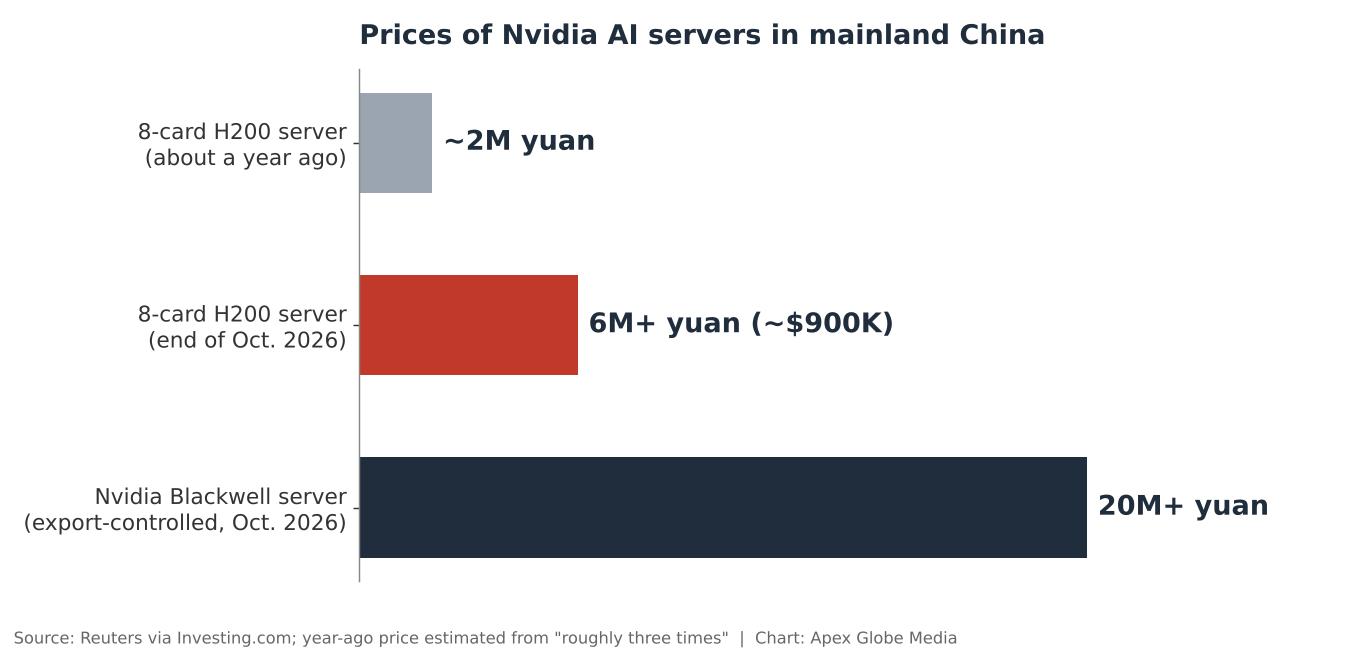
Scarcity has pushed prices up sharply. Reuters found an eight-card H200 server offered in mainland China for more than 6 million yuan, about $900,000, at the end of October. That is roughly three times the price a year earlier. Servers built on Blackwell chips, which China cannot legally import, were being offered for more than 20 million yuan each, showing that grey-market supply is still flowing.
Chinese companies are also hedging with weaker, legal chips. Last month it was reported that ByteDance, Alibaba and Tencent ordered more than 3 million of Nvidia’s export-compliant RTX Pro 5500 cards, worth more than $35 billion at list price. Smuggling remains a live issue too, as the case of Megaspeed, a firm under investigation over alleged smuggling of Nvidia chips to China shows, and this week a planned AI chip lease between Oracle and Tencent was cancelled.
Why it matters for AI
For Nvidia, 600,000 H200s represent billions of dollars of revenue that it cannot book until Beijing gives the green light, and the US government’s 25% cut is stuck along with it. For Chinese AI labs, the hold means slower training runs and higher costs at a time when they are racing to keep up with US models. For Chinese chipmakers, it is a protected market.
It also fits a wider pattern. On the same day, ABB said China had blocked SoftBank’s $5.4 billion purchase of ABB’s robotics business. Beijing is increasingly using its own approval powers, over imports and over acquisitions, to steer the technology industry rather than simply reacting to US controls.
Our take
For years, the debate in Washington was about how many AI chips to let into China. The Hong Kong stockpile shows that the question has partly flipped. Beijing now seems willing to accept slower progress in AI today in exchange for a stronger domestic chip industry tomorrow, and it is using import approvals as an industrial policy tool.
That is a risky bet. Chinese labs that cannot get enough compute could fall further behind, and high grey-market prices reward smugglers. But if Huawei and other local suppliers can handle most inference work, China only needs a limited number of Nvidia chips for training, and it can ration them. Watch for two signals: whether approvals for the Hong Kong chips speed up after any US-China trade talks, and whether Nvidia’s next earnings report counts any of this stockpile as China revenue. Until then, 600,000 of the world’s most wanted chips will keep gathering dust a few kilometres from the border.