


Updated November 12 with Alice Huang’s background and a timeline of events since this article was first published.
US intelligence agencies have concluded that Alice Huang, a senior figure at the Singapore AI cloud company Megaspeed who became close to Nvidia chief executive Jensen Huang, was recruited by China’s top spy agency to gather information on him and on Nvidia’s most advanced chips, The New York Times reported on November 6. The Jensen Huang China spy allegations land at a delicate moment for the world’s most valuable chipmaker: Congress wants a closed-door briefing, Democrats are preparing to step up oversight of chip exports, and Nvidia reports quarterly earnings in ten days.
What the reports say
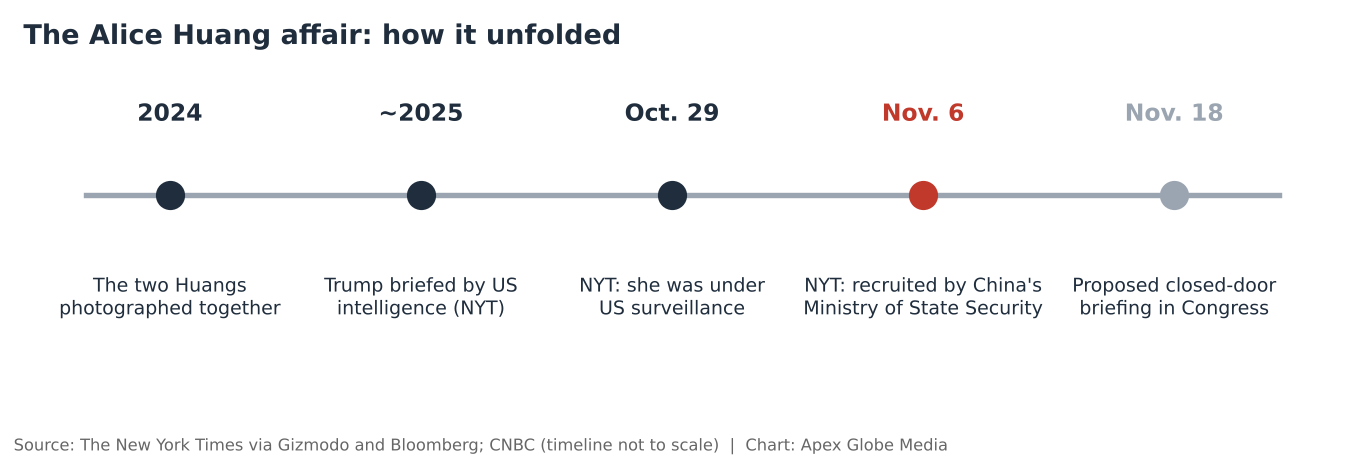
According to the Times, as summarised by Bloomberg and Gizmodo, US intelligence believes China’s Ministry of State Security (MSS) recruited Alice Huang, also known as Huang Le, to build a close relationship with the Nvidia CEO. The two are not related. Her alleged goals were to learn about Nvidia’s most advanced hardware and to encourage him to lobby Washington to allow more powerful AI chips to be sold to China. The effort dates back to at least 2024, when the two were photographed together.
The Times reported last week that she had been under US surveillance for at least a year. It also reported that intelligence officials briefed President Trump on the relationship about a year ago, and that at the time officials did not believe Jensen Huang knew she was working for Chinese intelligence. The White House and the CIA declined to comment. It is unclear how much influence she had, or whether the assessment has changed since.
China’s embassy called the reports “unsubstantiated” and “nothing but smears against China.” Alice Huang did not respond to requests for comment. None of the allegations has been tested in court.
Who is Alice Huang?
Much of her biography is still thin and partly unverified. Caixin reported on November 10 that she is about 42 years old, studied for a master’s degree in media management at Hong Kong Baptist University around 2006 and moved into private equity in 2015. The Financial Times reported that she was born in rural Hunan province.
A Washington Post profile published the same day added more detail and more doubt. A Chinese private equity database and a social media post by Shanghai Hexi Investment Management say she began as a journalist at Hunan TV and China’s state broadcaster CCTV and later worked at HSBC and CITIC, but the Post found no public record of her work at either broadcaster and could not verify her age. In the 2010s she became deputy general manager of Shanghai Hexi, and in March 2023 she became a director of Megaspeed International. Photographs show her with Jensen Huang at a Taipei bar in June 2024 and leaving a Taipei restaurant with him in May 2025. Her current whereabouts are unknown, and her social media accounts appear to have been deleted, the Post reported.
Who is Megaspeed?
Megaspeed is a Singapore-based company that builds data centers in Southeast Asia filled with Nvidia chips and rents the computing power to customers including Alibaba. The Times described its rapid rise in AI as something that “appeared to come out of nowhere” to many in the industry. It has an investment in a cybersecurity subsidiary of China Electronics Technology Group, a state military electronics supplier. US authorities have been examining whether the company helped move export-controlled Nvidia chips to China, as we reported when the first reports about Megaspeed and Alice Huang appeared. Nvidia says its own investigation found no evidence of smuggling.
Nvidia’s response
Nvidia has defended its CEO. A spokesperson told CNBC that regional cloud customers receive “ordinary business information,” not trade secrets or anything relevant to national security, and that “meetings with customers are part of a CEO’s job.” The company said Huang meets thousands of executives a year, that customers do not ask it to lobby the president, and that it is “confident that if the U.S. government believes that any person is a threat,” Nvidia would be told.
Pressure from Washington
The political pressure is building on both sides of the aisle. Three Republican committee chairmen, Brian Mast of the House Foreign Affairs Committee, John Moolenaar of the Select Committee on China and Rick Crawford of the Intelligence Committee, have asked Jensen Huang to attend a closed-door briefing on November 18 about his contacts with Alice Huang and Nvidia’s protections against foreign espionage. Nvidia has not said whether he will attend. The date falls one day after the company’s third-quarter earnings.
Democrats, who will control both chambers of Congress after this week’s midterm elections, are also preparing to increase oversight of Nvidia’s chip exports, Bloomberg reported. A separate New York Times investigation published on Saturday found that some Chinese firms approved by the Commerce Department to handle Nvidia’s H200 chips have empty offices and ties to companies under sanctions. That comes as about 600,000 H200 chips wait in Hong Kong for Beijing’s approval.
Timeline of the Alice Huang affair
Events after November 7 were added on November 12.
- 2015: Alice Huang moves into private equity (Caixin).
- March 2023: she becomes a director of Megaspeed International. The company’s assets grow from $33 million in 2023 to $3 billion in 2024, according to corporate filings cited by the Washington Post.
- June 2024 and May 2025: she is photographed with Jensen Huang in Taipei.
- Around late 2025: US intelligence officials brief President Trump on the relationship, according to the New York Times.
- October 29, 2026: the Times reports that she has been under US surveillance and that Megaspeed is being examined over export-controlled chips.
- Early November: three Republican committee chairmen ask Jensen Huang to attend a closed-door briefing on November 18.
- November 6: the Times reports that US intelligence believes China’s Ministry of State Security recruited her.
- November 8: Jensen Huang sends an email to Nvidia employees, published on Nvidia’s newsroom, apologising for being unfaithful to his wife. The message does not name Alice Huang. It says Nvidia’s board has started an independent investigation into the national security concerns raised in news reports and that he will cooperate fully. The board says it still has confidence in him.
- November 9: Nvidia shares fall more than 6% as the board’s review gets under way. We covered the board’s investigation that day.
- November 10: the Washington Post reports that Alice Huang’s whereabouts are unknown. The board hires former acting US Attorney Joon H. Kim and the law firm Wachtell, Lipton, Rosen & Katz to run its inquiry. President Trump has said Jensen Huang told him he had no idea she was linked to Chinese intelligence.
- November 11: the New York Times reports a second relationship, with a senior Nvidia executive who reported to Huang, and the Wall Street Journal reports that the board is preparing to oust him.
- November 12: Jensen Huang resigns as Nvidia’s CEO and leaves the board. Chief financial officer Colette Kress becomes interim CEO.
- November 17 and 18: Nvidia’s third-quarter results are due, and the closed-door congressional briefing had been proposed for the following day. It is not yet clear whether the briefing will go ahead after his resignation.
Why it matters for the AI chip race
Jensen Huang has been the most powerful voice arguing that the US should keep selling chips to China, on the grounds that cutting China off would only speed up Huawei and other local rivals. He persuaded the Trump administration last year to allow sales of the H200, with the US government taking a 25% cut. If lawmakers come to believe that his views were shaped, even indirectly, by a Chinese intelligence operation, that argument will be much harder to make in Washington.
Our take
There is no public evidence that Jensen Huang knowingly did anything wrong, and the core claims come from anonymous intelligence sources reported by one newspaper. That should be stated clearly. But the story shows how far the AI chip business has moved into the world of national security. The CEO of a chip company is now treated by both Washington and Beijing as a strategic target, and his customer meetings are a matter for intelligence briefings.
For Nvidia, the practical risk is not a criminal case but policy. A Congress that distrusts its CEO could tighten export rules, demand chip tracking, or block future sales to China altogether. Nvidia is already asking some Southeast Asian customers to join a program that tracks where its chips are located. Expect more of that, and expect the November 18 briefing, whether Huang attends or not, to shape the next round of chip export rules.