



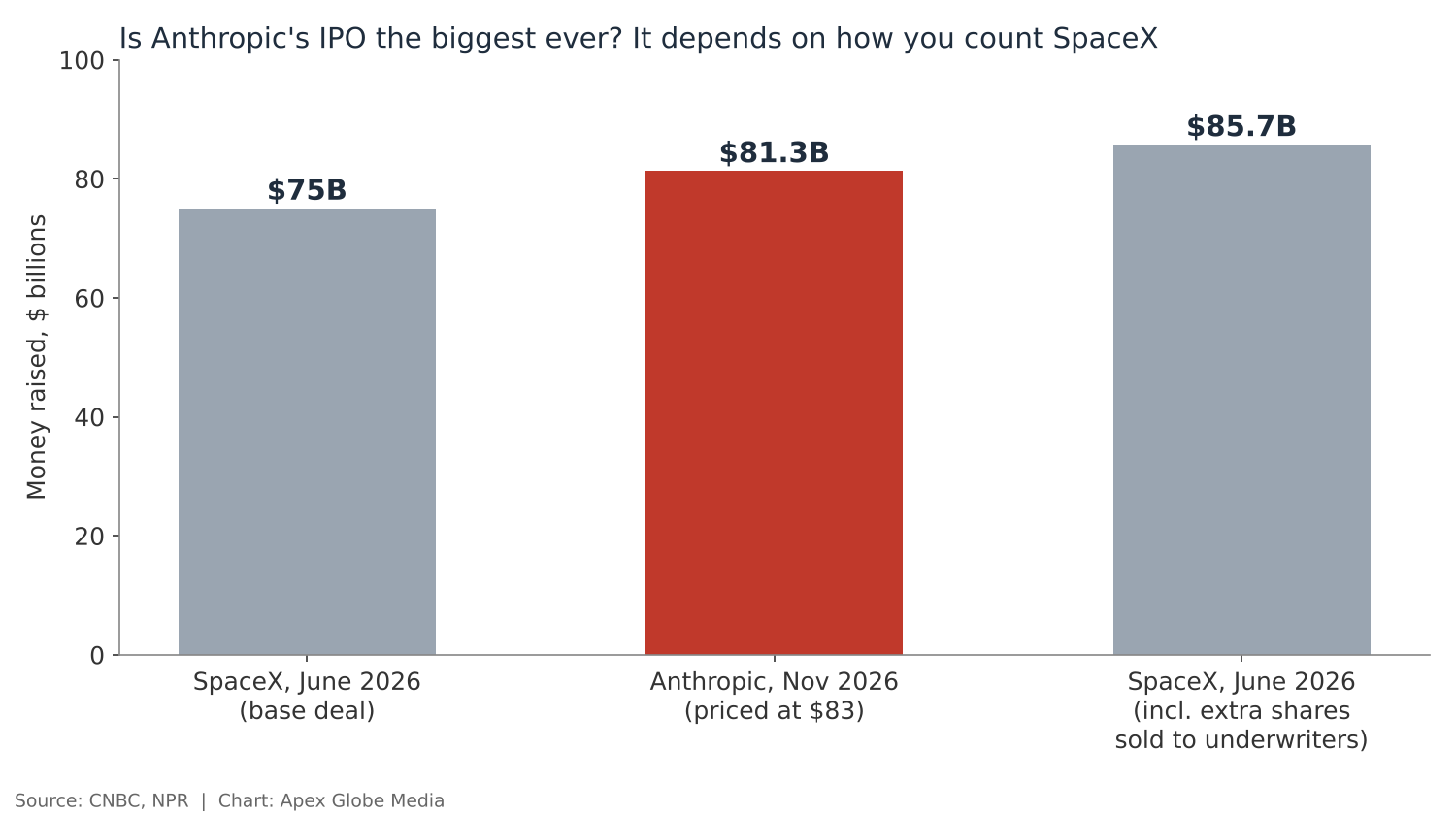
Anthropic, the maker of the Claude chatbot, sold its shares to investors at $83 each on Wednesday, well above the $70 to $78 range it set at the start of its roadshow. At that price the Anthropic IPO raised $81.3 billion, which CNBC calls the largest offering on record, ahead of SpaceX’s listing in June. The stock starts trading on the Nasdaq on Thursday, November 19, under the ticker ANT, after the market opens at 9:30 a.m. Eastern time.
The final price is the first hard number on how much public investors will pay for an AI lab that is growing very fast and losing a lot of money on paper. They paid more than the company asked. That happened in a week when AI stocks were weak, Nvidia was in crisis and a wave of US tech outages had shaken trust in the industry.
What was sold, and to whom
Anthropic made the deal bigger as demand came in. The prospectus offered 825 million Class A shares. In the end about 980 million were sold, according to CNBC. Of those, 956,351,354 were new shares from the company itself, which brings Anthropic about $79.4 billion before fees, NPR reports. The rest came from existing shareholders, and that money goes to them, not to the company.
Those other sellers are a small group. CNBC reports that each of Anthropic’s seven co-founders is selling 3.38 million shares, worth about $1.96 billion in total at $83. That is roughly 23.7 million shares, which matches the gap between the 980 million sold and the 956 million issued by the company. In other words, almost all of the money raised goes to Anthropic, and the founders are cashing out only a sliver of their stakes.
On top of the IPO itself, big technology partners agreed to buy $26 billion of stock at the same price. CNBC names Google, Microsoft, Nvidia and AMD, and CBS News adds Broadcom to the list. Amazon and Google already hold stakes that CNBC values at more than $100 billion each.
CNBC says the $83 price puts Anthropic’s value above the $1.4 trillion it had been aiming for. Yahoo Finance puts it at about $1.5 trillion. The exact figure depends on how many shares, options and convertible securities are counted, so different outlets will quote different numbers on Thursday.
Is it really the biggest IPO ever?
Yes and no. SpaceX raised $75 billion when it priced its shares in June. Later its banks used an overallotment option, which lets underwriters buy extra shares at the IPO price if demand is strong, and the total rose to $85.7 billion, according to CNBC. Anthropic’s $81.3 billion beats the first number but not the second. If Anthropic’s banks also buy extra shares, the comparison could change again. Before pricing, CBS News described the deal as what “could be the second-largest IPO ever”. Either way, the two largest stock listings in history have now happened within five months of each other, and both are bets on the same thing: huge spending on computing power that will pay off later.
The numbers behind the price
Anthropic is growing faster than almost any company of its size. CNBC reports revenue of $33.24 billion for the first nine months of 2026, up about 1,200% from a year earlier. Third-quarter revenue alone was nearly $17 billion, 45% more than in the second quarter, according to CBS News. By the end of October the company’s run-rate revenue, meaning its current monthly revenue multiplied by twelve, was about $81 billion, up $10 billion in one month. Much of this year’s growth came from Claude Code, Anthropic’s coding tool. We looked at the earlier figures in our report on Anthropic’s third-quarter update to its filing.
The losses are just as large on paper. The company reported a net loss of $104 billion for the nine months, compared with $25.1 billion a year earlier. CNBC says most of it comes from changes in the value of convertible notes and derivatives, accounting entries that rise as the company’s own valuation rises, rather than cash spent. The real costs are still enormous. CBS News reports $6.2 billion of debt, which the filing calls “substantial”, and commitments to spend nearly a trillion dollars on chips and AI infrastructure through 2045. Anthropic buys expensive systems from Nvidia, Google, Amazon and AMD, which are also among its investors.
The prospectus has more than 90 pages of risk factors. They include the company’s two public disputes with the US government this year, competition from OpenAI and Google, and the cost of borrowing for the data centre builders it depends on. OpenAI has filed confidentially for its own IPO and is expected to list, most likely in 2027.
What experts expect on Thursday
Matthew Kennedy, a senior market strategist at Renaissance Capital, told CBS News that a first-day move to $100 would be a “solid pop”, while a price closer to $140 would show that “AI enthusiasm has come roaring back.” He called the deal “so central to the AI thesis, that it’s going to be a turning point for the AI sector.”
Jay Ritter, an IPO expert at the University of Florida, was more cautious. “The whole AI sector has sold off from its July peak. Investor enthusiasm was greatest then,” he told CBS News. “The company is likely to be very successful, but the market is pricing in very lofty expectations.” He warned that cheaper open-source models could make it hard for Anthropic to keep its growth rate.
The timing is not easy. CNN notes that the Nasdaq Composite was more than 10% below the record it set six weeks earlier. Nvidia shares are down more than 35% from their October high after Jensen Huang left as chief executive. In September Anthropic chief executive Dario Amodei called for an industry-wide slowdown in AI development. In the roadshow video he struck a different note, saying “we can create an age of miracles where humanity is able to solve problems.”
A payday for thousands of employees
The listing will also turn many Anthropic staff into paper millionaires, Reuters reports. The company had about 5,300 employees at the end of September, up from roughly 940 at the end of 2024. Option holders had $119 billion in paper gains as of September 30, and about $73 billion of that had already vested. Research firm Sacra estimates that around 2,800 current and former employees could hold at least $1 million in vested equity. Hill, a marketplace for private company shares, estimates that 598 non-founder employees will hold at least $100 million each. Reuters notes that it could not verify these estimates.
Employees cannot sell everything at once. Non-founder staff may sell up to 10% of their holdings on the first trading day and up to another 35% after the company reports its results for fiscal 2026. That schedule matters for anyone buying ANT on Thursday, because it sets when a large new supply of shares can reach the market.
When Anthropic set its price range ten days ago, we wrote that the roadshow would test demand. The answer came back clearly: investors wanted more shares, at a higher price, than the company first offered.
Our take
Pricing above the range in a falling market says that big investors still see Anthropic as one of the two or three companies that will decide how AI develops, and they are willing to pay for that place even with huge losses on the books. But the IPO price is set by a small group of funds. The real verdict comes on Thursday from ordinary traders, and then over the next year as lock-ups end and employees start selling. The “record” headline matters less than one practical fact: Anthropic now has around $79 billion of fresh cash, plus $26 billion from partners, to spend in a race where computing power is the main cost. Whether that is enough to keep up with OpenAI and Google, without the growth slowing, is the question its new shareholders have just paid $83 a share to find out.