


For six days in November, America’s critical systems failed one after another: Microsoft 365, the air traffic control network, United’s flight operations, the country’s biggest bank, Apple’s online services and even the NSA’s classified network. Officials say none of it was a cyberattack. That leaves a simpler question nobody has answered in one place: what did the US tech outages actually cost? There is no official total. Transportation Secretary Sean Duffy told CNBC the damage from the air traffic shutdown alone could run into “billions of dollars,” Al Jazeera reported, but no agency has put a figure on it. So we collected every published estimate, checked what each one measures, and set them side by side.
The short answer: the numbers that exist range from under $100 million to about $7 billion, and they are not measuring the same thing. The biggest costs fell on people and companies who will never be paid back.
The outage week, failure by failure
We have covered each of these failures as it happened. Here is the whole week in one table, with the cause each organisation gave and the best available measure of its scale.
| Date | What failed | Official cause | Scale | Published cost estimate |
|---|---|---|---|---|
| Nov 12–14 | Microsoft 365 (Outlook, Teams, SharePoint, Copilot) | Defect in a July fix to network gateway servers, triggered during a capacity shortfall | More than 7.4 million Downdetector reports; services in 70+ countries; about a day for most customers | Up to $7 billion in lost productivity (Anderson Economic Group, high estimate); insured losses likely under $100 million (CyberCube) |
| Nov 13 | FAA air traffic communications, nationwide ground stop | New router installed during copper-to-fiber work flooded the network | About 12,000 of 50,000 scheduled flights did not fly on Friday; roughly 18,000 cancellations Friday to Sunday | $270–430 million for the four largest US airlines (Bernstein); $370–964 million (Raymond James) |
| Nov 16 | JPMorgan Chase online and in-branch transactions; delays at other banks and Zelle | Software bug in an on-premise hardware system | More than 4,600 Downdetector reports for Chase; payments delayed for several hours | None published |
| Nov 16 | United Airlines departures | System outage affecting weight-and-balance calculations | About 30 minutes; fewer than 150 flights, according to United | None published |
| Nov 17 | Apple Account sign-in, App Store, Apple Music, store checkouts; Apple Pay disrupted | “An internal update” | Several hours | None published |
| Nov 17 | NSA Net, the agency’s classified internal network | “Scheduled routine maintenance”; sources say patching | Staggered staff arrivals at Fort Meade; work moved to other sites | None published |
| Nov 17 | Marriott sign-in | Not cybersecurity-related, Marriott says | Not disclosed | None published |
Only two of the seven failures have any cost estimate at all, and both come from analysts or consultants, not from the companies. That is the first thing the week tells you: when an outage is not a cyberattack, nobody is obliged to count what it cost.
Airlines: the clearest bill
The air traffic failure is the easiest to price because airlines report their results every quarter and analysts already model them flight by flight. The ground stop began at 3:36 p.m. Eastern on Friday, November 13, and was lifted at around 8:20 p.m., as we reported in our account of the router that grounded the country. FAA Administrator Bryan Bedford said about 12,000 of the 50,000 flights scheduled that day did not fly. The disruption then rolled through the weekend because planes and crews ended up in the wrong cities, and close to 18,000 flights were cancelled from Friday through Sunday, Skift reported.
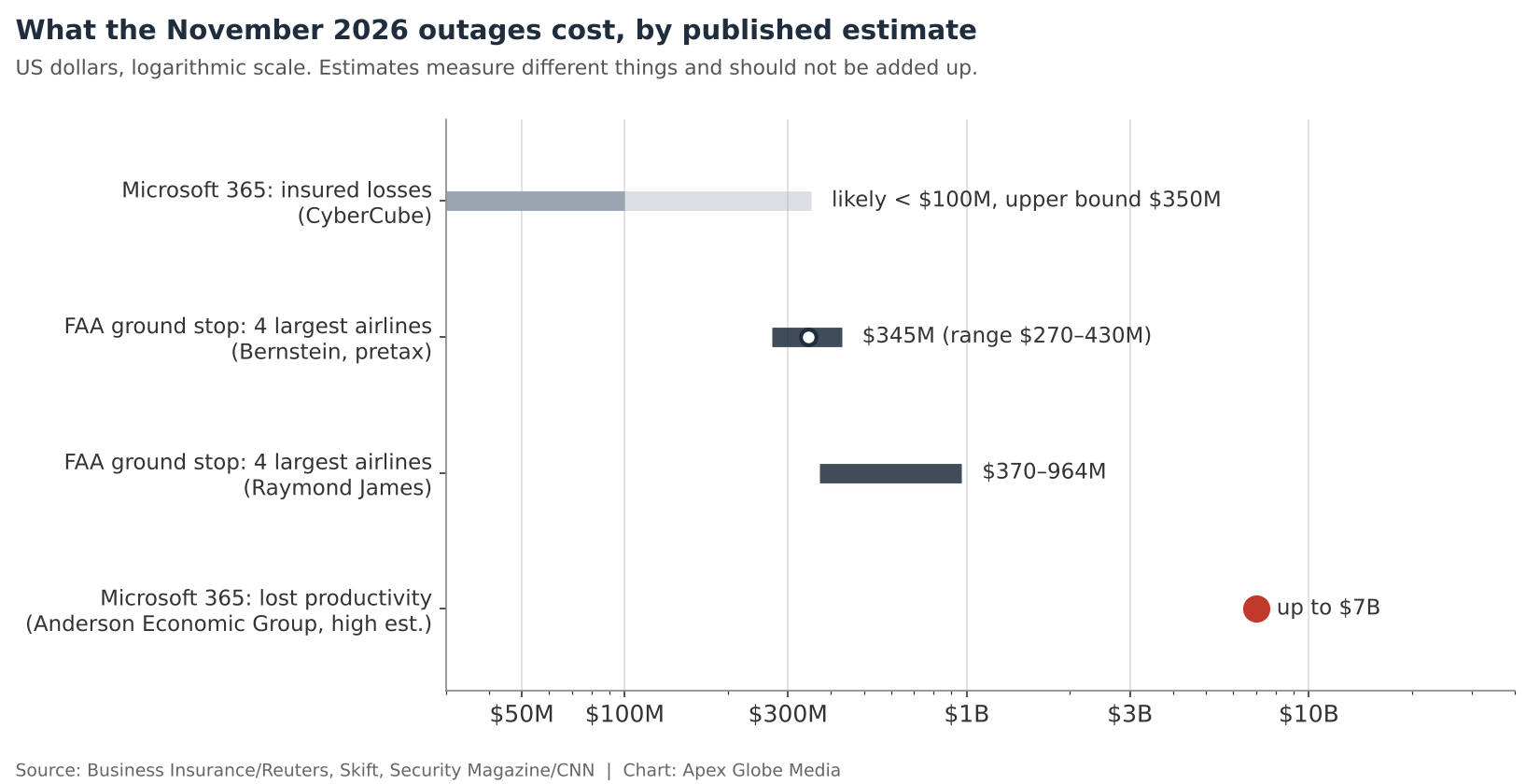
Brokerage Bernstein estimated that American, Delta, United and Southwest together face a pretax earnings hit of about $345 million, with an 80% range of roughly $270 million to $430 million, according to a Reuters report carried by Business Insurance. Raymond James was more pessimistic. Its estimate for the same four airlines was $370 million to $964 million, with American alone at $136 million to $354 million, Delta at $94 million to $244 million, United at $88 million to $229 million and Southwest at $53 million to $137 million, according to Skift.
The split between airlines matters as much as the total. On Sunday, American cancelled 22% of its schedule and JetBlue 28%, while Delta cancelled 5%, Business Insurance reported. Same ground stop, very different recoveries. Airlines that could reposition crews quickly lost a day; those that could not lost a weekend.
These estimates cover lost ticket revenue, refunds, crew overtime and the cost of moving aircraft back into place. They do not cover passengers. The roughly 3 million people who were scheduled to fly on Saturday alone, the missed connections, hotel nights and lost working days are not in anyone’s number. Under US rules airlines owe a cash refund for a cancelled flight but not a hotel or meals when the cause is outside their control, as it was here, AeroCorner explains.
Microsoft: a $7 billion problem with a $100 million insurance bill
The Microsoft 365 outage produced the largest number of the week and the smallest one. Michigan consultancy Anderson Economic Group estimated that lost productivity could reach $7 billion, according to a CNN report summarised by Security Magazine, which notes that the firm is known for cautious estimates. That figure is CNN’s description of the firm’s high estimate, and it reflects office workers around the world unable to use email, chat and shared files for most of a day.
Insurers expect to pay a tiny fraction of that. Cyber risk modeller CyberCube projected that insured losses will “most likely” be under $100 million, with a conservative upper bound of $350 million, Business Insurance reported. CyberCube gave three reasons: the outage was relatively short, no data was corrupted or leaked, and companies switched easily to other ways of communicating.
Microsoft itself will pay less still. Its contract promises business customers 99.9% monthly uptime and offers a credit of 25%, 50% or 100% of the affected service’s monthly fee when it falls short. But the credit is capped at that fee, only applies to business plans, and has to be claimed, as we explained in our guide to the Microsoft 365 refund. Office Watch calculates that for one or two users on a Business plan, even a 50% credit is worth $3.50 to $14 off one month’s bill. The credit is also the only contractual remedy: there is nothing for lost sales, overtime or missed deadlines.
Put those three numbers together and the shape of the week becomes clear. Up to $7 billion of working time was lost. Insurers will cover perhaps $100 million of it. Microsoft’s contracts cover a few dollars per seat for the customers who file a claim before the end of December. The rest is absorbed by the companies and employees who were affected.
Banks, Apple and the NSA: no number at all
For the other failures there is no published estimate, and probably never will be. JPMorgan Chase said its problem on Monday, November 16, came from a software bug and that customers kept access to their funds. But payments, transfers and Zelle transactions were delayed for hours, and other banks reported knock-on delays, as we described in our report on the Chase outage. JPMorgan shares fell more than 2.4% that afternoon, but the whole market was down that day, so the drop says little about the outage itself.
The real cost of a bank outage is spread thin: a late fee here, a bounced rent payment there, a payroll deposit that arrives a day late. None of it is reported, and customers usually have to ask for fees to be reversed one by one. Apple’s outage on November 17 stopped in-store purchases and App Store sales for several hours, and the NSA had to stagger staff arrivals at its headquarters, as we covered in our report on the NSA and Apple failures. Neither has said what it lost.
Why the estimates look so different
The published numbers fall into three groups, and it helps to keep them apart.
- Earnings impact. The airline estimates from Bernstein and Raymond James are about what the companies will report to shareholders: lost revenue and extra costs, before tax.
- Economic cost. Anderson Economic Group’s $7 billion is a model of lost working time across all affected customers. It is the closest thing to a cost to society, but it depends heavily on assumptions about how many people were idle and for how long.
- Insured losses. CyberCube’s figure is what insurers expect to pay out. It is always far smaller than the economic cost, because most of the losses are not insured.
Adding them up would be wrong, since they overlap and measure different things. But reading them together shows something the individual stories do not: the bill for routine IT failures lands mostly on the customers of the companies that failed, not on the companies themselves.
The cause of the wave is still debated. Executives and the NSA have told Congress that the failures came from rushing to patch flaws found by AI, as we reported in our analysis of the AI patch rush, although outside the NSA that link rests on anonymous sources. Whatever the trigger, the cost structure would be the same.
Our take
The most striking number from the outage week is not $7 billion but zero: the number of failing organisations that have published what their outages cost anyone else. Airlines will report their losses because shareholders demand it, but Microsoft, Chase and Apple have no such duty, and their contracts are written so that customers carry almost all of the risk. If the US wants infrastructure companies to invest in safer updates and tested rollbacks, a good first step would be requiring large providers to report the scale and estimated cost of major outages, the way public companies already have to disclose material cyberattacks to the SEC. What gets counted gets fixed.