

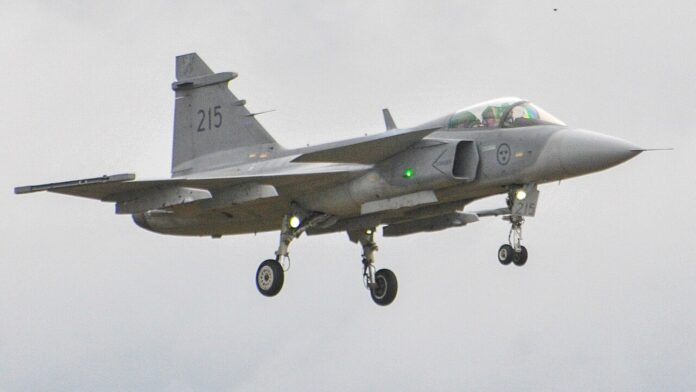

A Russian cruise missile crashed into a field in eastern Poland on Friday morning after spending about three minutes in Polish airspace, while two Swedish Gripen fighters that tried to intercept it never fired a shot. Poland’s defence minister, Władysław Kosiniak-Kamysz, confirmed that the weapon that came down near the village of Nowy Lipowiec was a Kh-101, one of three Russian objects that entered the country during one of Russia’s largest attacks on Ukraine of the war, AeroTime reports.
Nobody in Poland was hurt and officials say no infrastructure was damaged. But the night exposed an uncomfortable gap in NATO’s air defence on its most exposed border. Fighters, a tanker, an airborne radar plane and Patriot batteries were all active, and a missile still flew across Polish territory and landed where it pleased. Prime Minister Donald Tusk called it “an intentional provocation”, and the reason no one shot the missile down comes down to weather, identification rules and the way the Kh-101 is built to fly.
Three crash sites and a missile in a field
Kosiniak-Kamysz named three impact sites in the south-east of the country: Nowy Lipowiec in Biłgoraj County, Rudnik nad Sanem and Mołodycz. At Nowy Lipowiec the object was confirmed as a Kh-101. The one at Rudnik nad Sanem was probably also a missile, and the one at Mołodycz was probably a jet-powered drone, according to the minister’s briefing as reported by AeroTime and United24.
Lublin police said the missile hit a field next to a forest and caught fire. A local woman told broadcaster TVN that her “whole house shook” at around 6:30 a.m., AFP reported. Tusk said one of the objects exploded. Prosecutors in Lublin opened an investigation together with the Military Gendarmerie and military counterintelligence.
It is the second Kh-101 to land in Biłgoraj County in less than four months. On July 30, a missile of the same type hit a field near Tarnawa-Kolonia after a Polish F-16 was scrambled to intercept an unidentified object crossing the border, according to AeroTime.
Why the Gripens did not shoot
Lieutenant General Ireneusz Nowak, commander of the Polish Armed Forces Operational Command, said 11 objects posed a potential threat to Polish airspace overnight and three actually crossed into it. Two Polish F-16s and two Swedish Gripens were in the air, backed by a Dutch tanker and a Polish airborne early-warning aircraft. Patriot batteries around Rzeszów-Jasionka and Świdnik were switched on, along with the short-range Poprad and Pilica+ systems, Nordic Defence Sector reported, citing the Polish defence ministry.
The Swedish pilots went after the object believed to be the Kh-101. One of them reported that poor weather made it impossible to identify the target visually. “No weapons were used that night. Not all the conditions for using a weapon system were met,” Nowak said.
That sentence matters because Poland changed its rules less than two months ago. The revised procedures allow pilots to engage some threats without seeing them, as long as other conditions for positive identification are met, and Polish officials told AeroTime the rules also cover allied aircraft defending Polish airspace. Friday was the first big test of that change, and the missile still got through. The military has not said which condition was missing.
The Kh-101 is a hard target by design. It is an air-launched cruise missile that flies low and can change direction in flight to slip past air defences, United24 notes. It has been in service since 2012 and has a reported range of about 4,500 kilometres. A version introduced in 2024 carries two warheads with a combined weight of about 800 kilograms. A missile hugging the ground in cloud gives a fighter pilot little to work with, and three minutes over a border region is not much time to decide whether to fire over Polish villages.
Two counts of the same attack
The objects that reached Poland were a small spill-over from a huge strike on Ukraine. The two countries do not agree on how huge.
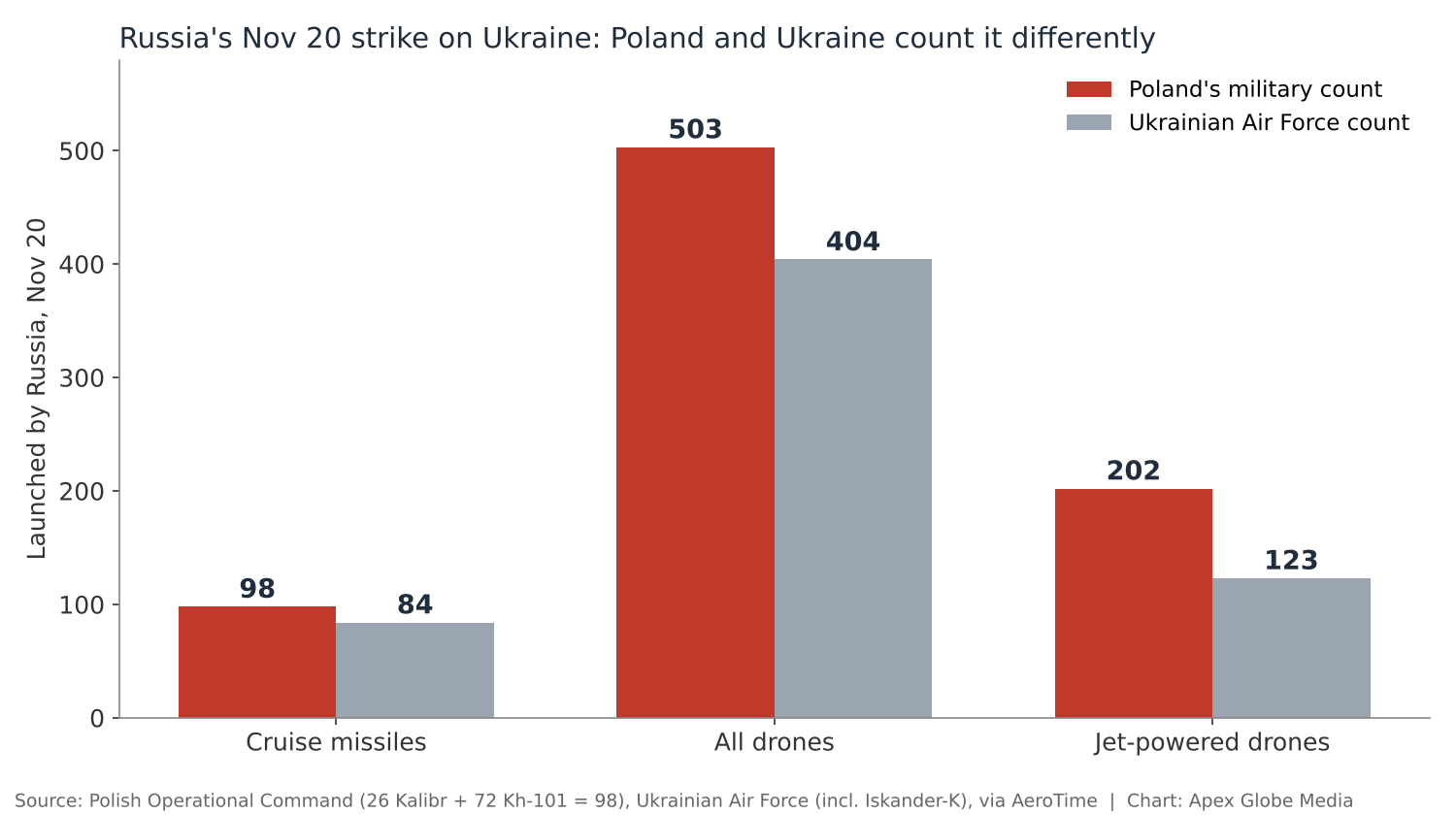
Nowak said Russia launched 26 Kalibr and 72 Kh-101 cruise missiles and 503 drones, 202 of them jet-powered. The Ukrainian Air Force reported 84 Kh-101, Kalibr and Iskander-K cruise missiles and 404 drones, including 123 jet-powered ones, plus an unspecified number of ballistic and other missiles. Ukraine said it shot down or suppressed 462 targets, including 79 cruise missiles, three ballistic missiles and 380 drones. Kosiniak-Kamysz said Russian long-range aviation also fired Kinzhal missiles.
The jet-powered drones are the newer worry. They fly much faster than the propeller-driven Shahed types that dominated earlier waves, which leaves defenders less time to react. One of them appears to have ended up in Poland too.
An evacuated control tower and closed airports
The incursion also hit civilian aviation. Rzeszów-Jasionka and Lublin airports halted flights to give military aircraft room to operate, the Polish Air Navigation Services Agency said. Infrastructure Minister Dariusz Klimczak said the air traffic control tower at Rzeszów-Jasionka was evacuated for the first time, with nine people, six of them operational staff, moved to a temporary shelter. Both airports briefly reopened and then suspended operations again at 9:26 a.m. as another wave of Russian strikes came in, before resuming later.
Rzeszów-Jasionka is not just a regional airport. South-eastern Poland is the logistics hub for Western military and civilian aid to Ukraine, and Sweden’s Gripens have been part of a NATO operation since October to help protect it, according to the Swedish government. An evacuated control tower at the heart of that hub is the kind of disruption the air defence mission exists to prevent.
A provocation, or a mistake?
Warsaw is sure it was not an accident. The objects fell during Koalicja 26.2, a drill at Nowa Dęba in south-eastern Poland by the “Coalition of the Willing”, the group of roughly 30 countries led by France and the United Kingdom that is preparing a possible force for Ukraine. Several European defence ministers were in the area. “This does not look like a coincidence,” Tusk said, adding that NATO partners share his view.
The day before, Fox News quoted US President Donald Trump as saying that Vladimir Putin “has been landing drones in Poland, and a couple of little missiles, by mistake.” Tusk said he does not always agree with Washington’s reading of these incidents, but that US officials have been given access to the crash sites and the debris. NATO Secretary General Mark Rutte called the incursions “grave violations” and said NATO jets had been scrambled. Kosiniak-Kamysz said he would ask Rutte, who is due in Warsaw on Saturday, for more forces and equipment for Operation Eastern Sentry, the mission set up after Russian drones entered Polish airspace in September 2025. The Kremlin had not commented by Friday.
We have written before about Europe’s push to build its own long-range weapons, such as Denmark’s Anthem cruise missile, and about the satellite links that keep Ukraine’s forces connected, in our report on the Starlink loophole. Friday showed the other side of the problem: the defence of NATO territory against a single low-flying missile.
Our take
Poland had everything a modern air defence is supposed to have in the air or switched on, and it still could not stop one cruise missile in bad weather. That is not a failure of courage; it is the identification problem every NATO country on the eastern flank faces, made worse by weapons designed to fly low and late. The rule change this autumn was meant to fix exactly this, so Warsaw now owes the public a clear explanation of which condition was missing. If the answer is that the sensors could not build a confident picture fast enough, the next investment should be in low-level radar coverage of the border, not more fighters on patrol.