



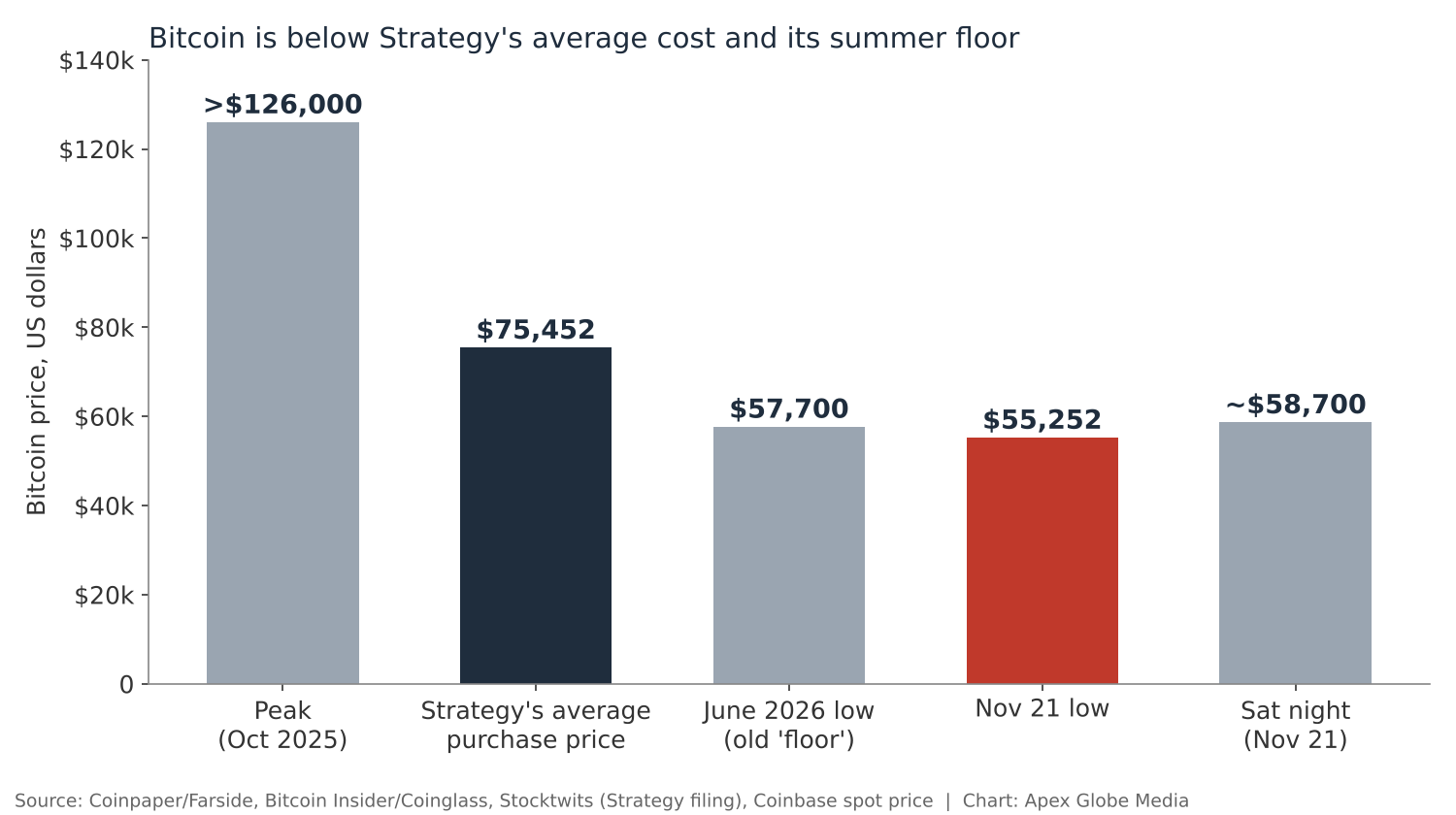
Bitcoin fell to about $55,250 early on Saturday, its lowest price in more than two years, then bounced back above $60,000 within hours. By Saturday night it was trading near $58,700. The drop came at the end of a week in which technology stocks had their worst run since 2020, and the timing is not a coincidence: this week bitcoin traded less like “digital gold” and more like a leveraged bet on the AI boom. According to market data compiled by Coinpaper, the intraday low was $55,251.60, and more than $2.5 billion of leveraged positions were forcibly closed over 24 hours.
The price is now less than half of the peak above $126,000 that bitcoin reached in October 2025. It has lost roughly a fifth of its value in November alone, which would make this its worst month since June 2022.
How the week unfolded
The fall was a slide, not a single crash. Bitcoin tested the $62,000 area several times early in the week, lost it on Thursday and broke below $60,000 on Friday for the first time since July. On Saturday morning it went through $57,700, the low it set in June, which many traders had treated as a floor. Bitcoin Insider reported, citing Coinglass data, that about $2.4 billion of crypto positions were liquidated in one 24-hour stretch, including more than $1 billion in bitcoin futures. The largest single liquidation was a $51.7 million bet that the price would rise.
Liquidations explain why the move overshot. When a trader borrows to bet on a rising price and the price falls far enough, the exchange closes the position automatically by selling. That selling pushes the price lower, which triggers the next round of closures. Once the forced selling ran out on Saturday morning, the price jumped almost 9% in a few hours, partly as traders who had bet on a fall bought back to lock in profits.
Why bitcoin fell with Nvidia
The selling started in the stock market. On Friday the Nasdaq Composite fell 5.3% and the S&P 500 3.7%, while Nvidia closed down 14% for its seventh straight losing day, as we reported in our coverage of the Nasdaq 100’s worst week since March 2020. Investors are questioning whether hundreds of billions of dollars of spending on AI data centres will pay off, and Nvidia has been hit on top of that by the removal of Jensen Huang as chief executive and a reported SEC look at its accounting.
Bitcoin followed the tech stocks lower all week. Part of the reason is who owns it now. Since US spot bitcoin exchange-traded funds launched in January 2024, a large share of demand has come from the same fund managers and retail brokerage accounts that own Nvidia. When they cut risk, they sell both. Data from Farside Investors, cited by Coinpaper, show US spot bitcoin ETFs lost $582.3 million on Thursday, November 19, including a record one-day outflow of $541 million from BlackRock’s iShares Bitcoin Trust, and another $124.5 million on Friday. Net outflows for November are about $3.5 billion.
Interest rates are the other half of the story. Analysts quoted by Bitcoin Insider pointed to rising inflation-adjusted Treasury yields and a more hawkish outlook for the Federal Reserve. When safe government bonds pay a real return, assets that pay nothing, such as bitcoin and gold, look less attractive. That helps explain one awkward detail of this week: gold fell too, by more than 4% on Friday, to its lowest level since September 2025. Neither of the supposed safe havens worked as one.
The company with 850,849 bitcoins
The weak spot most traders are watching is Strategy, the software company turned bitcoin treasury run by Michael Saylor. It holds 850,849 bitcoins bought at an average price of $75,452 each, about $64.2 billion in total, according to Stocktwits, citing the company’s latest filing. At Friday’s prices that stake was worth about $50 billion, a paper loss of around $14 billion. Strategy shares fell nearly 10% on Friday to about $78, a 52-week low.
Strategy’s model depends on its shares trading above the value of the bitcoin it owns, a ratio known as mNAV. When the premium exists, the company can sell new stock and buy more bitcoin per share than before. As TIKR explained in an analysis on Yahoo Finance, bitcoin critic Peter Schiff said on Thursday that the ratio had fallen below 1. At that level, each new share brings in less money than the bitcoin it represents, so the trade stops working. Strategy’s own management had set the break-even for buying bitcoin with new stock at 1.22 times.
Saylor says Strategy will keep buying back its STRC preferred shares while they trade below $100, and that its $4.9 billion of dollar assets as of November 15 can cover 3.4 years of interest and dividends. Schiff argues the company will burn through that cash and then have to sell bitcoin. There is no sign of that yet: Strategy has not sold any bitcoin, and its cash cushion is large. But a forced seller holding about 4% of all bitcoin that will ever exist is the scenario crypto markets fear most. Bitcoin miner MARA Holdings is already selling some of its coins to pay down debt, according to its third-quarter shareholder letter.
What to watch next
The weekend rebound happened while US stock markets, and therefore the ETFs, were closed. Monday’s ETF flow figures will show whether the funds’ investors are still leaving or have started buying the dip. The second signal is the Nasdaq: crypto has followed tech stocks lower all week, and a rebound in Nvidia and its peers would probably be the first real relief for bitcoin too. The third is Strategy’s weekly update on Monday, which will show how much of its cash it spent and whether the premium to its bitcoin has come back.
The Crypto Fear and Greed Index, a sentiment gauge built from price swings, trading volume and social media, fell to single digits on Friday, its lowest since February. Readings that low have often come near short-term bottoms in the past, but they have also stayed there for weeks during longer bear markets.
Our take
This week settled an argument that bitcoin’s supporters have been losing for a while. An asset that falls 20% in a month alongside Nvidia, with gold also falling, is not acting as a hedge against market stress. It is acting as one of the riskiest parts of the same trade. That is the price of success: ETFs and corporate treasuries brought trillions of dollars of mainstream money within reach of bitcoin, and that money sells when the AI story wobbles. The thing to watch is not the next $5,000 bounce but whether Strategy can stay a buyer. If the largest corporate holder ever has to become a seller, the floor under this market will look very different.