

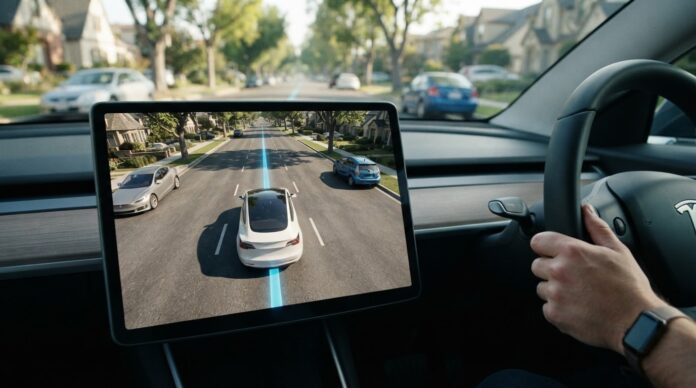

Tesla started rolling out FSD v15 on Saturday, November 21, to a first wave of owners, and the update arrives with two very different kinds of promise. The first you can see: a new “Reality View” that redraws the street around the car as a live, photorealistic scene, which Elon Musk summed up on X as “It’s like GTA.” The second you cannot see yet: Tesla says a new vision encoder improves the “critical intervention rate by 25x.” The full release notes, published by Tesla’s AI account and detailed by Electrek, also read like a list of the system’s best-known weak spots: speed signs, potholes, school zones and debris.
FSD, short for Full Self-Driving (Supervised), is Tesla’s driver-assistance software. Despite the name, the driver must watch the road and be ready to take over at any moment. A “critical intervention” is when the human has to grab the wheel or brake to prevent something unsafe.
What Reality View actually shows
Until now, Tesla’s screen showed a fairly sparse sketch of the road: grey lanes, boxy cars, a blue line for the planned path. Reality View replaces that with a rendered view of the real street, seen from a virtual camera just above and behind the car. According to Drive Tesla, Tesla’s AI software chief Ashok Elluswamy said the picture is produced by the same end-to-end driving model that controls the car.
“It’s not there just because it looks cool, but it also communicates the intent of the car,” Elluswamy wrote on X. “The arrows show the turns FSD intents to take, the pins show its intent to park in a spot and so on.” In the release notes Tesla calls the feature “Tesla Augmented Reality” and says it replaces all the separate model signals with a single visualization “using less total compute.” Elluswamy compared it with the wireframe view from 2020 and said the new one uses less computing power than the old one did.
It helps to be clear about what this picture is. It is not a video feed from the car’s cameras, and it is not a pre-built 3D map of the city. Tesla describes it as a real-time generative visualization: the driving model takes what its cameras see, builds its own understanding of the scene, and then draws that scene from a camera position that does not physically exist. Musk has called it real-time AI video generation. That is also its weak point. A generative model can, in principle, add or leave out details, and Tesla has not explained how closely Reality View matches the real street, or what happens when the model’s picture and reality disagree. For a display whose whole purpose is to show the driver what the car “thinks”, that is a question worth answering.
Drivers can pick a full-screen view, a map, or a split screen, and there is a new quiet mode. Drive Tesla expects Reality View to be limited to newer HW4 cars with the AMD Ryzen infotainment computer; Tesla has not said so itself.
The list of fixes is the real story
Most of v15’s driving changes go straight at complaints owners and regulators have made for years. Tesla says the update improves detection of road signs, small animals, road debris, chains and potholes, avoids deep standing water, and handles speed better in school zones, at speed limits and in bad weather. FSD will now also slow down for speed cameras, and a new Bike Rack Mode allows the system to run with a hitch accessory fitted.
Those are not random choices. In a September test cited by Electrek, the Brussels nonprofit Johanna.be found that FSD exceeded the limit in 55% of the 30 km/h zones it drove through, averaging 44 km/h, often because the screen showed a 50 km/h limit and the car never read the sign. Musk promised pothole avoidance back in 2019 and called it “coming soon” again in August. And the US road safety regulator NHTSA has been investigating FSD traffic-law violations, such as running red lights, since October 2025.
Navigation also changes. Tesla says it now uses a learned model built from the fleet’s route preferences, and that the car picks parking spots using your own parking history and shows several options at the destination. For now the learning only covers the start and end of a trip; Tesla says later v15 releases will extend it to the whole route.
One change goes the other way
Not every tweak tightens things. The release notes say driver monitoring now works more often when the driver wears a hat or sunglasses, but also that Tesla is “decreasing strictness in higher speed driver profiles.” That is the camera that checks whether the person behind the wheel is paying attention, and Tesla is loosening it at a time when it is tightening the same system in Europe at regulators’ request. The speed-camera feature raises a similar question, as Electrek pointed out: slowing down only where a camera is watching suggests the car may still go over the limit where none is.
What “25x” means, and what it does not
Tesla gives only a multiplier, not the underlying number of miles between critical interventions. That makes the claim impossible to check from outside. The best public yardsticks come from owner-collected data. When v14 arrived in October 2025, crowdsourced logs showed about 732 miles between critical disengagements. Electrek’s data from earlier this year suggested v14 had climbed to “a couple thousand” miles.
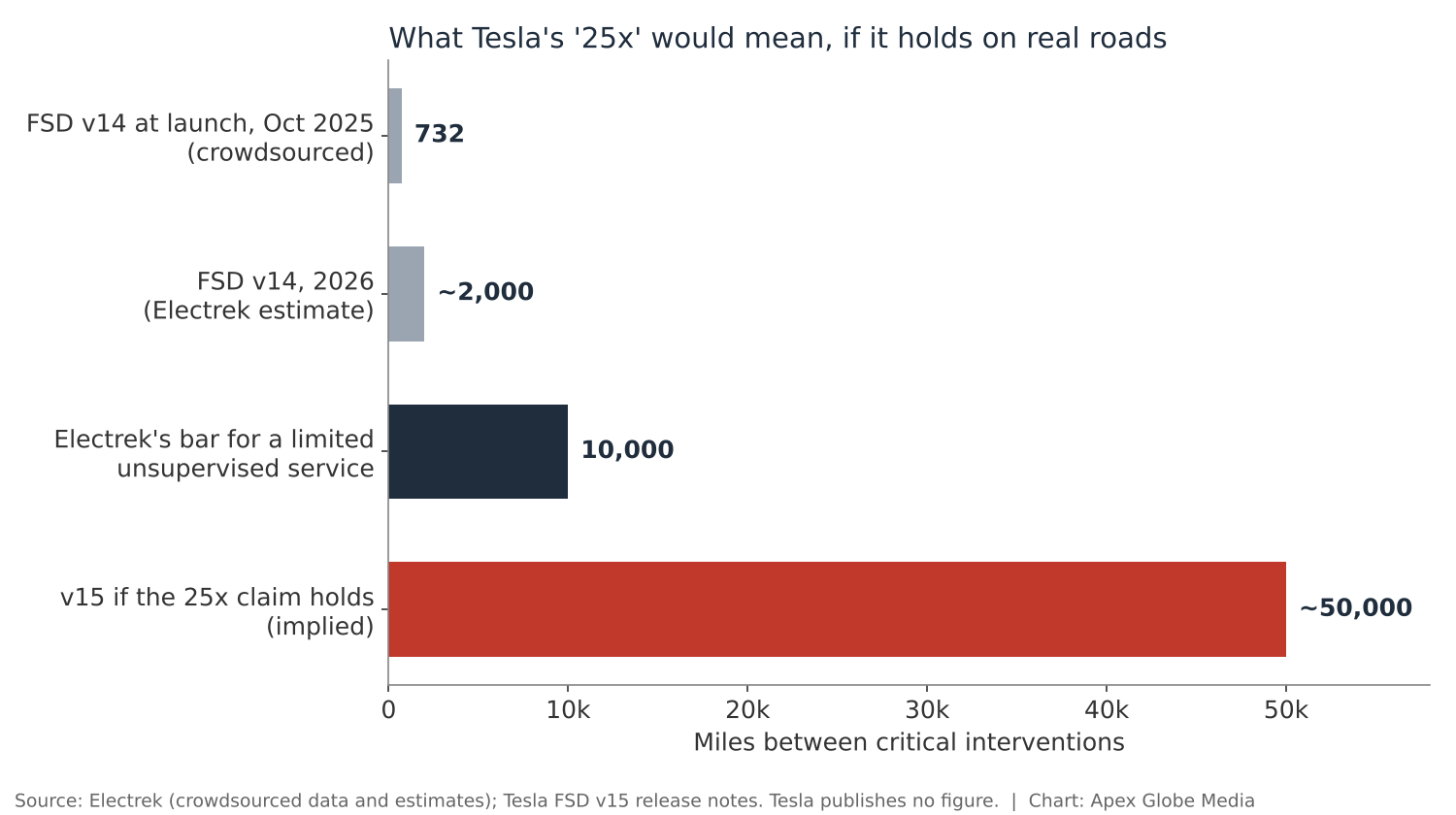
Multiply that by 25 and you get roughly 50,000 miles, five times the 10,000 miles Electrek has said Tesla needs before it could run even a limited service with no one supervising. If that held across the fleet, it would be Tesla’s biggest step toward real autonomy in years. That is a big “if.” Tesla has not said which version the 25x is measured against, on what roads, or over how many miles.
History also argues for patience. Electrek’s Fred Lambert notes that FSD “has never improved in a straight line”: v14 launched with hallucinations, brake stabbing and excessive speeding, got much better, and then went backward again in v14.2 before Musk sold v14.3 as the version where “the last big piece of the puzzle finally lands.” In April, Musk wrote that v15 “will far exceed human levels of safety, even in completely unsupervised and complex situations.” He said similar things about earlier versions.
Who gets it, and when
Elluswamy wrote that v15 was “releasing to the first wave of customers today.” Tesla has not said which cars or countries come first, though it has told investors that its AI4 (HW4) computer can run v15; older HW3 cars are not expected to get it. Musk said on X that “FSD V15 goes to wide release next month,” bundled with Tesla’s holiday software update, Drive Tesla reported.
The update lands as rivals close in. Mercedes is bringing its own point-to-point city assistant to US streets next month, which reviewers liked most in town traffic, and Tesla is already taking personal orders for a Cybercab that comes with a $299 monthly subscription. Meanwhile California has just banned Waymo from its freeways, a reminder of how fast regulators can act when a self-driving system misbehaves.
Our take
Reality View is a genuinely smart idea, and not only because it looks like a video game. A driver who can see where the car plans to turn or park can catch a bad decision before it happens, which is exactly what supervised driving needs. The fix list is also the right one: signs, potholes and school zones are where FSD has been failing people. But a 25x claim with no baseline is marketing until Tesla publishes the intervention data, and loosening driver monitoring at higher speeds is the wrong signal to send while the human is still legally in charge. We will judge v15 by the December wide release and the owner data that follows, not by the screenshots.