



A Ukrainian laser air defense system has shot down one of Russia’s jet-powered Geran attack drones, according to Serhii “Flash” Beskrestnov, a defense technology adviser to President Volodymyr Zelensky. In a Telegram post on November 25, he said the Blysk laser, built by the Ukrainian company Carmine Sky and guarding a critical infrastructure site, had become the first combat laser in the world to bring down a jet Geran. He posted a 21-second video of the interception, as AeroTime and DroneXL reported.
If it holds up, this is a real milestone. Lasers have downed slow drones before. A jet drone is a much harder target, and Russia is now sending dozens of them at Ukraine every night. But the claim also comes with large gaps, and Beskrestnov himself was careful about what it means.
What Ukraine has actually said
The evidence so far is one post and one video. Beskrestnov did not say where or when the drone was hit, at what range, or which jet Geran variant it was. He wrote only that the drone fell “recently” and that Carmine Sky’s Blysk units were showing their first combat results. The video shows a targeting screen: a crosshair follows a small target past street lamps, and then a bright flash fills the corner of the frame, DroneXL said. Nothing in the footage itself identifies the drone type.
Beskrestnov also played down any rush to scale. “For now, it is too early to talk about serial production of the laser,” he wrote, according to AeroTime. He said several Ukrainian companies are working on laser air defense, that the technology is complex and expensive, and that the lasers are protecting infrastructure sites while their trials continue.
Carmine Sky says Blysk is a separate system from Tryzub, the laser that former Unmanned Systems Forces commander Vadym Sukharevskyi described in 2024, and from Sunray, a truck-mounted laser reported earlier this year, DroneXL noted.
A small laser that had a fog problem
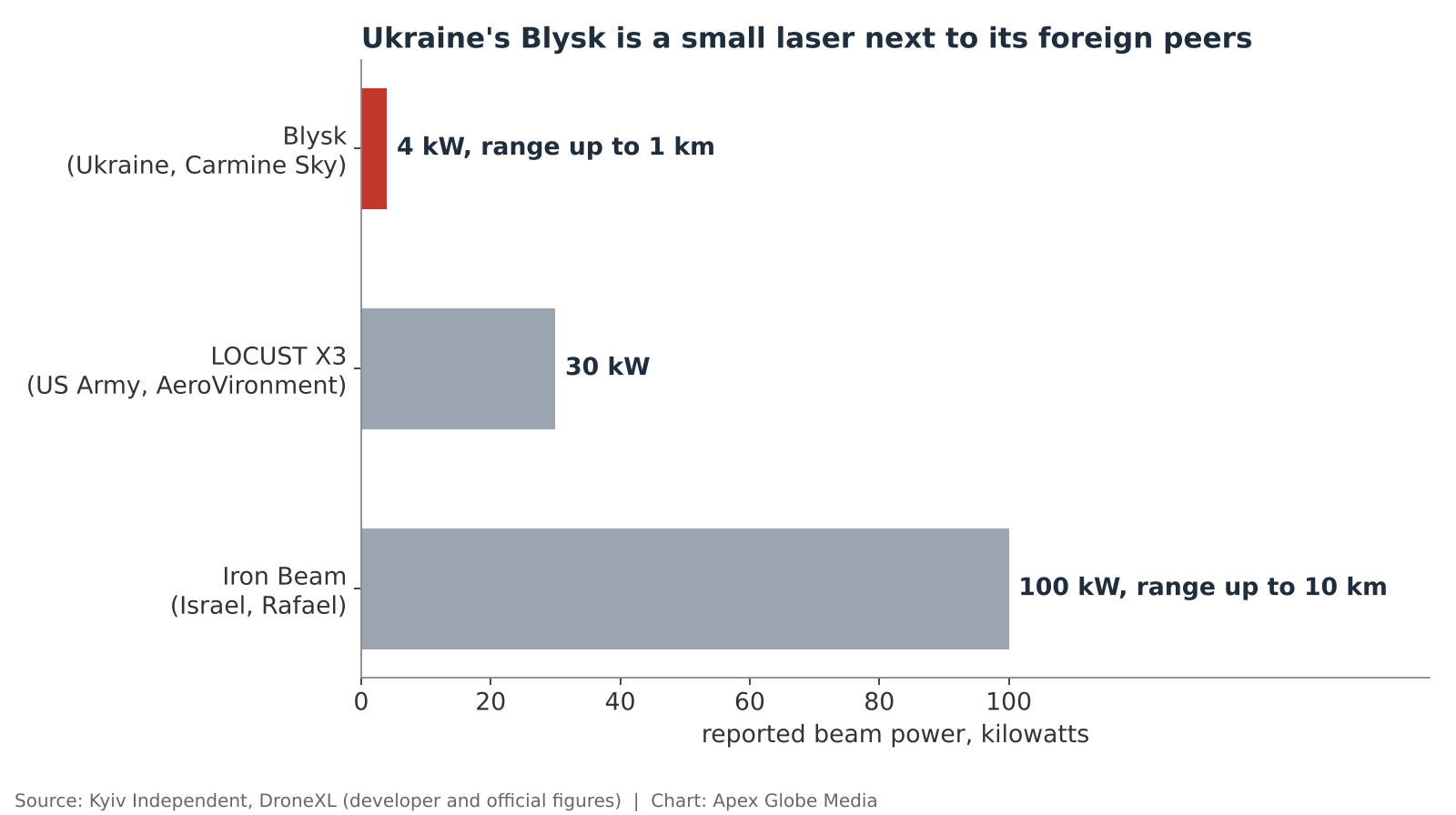
Blysk is modest by world standards. Its developers rate it at 4 kilowatts with an effective range of up to one kilometre, the Kyiv Independent reported on November 19. Carmine Sky put it on combat duty in Kyiv in early November.
Its first days were not a success. The company told BBC News Ukraine that persistent cloud cover and fog over Kyiv had kept Blysk from engaging Russian drones at all. That is the classic weakness of laser weapons: water droplets in the air scatter the beam before it reaches the target, so a system that works on a clear night can be useless on a grey one.
The weapon also does not work like a film laser that slices wings off. In a follow-up post, Beskrestnov explained that the beam holds a spot on one point of the airframe until the parts inside overheat and fail. Power decides both the range and how long the beam has to stay on the target. Carmine Sky says a small FPV drone burns in a fraction of a second, while a Shahed-type airframe needs the beam held for several seconds because of its multilayer hull.
Why a jet drone is so much harder
Speed is the whole story. The propeller-driven Geran-2, Russia’s version of the Iranian Shahed, tops out at around 185 km/h. Ukraine’s military intelligence says the jet-powered Geran-4 flies at up to 500 km/h and the Geran-5 cruises at more than 450 km/h, DroneXL reported.
At 500 km/h a drone covers about 139 metres every second. That means it crosses Blysk’s one-kilometre bubble in roughly seven seconds. If the laser needs several of those seconds of steady contact on a single spot, the tracking has to be nearly perfect from the moment the drone enters range. That is why hitting a jet Geran with a 4 kW beam, if confirmed, says more about the tracking system than about raw power.
And these drones are no longer rare. On the night of November 25 alone, Russia launched 113 drones at Ukraine, 76 of them jet-powered, along with ballistic missiles and decoys, Ukraine’s Air Force said, according to the Kyiv Independent. Last week jet drones were part of the mass attack that also sent a Russian cruise missile into Poland, as we reported in our story on the Kh-101 crash and the Gripens that failed to identify it.
Business is now part of Ukraine’s air defense
Blysk is not a state weapon in the usual sense. It was developed under Ukraine’s Private Air Defense program, which lets companies form their own air defense crews under the Air Force’s operational control, with support from the state-backed Brave1 defense tech cluster. About 100 companies have joined, and half of them have formed active combat units, according to the Kyiv Independent. As of October 14, private units had shot down more than 60 Russian aerial targets, mostly drones, the Defense Ministry said.
Carmine Sky already had results before the laser. On March 30, then-Defense Minister Mykhailo Fedorov said the company had shot down Shahed and Zala drones over the Kharkiv region with its Sky Sentinel gun turret, AeroTime reported.
Ukraine is also trying almost everything else against jet drones. On November 23 the Air Force released footage of a French-supplied Mirage 2000 shooting one down with its cannon. Ukrainian firms have also shown interceptor drones built to chase the faster Gerans.
How it compares with other lasers
The best-known laser air defense system is Israel’s Iron Beam. Built by Rafael and delivered to the Israeli military in December 2025, it is rated at 100 kilowatts and designed to hit drones, rockets and mortar shells at up to 10 kilometres. In May 2025 Israel’s Defense Ministry said lower-power laser prototypes developed with Rafael had already intercepted Hezbollah drones in combat.
In the United States, the Army in September awarded AeroVironment $464.8 million for the 30 kW LOCUST X3, the first production contract for a laser weapon in US military history, according to DroneXL. An Army version of LOCUST has been credited with cutting cartel drone flights over the Rio Grande Valley, but those targets were small quadcopters, not jet attack drones.
Blysk has a fraction of the power of either system. That is what makes Ukraine’s claim interesting: it suggests a cheap, small laser can matter if it is placed right next to the one site it has to protect.
Our take
We would treat “world first” as a claim, not a fact, until there is a second confirmed kill with a date and a place attached. One video with no location is how wartime announcements often look, and Beskrestnov’s own caution about production suggests he knows that.
Still, the direction matters more than the headline. Every interceptor drone, missile or cannon shell Ukraine fires at a Geran is used up, and Russia is betting it can build drones faster than Ukraine can build ways to stop them. A laser changes that maths. Its cost per shot is mostly electricity, and it never runs out of ammunition as long as the power stays on. Its limits are real: one kilometre of reach, a few seconds per target, and fog that can blind it for days. But a weapon that is cheap to fire and good enough to guard a power substation is exactly what Ukraine needs this winter. If Carmine Sky can repeat this in daylight and in bad weather, the bigger news will not be one drone. It will be that small companies, not only defense giants, are now building working laser weapons in the middle of a war.