

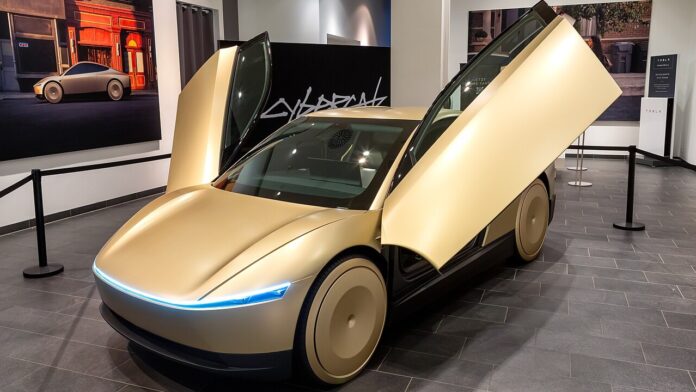

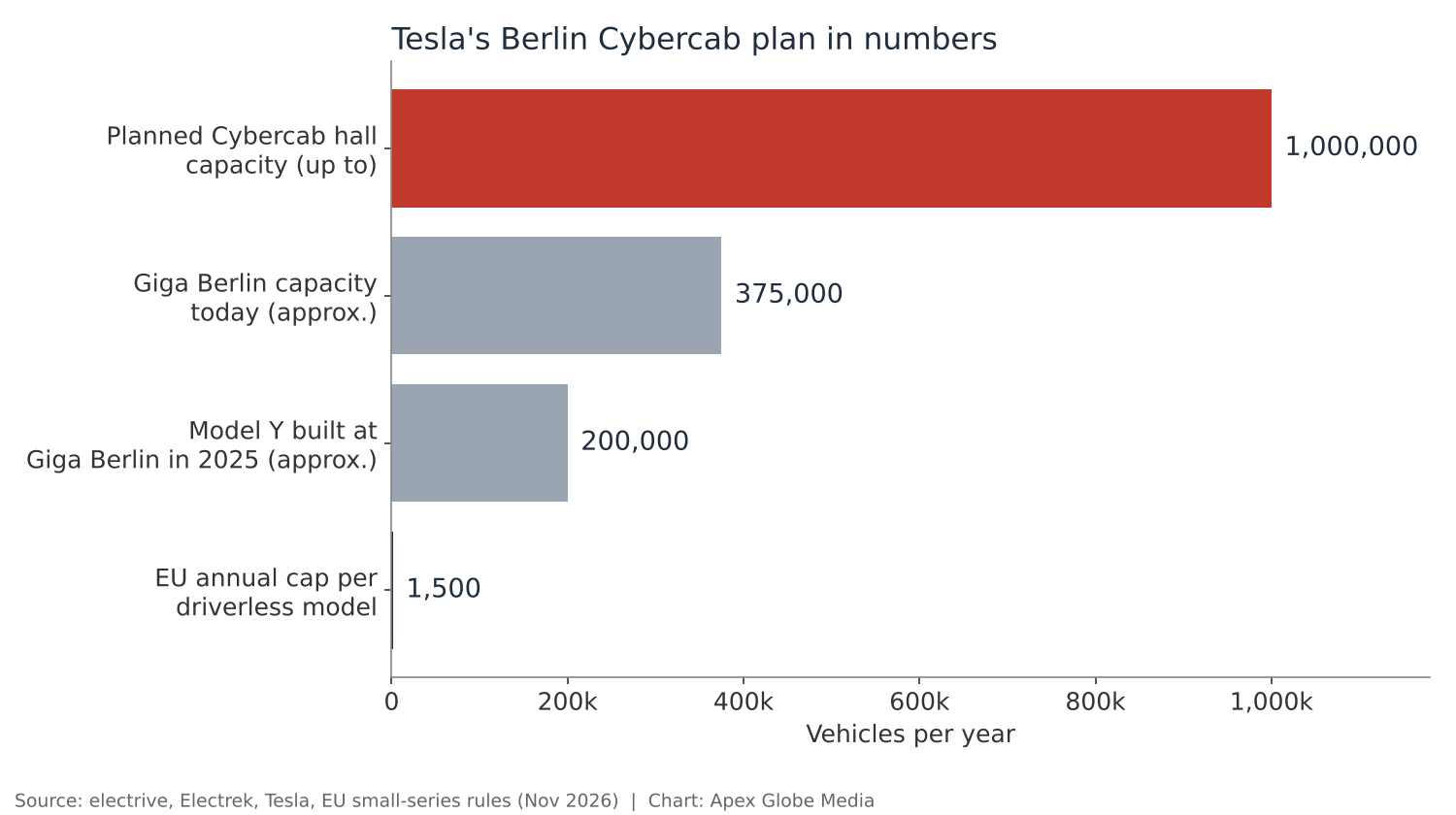
Tesla is going to build its steering-wheel-free robotaxi in Germany. The company confirmed on November 16 a first investment of about €3 billion ($3.3 billion) in a new production hall at its plant in Grünheide, outside Berlin, designed to make up to one million Tesla Cybercab vehicles a year, with production planned for 2029, electrive reports. “We are expanding! Cybercab production is coming to Giga Berlin!” plant manager André Thierig wrote on X, according to Electrek.
It is the biggest new car-factory commitment Germany has heard in a while, and it arrives in a month when German carmakers are mostly talking about cuts. It also bets on a vehicle that, under today’s European rules, could be registered in only small numbers.
What Tesla plans to build
The €3 billion covers a new production hall north of the existing factory, ancillary buildings and a second wastewater treatment plant. Tesla plans to file its building application before the end of 2026, start construction in the first half of 2027 and begin robotaxi production in 2029. Thierig said the project “will lay the foundation for the most technologically advanced Tesla factory in the world.” Automation engineer Steven Scholtysek reported that Elon Musk signed off on the project the week before and that the new hall will be bigger than the original factory, Electrek says.
The Cybercab is a robotaxi with no steering wheel or pedals. Tesla started building it in Texas in April, and 463 had been registered in Texas by late October, according to Electrek. Last week Tesla began taking personal orders at $29,990, with a mandatory $299 monthly subscription and use limited to its Robotaxi service areas.
Brandenburg’s state premier Dietmar Woidke called the investment and the prospect of up to one million Cybercabs “a decision of enormous economic significance.” If the hall ever ran at full capacity, Grünheide could overtake Volkswagen’s Wolfsburg plant as Germany’s largest car factory, Cryptopolitan notes. The automotive expert Matthias Schmidt was more cautious, questioning how much of the money will create “sustainable, long-term employment.”
A plant that only recently got busy again
Giga Berlin opened in March 2022 and builds only the Model Y. Its capacity is about 375,000 cars a year, which it did not fully use until recently, electrive reports. About 200,000 Model Ys left the plant last year. After Tesla’s sales slump of 2024 and 2025, expansion plans were put on hold and the workforce fell to about 11,000. It has since grown back to 12,600, and weekly output is now about 7,000 cars, close to the technical limit of 7,500.
Tesla also plans to hire about 1,500 more people for battery production, where it is adding its own 4680 cells with 18 GWh of planned annual capacity, plus several hundred specialists for the robotaxi hall. It has not said how many permanent jobs Cybercab production would create.
Germany needs the good news. Days ago, Mercedes-Benz froze new investment in Germany and said it was weighing plant closures, and Reuters framed Tesla’s move as a boost for the country’s “troubled auto sector.” The contrast is awkward for German industry: the American company that local brands spent years dismissing is now the one pouring billions into a German plant.
The rules problem
The hardest part of this plan is not the factory but the law. Under current EU rules, a fully driverless vehicle model can only be approved through a “small series” route capped at 1,500 vehicles per type per year. In March the European Commission lifted that cap for automated valet parking, where cars park themselves at low speed, but urban robotaxis still fall under it. Germany allows Level 4 driverless vehicles in principle, but each operating route still needs approval from local and national authorities.
Tesla does not yet have European approval for any unsupervised driving software. The Dutch regulator RDW approved its supervised system, sold in Europe as Tesla Assisted Driving, which still requires a driver’s constant attention. A Cybercab has nobody inside to take over, so it would need a completely different approval at Level 4. Electrek points out that the EU said this spring that no carmaker had yet used its existing driverless approval path, and that a UN regulation on automated driving systems is still being written. The Commission wants large-series approval for driverless vehicles, and Electrek expects the rules could change within three years, which is roughly when the hall is due to open.
Safety will matter for any regulator looking at the car. Electrek counted eight Cybercab crashes in the US federal crash database, about two months after public rides began in Austin. Four came from driverless operation, all at very low speed or with the Cybercab standing still, and two of them were not Tesla’s fault. Four came from test cars with a driver aboard, including a 53 mph highway collision in Philadelphia, and Tesla redacted the descriptions of all four.
Permits, water and neighbours
Grünheide has never been an easy site, and water use has long been the most sensitive local issue. The new hall and extra staff will raise consumption, but Tesla says its own treatment plant means no additional sanitary wastewater, and regional broadcaster RBB reports that the volumes contracted with the local water utility should be enough. The wider expansion covers 70 hectares in the north of the site and is split into three permit phases, the first approved in October 2024. Residents voted against parts of the earlier expansion in a non-binding local ballot over forest clearing and traffic, and Brandenburg authorities still have to check the new plans against water and environmental rules.
There is also a labour angle. Electrek recalls that Musk linked the Berlin expansion to the plant’s works council election in March and warned workers against the influence of the IG Metall union.
Our take
Tesla is doing what it usually does: building the factory first and expecting the rules and the demand to catch up. A capacity of one million Cybercabs a year is a statement, not a forecast, especially for a car that Europe currently lets each manufacturer register only 1,500 times a year and that Tesla has not yet proven at scale in Texas. Still, the risk is smaller than it looks, because a new hall can build other vehicles if robotaxi approval drags on, and Germany’s politicians are clearly glad to get any big investment right now. The real test comes in 2029: if Brussels has not opened a large-series path for driverless cars by then, Europe’s newest car factory will be waiting on regulators rather than on customers.