



For two decades, computer science was the safest bet in American higher education. That is changing fast. Preliminary figures released on October 29 by the National Student Clearinghouse Research Center show computer science enrollment falling by double digits for the second year running, at every level of study, while the number of college students overall edged up. The decline is happening just as AI tools learn to do much of the entry-level programming that graduates used to be hired for.
What the new data shows
According to the Clearinghouse’s preliminary fall 2026 report, enrollment in computer and information science fell 12.4% at four-year colleges compared with last fall, 12.3% at two-year colleges and 10.4% in graduate programs. Over the same period, total undergraduate enrollment rose 0.6% and health majors grew, by 6.2% at four-year schools. The Clearinghouse tracks enrollment records from most U.S. colleges; the final version of this report usually comes out in January, so the numbers may shift slightly.
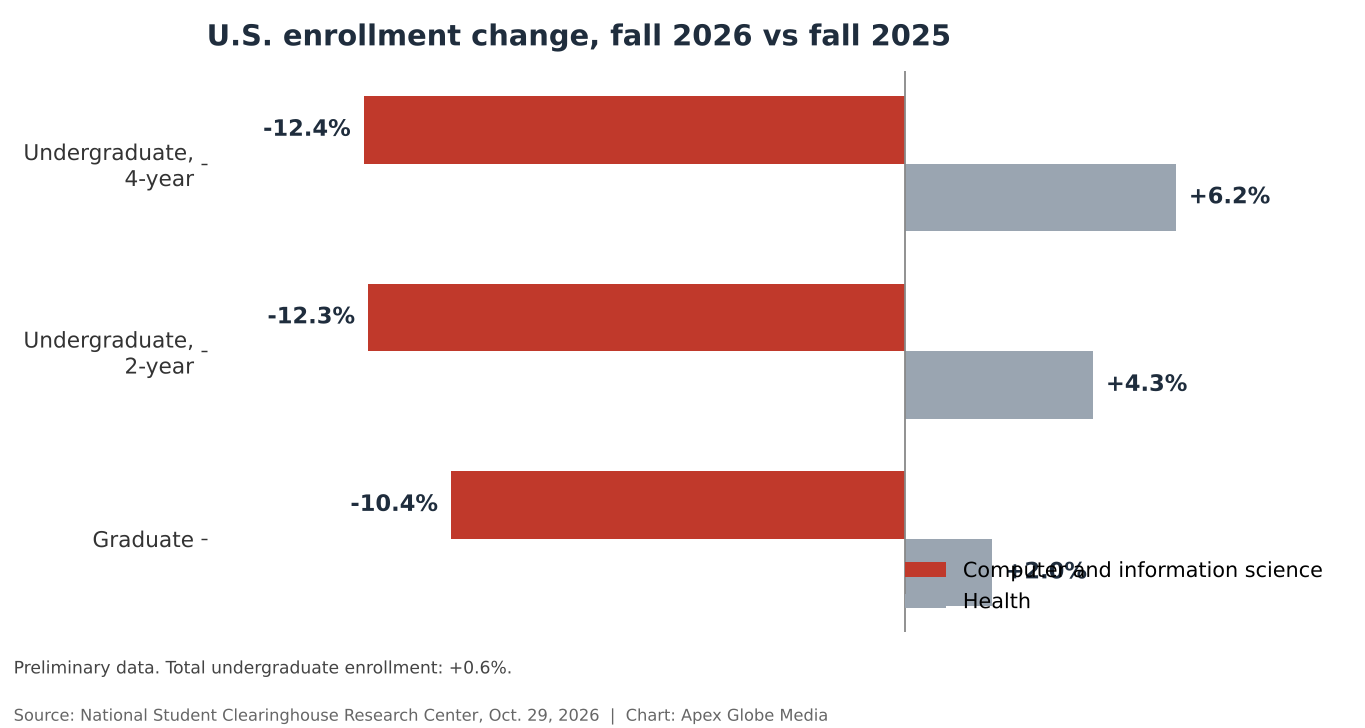
This is not a one-off. The Clearinghouse had already reported an 8.1% drop in undergraduate computer science enrollment at four-year colleges in fall 2025, from about 659,700 students to 606,100, TNW reported in July. A separate study by Stanford economist Jacob Light, based on more than 50 million course sections at 1,019 colleges since 1996, found that computer science class enrollment at the average school was falling for the first time in about 20 years.
Why students are walking away
The timing points to AI, but the evidence does not prove it. Light treats his findings as descriptive and lists several possible causes: a weaker job market for junior developers, doubts about the value of the degree, weaker maths preparation, demographic shifts linked to immigration, and the rise of data science as a separate major. Computer science has also gone through boom-and-bust cycles before, including after the dot-com crash.
The job market is the clearest factor. Recent graduates in computer science and computer engineering have had some of the highest unemployment rates of any major in the New York Federal Reserve’s tracking of young graduates, around 7% in recent data. At the same time, the people who hire engineers say the job itself is changing. Felix Rieseberg, who leads engineering for several Claude products at Anthropic, wrote on October 27 that he no longer uses coding interviews because Claude now beats candidates on the small programming tests his team used to set. “There’s no more point in giving you a little React challenge,” he wrote, arguing that “execution isn’t expensive anymore” and that junior engineers should stand out by building working prototypes that solve business problems.
For an 18-year-old choosing a major, that message cuts both ways. It suggests that writing code is becoming a less scarce skill, but also that people who understand software and can direct AI tools may become more productive, not less. We have reported on how quickly the tools are improving, from AI that operates a computer on its own to a model that built working exploits for major operating systems.
What it means for the AI industry
There is an irony here. The companies building AI are spending hundreds of billions of dollars on data centers and still compete fiercely for researchers and engineers, while the pipeline of students learning the fundamentals is shrinking. A decline in computer science graduates now will reach the job market in four years, at a time when demand for people who can build, secure and maintain AI systems may look very different from today’s hiring freeze for juniors.
Universities face a planning problem too. Many expanded computer science departments during the last decade’s boom, when bachelor’s degrees in the field roughly doubled to about 122,000 a year by 2024, according to National Science Foundation data cited by TNW. Some are now launching AI-specific majors, which may absorb part of the demand that used to go to traditional computer science and make the decline look steeper than the real shift in interest.
Our take
Students are responding rationally to what they see: a tougher entry-level market and employers saying publicly that AI can do the tests they used to pass. But a degree takes four years, and a choice made on today’s hiring headlines can be wrong by graduation day, as it was for those who left the field after the dot-com bust. The more useful question is not whether to study computer science, but whether programmes teach what AI cannot yet replace: system design, security, judgement about what to build. Colleges that adapt their courses quickly will matter more than the headline enrollment numbers.