



The FBI asked crypto services to stop the hackers behind the $6.3 billion Binance theft. One of the biggest, THORChain, kept the money moving anyway. The cross-chain swap network has become the main route for laundering the Binance hack loot, and its founders say they could not block it even if they wanted to.
According to Chainalysis data reported by The Wall Street Journal on November 8, THORChain processed more than $46 million of stolen Binance funds in the first 72 hours after the hack and earned over $200,000 in fees from the hackers’ trades. The FBI attributes the theft to TraderTraitor, a North Korean state hacking group. North Korea denies it.
What the FBI asked for
In an alert issued with the Secret Service and IRS Criminal Investigation, the FBI said the hackers were converting stolen assets “primarily into Ethereum”. It listed 608 Ethereum addresses, 19 Bitcoin addresses and one Solana address, and urged THORChain node operators, other node providers, instant exchanges and DeFi services to block transactions linked to them, The Block reported. The list held no Tron addresses, even though a large part of the early laundering happened on Tron.
THORChain’s US co-founder Chad Barraford said the project’s official website blocked the listed addresses. But he said he expected node operators to “resume trading as normal”. The website is only one way in: anyone can send transactions to the network directly. In an October podcast, Barraford said the protocol cannot screen individual wallets because “that code simply does not exist”. Co-founder John-Paul Thorbjornsen told the Journal he no longer plays an active role, that the network’s admin key has been removed and that it now runs on 111 independent nodes. “All blockchain protocols earn fees based on usage,” he wrote.
Investigators are not convinced. Nick Carlsen, a former FBI analyst now at TRM Labs, called THORChain “the biggest channel for North Korean money laundering”. It played the same role after the $1.5 billion Bybit theft in 2025, when North Korean hackers ran nearly $1 billion through it and THORChain operators earned at least $12 million in fees, according to Chainalysis.
A race across bridges
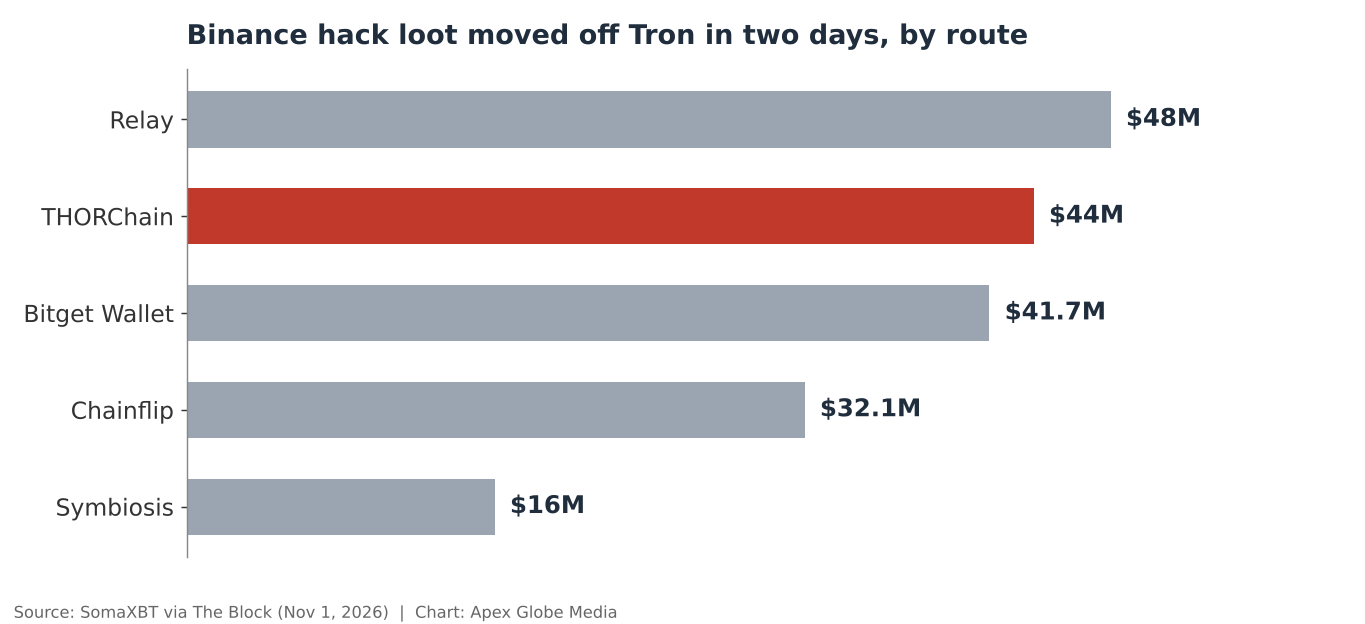
THORChain is not the only exit. On-chain analyst SomaXBT, cited by The Block, found that about $242 million of the loot left Tron within two days. Relay carried about $48 million, THORChain $44 million, Chainflip $32.1 million and Symbiosis $16 million, and another $41.7 million went through Bitget Wallet. Chainflip and Symbiosis both admitted that their screening had gaps against fast-moving transfers and said they were closing them. Chainalysis said the hackers spread the funds across more than 10,000 wallets within minutes of the theft, and nearly $4 million also passed through the Wasabi Wallet coin mixer.
Freezes have helped. Blockchain firm Elliptic counts $2.85 billion of the stolen assets as frozen or seized, about 44% of the $6.43 billion it considers stolen, mostly stablecoins that Tether and Circle can lock. About $3.25 billion sits in assets that no company can freeze, such as Ether and Bitcoin. That money can only be stopped at the points where it changes hands. We covered how the theft itself happened in our report on the $6.36 billion Binance hack.
Why it matters beyond crypto
North Korea’s crypto theft funds its weapons programs, according to US and UN officials, which turns a protocol design choice into a national security question. Lawyers point to the Tornado Cash case, where US prosecutors charged the developers of a mixing service, as a sign that “we can’t block it” may not protect node operators. Former federal prosecutor Scott Armstrong told the Journal that offering escape routes after hacks is “almost part of the business model” for some services. After the US midterms, a new Democratic majority in Congress has also signalled tougher oversight of the crypto industry.
Our take
THORChain’s defence is technically honest: a network with no central switch cannot easily say no. But a network that keeps earning fees from the same state hackers after two record thefts is making a choice, not just running code. Decentralisation was meant to protect users from censorship, not to give the world’s most active crypto thieves a toll road. Expect pressure to land on the people who run nodes and the front ends that route trades, because that is where the law can reach. For everyone else, the lesson from the Binance theft is simple: stolen stablecoins can often be frozen, stolen Ether and Bitcoin usually cannot.