

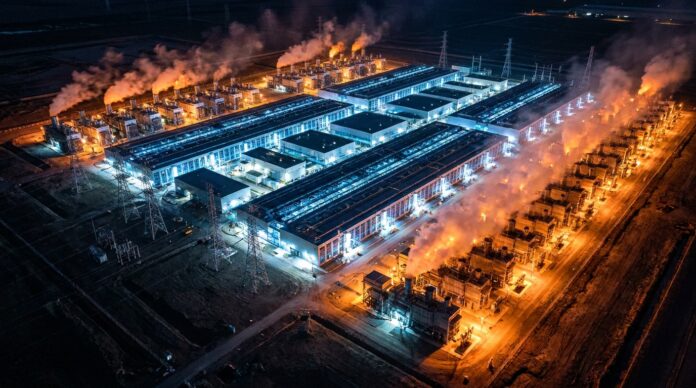

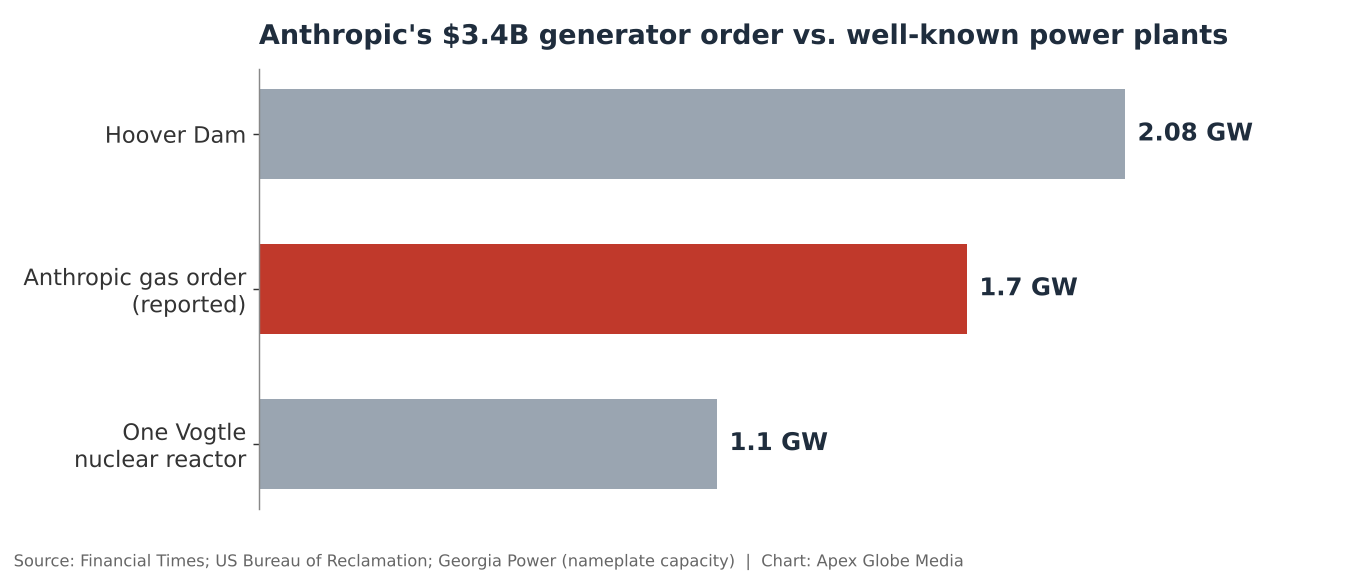
Anthropic has reportedly spent $3.4 billion on gas-fired generators to power its own data centers. According to the Financial Times, the deal covers 1.7 gigawatts of generating capacity, close to the output of the Hoover Dam. The FT calls it the biggest known single purchase of power equipment by an AI company. The Anthropic gas generators deal shows how far AI labs now go to get electricity the grid cannot deliver fast enough.
Neither Anthropic nor the supplier has confirmed the purchase. Neither company commented to the FT or answered follow-up questions from Bloomberg, and Reuters said it could not immediately verify the report, according to The Next Web.
A generator order bought second-hand
The seller is OnePWR Solutions, a power supplier in San Antonio, Texas. About two years ago it ordered large gas generators from Caterpillar, but it needed money to finish the purchase. Anthropic first planned simply to buy electricity from OnePWR. Instead, in late September, it took over the Caterpillar order itself, along with the engineering and construction work needed to install the units.
Anthropic did not buy OnePWR, and no OnePWR staff moved to the AI company, the FT reported. It is not known where the generators will run. A disclosure by the investment bank Piper Sandler lists a $3.4 billion sale of OnePWR’s power-generation platform to an unnamed AI lab, which matches the reported deal.
The price works out to about $2 million per megawatt. That is expensive for gas equipment, but what Anthropic is really paying for is time. Big gas turbines from the main makers are sold out for years, and new grid connections in many US states take even longer. Taking over a two-year-old order lets Anthropic jump the queue.
Why AI labs are building their own power
Anthropic is preparing for a stock market listing, and its amended IPO filing showed $895 billion in commitments, almost all for computing power and infrastructure. We looked at those numbers in our report on Anthropic’s revenue and compute promises. Chips are only part of the bill. Each new campus needs hundreds of megawatts, and utilities often cannot supply that for years.
So AI companies are going “behind the meter”, producing power on site instead of waiting for the grid. Elon Musk’s xAI ran gas turbines at its Memphis site and now faces a lawsuit over them. Other developers are turning old aircraft engines into power plants, as we reported in our story on jet engines powering AI data centers. Anthropic’s order is the largest such move by a model maker so far.
The political risk
The timing is awkward. In the US midterm elections, voters in several places backed candidates who promised to slow or stop data center construction, as we covered in our midterms report. Gas generators add a new target: local air pollution and carbon emissions. Anthropic has presented itself as a safety-focused company, and its backers spent heavily in the midterms on AI-safety candidates. Running large fossil-fuel plants for its own servers may be harder to explain to the same voters and regulators.
There is also a financial question. Gas generators can be moved, resold or later replaced by grid power, which makes them less risky than a fixed power plant. But $3.4 billion is a large bet on future demand, at a time when investors are asking whether Anthropic’s IPO can hold a valuation above $1 trillion, as we noted in our story on Anthropic and OpenAI’s valuations.
Our take
The race for AI is turning into a race for power plants. Anthropic did not want to be an energy company, but when the grid cannot keep up, the lab with its own electricity trains first. The deal is logical and the price shows how scarce power has become. It also makes AI’s environmental cost much harder to hide. A company that asks the public to trust it on AI safety will now have to answer questions about gas burned next to its servers. Expect more labs to follow, and expect local opposition to follow them too. The key detail to watch is where these generators end up, because that will decide which community carries the cost.