

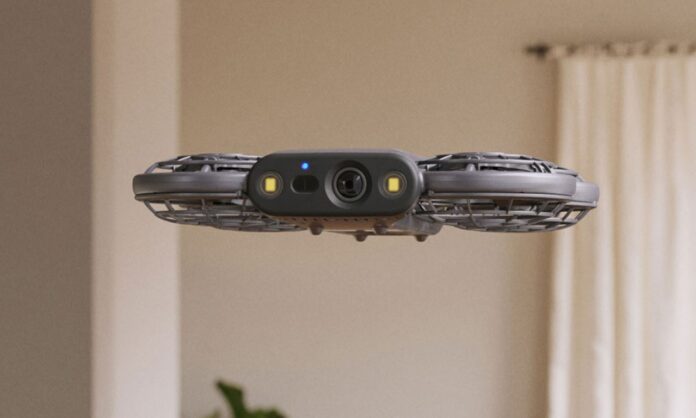

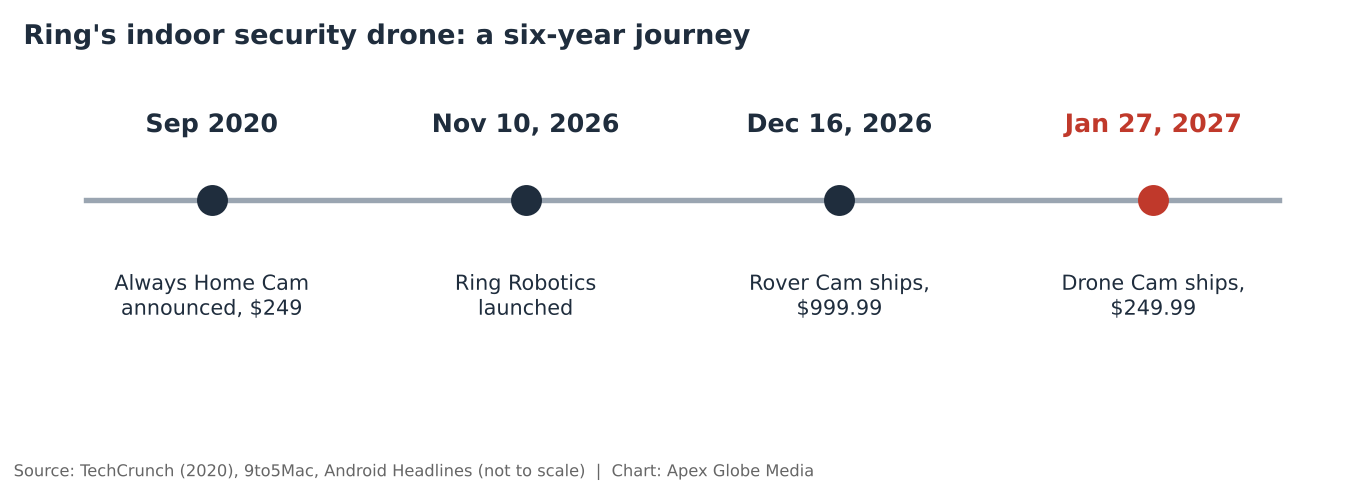
Amazon’s Ring is finally sending a flying camera into people’s homes. On November 10 the company launched Ring Robotics, a new line of autonomous security devices, with two first products: the $249.99 Ring Drone Cam, a small indoor drone that flies to wherever an alarm goes off, and the $999.99 Ring Rover Cam, a wheeled patrol robot aimed at businesses. The Rover ships on December 16 and the drone on January 27, 2027, in the US, according to 9to5Mac.
Ring first showed an indoor security drone, the Always Home Cam, at the same $249 price back in September 2020, when it said the device would ship in 2021, as TechCrunch reported at the time. It never reached a wide release. Six years later, the idea is back with a new name and new software.
How the robots work
Both devices run on what Amazon calls AI Pilot, which combines the robots’ cameras, on-device sensors, vision models and processing in Amazon’s cloud. During setup, the owner carries the drone through the home, or lets the Rover explore on its own. The system draws a floor plan, labels rooms and suggests patrol points such as doors, windows and long hallways. Owners can add their own points.
Patrols can run on a schedule or on demand. More important, both robots move automatically to the right spot when another Ring camera, sensor or alarm is triggered, so the owner sees live video of the room where something happened instead of a fixed camera angle. The Rover can also start recording when it detects a person, even while it sits on its charging dock.
There are catches. The drone needs an internet connection to navigate, because much of AI Pilot runs in the cloud, and it did not yet have authorization from the US Federal Communications Commission at launch, reviewers noted. Some features also require a paid Ring Protect subscription, so the hardware price is not the full cost. The Rover is built on technology from Amazon’s Astro home robot, according to reports.
The privacy question
A camera that can fly into any room raises obvious concerns. Ring has a difficult record on privacy. In 2023 it agreed to pay $5.8 million to settle US Federal Trade Commission charges that employees and contractors had been able to access customers’ private videos. It has also faced criticism for years over its cooperation with police. A device that maps the inside of a home and sends video and navigation data to the cloud will put those questions back in the spotlight.
Ring’s design choices answer part of that. The drone is meant to stay docked until it is sent on a patrol or triggered by an alarm, rather than flying around freely. But the floor plan of a home, which rooms exist and where doors and windows are, is itself sensitive data, and Amazon has not yet published detailed rules on how long it keeps it.
Robots move into the home
Ring’s launch is part of a wider shift of AI from screens into physical machines. We have covered Alphabet’s plans to build delivery drones at scale in our story on Wing’s Texas drone factory, and the rush of new humanoid robot companies in our report on the humanoid robot industry. Ring’s bet is smaller and more practical: a robot that does one job, checking on the home, and costs less than a smartphone.
Our take
The Drone Cam is the kind of gadget that sounds silly until an alarm goes off at 3 a.m. and you want to see the kitchen right now. Fixed cameras leave blind spots; a camera that flies to the problem fills them for $250. That is a real use case, and Ring has waited years to get the software right. The open questions are trust and noise. People will have to accept a cloud-connected flying camera inside their home from a company with a mixed privacy record, and a buzzing drone in the living room is a lot harder to ignore than a camera on a shelf. Early reviews in January will show whether Ring has solved those problems or simply relaunched an old idea.