

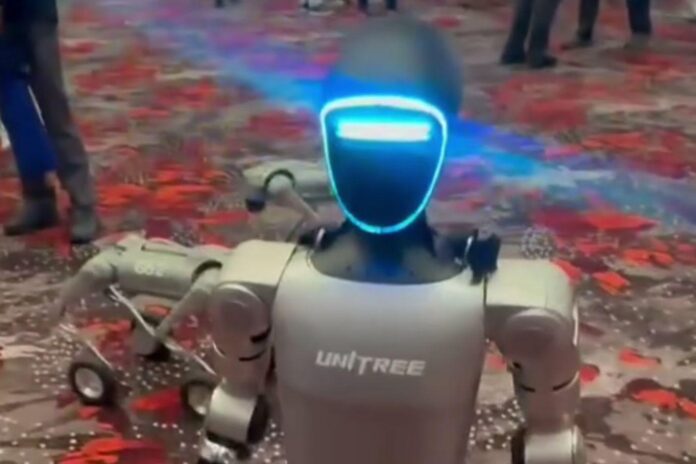

The humanoid robot industry passed a milestone on August 19, when shares of China’s Unitree Robotics surged more than 620% on their first day of trading in Shanghai. The jump lifted the Hangzhou-based company’s market value to as much as 445 billion yuan ($66 billion), Al Jazeera reported. It was the first listing of a humanoid robot maker on mainland China’s stock market.
Unitree had priced its initial public offering at 150.8 yuan per share, valuing the company at about 61 billion yuan ($9 billion). The shares opened at 1,100 yuan, the day’s high, and were trading around 900 yuan in early deals on the tech-focused STAR Market.
Who Unitree is
Unitree was founded in 2016 by engineer Wang Xingxing. It first became known for four-legged robots, often called robot dogs, and later for humanoid robots whose videos of dancing, boxing and martial arts routines spread widely online. Last year the company said it shipped more than 5,500 humanoid robots to customers worldwide.
The company raised about $900 million in the IPO by selling roughly 10% of its shares, according to Reuters. Wang still owns about a fifth of the company, and the debut lifted his personal wealth to more than $12 billion on paper. Unitree is backed by some of China’s most influential tech companies, including Tencent, Alibaba and DeepSeek.
Unlike most of its rivals, Unitree is profitable. “It is one of the few companies in humanoid robotics with genuine revenue, profitability and meaningful production volume,” said Rinat Mirzaitov, founder of Humanoid Analytics.
A market still in its early stage
The excitement should not hide how young the market is. Reuters noted that few of Unitree’s robots are used in commercial applications. Many go to research, education and development work, where Mirzaitov says the company is strong, but it does not dominate the whole humanoid market. “Its main challenge is turning hardware and manufacturing leadership into application and workflow leadership,” he said.
In other words, building a robot that can move like a person is one problem. Making it do a useful job in a factory, warehouse or home, reliably and at a reasonable cost, is a harder one. That is where the long-term money is.
Forecasts are large. Worldwide sales of humanoid robots could reach $300 billion by 2035, up from $2 billion in 2025, according to analyses cited by JP Morgan. China already controls about three-quarters of the global market for humanoid robots and autonomous vehicles, the bank estimates.
Politics and valuation
Part of the demand for Unitree’s shares comes from its perceived state support. China is pushing the robotics sector as part of its technology competition with the United States, and as a way to make up for labour shortages caused by its ageing population. Wang had a front-row seat at a summit with tech business leaders hosted by President Xi Jinping early last year.
“Its price is dictated by political and economic considerations, rather than valuation models,” said Yan Kai, a partner at Ivy Capital in Shanghai.
The listing also came during rising US-China tension over robots. Last month, the US government moved to block imports of new foreign-made robots on national security grounds. Unitree’s main competitors include China’s AgiBot and the US companies Tesla and Boston Dynamics.
The timing of the debut was symbolic. It coincided with the opening of the World Robot Conference in Beijing, where hundreds of mostly Chinese companies were showing new products. Unitree had unveiled its latest humanoid, called Superman, two days earlier, marketing it as able to jump two metres high.
Why it matters for businesses
For companies considering automation, Unitree’s success is a sign that humanoid robots are becoming cheaper and more widely available, especially from Chinese makers. But most current deployments are still pilots and research projects. Businesses should test humanoids on specific tasks before planning large investments, and should watch trade rules, since restrictions on Chinese robots could limit which models they can buy. AI is moving into physical devices of all kinds, a shift we also described in our look at how AI will change smartphones.
Our take
Unitree’s debut shows that investors are willing to pay a very high price for a credible humanoid robot company, and Unitree is more credible than most: it has real sales and profits. But a valuation that rose about sevenfold in a day reflects national strategy and scarcity of listed robot makers as much as business results. The real test will come over the next few years, when buyers decide whether humanoids can do enough useful work to justify their cost.