

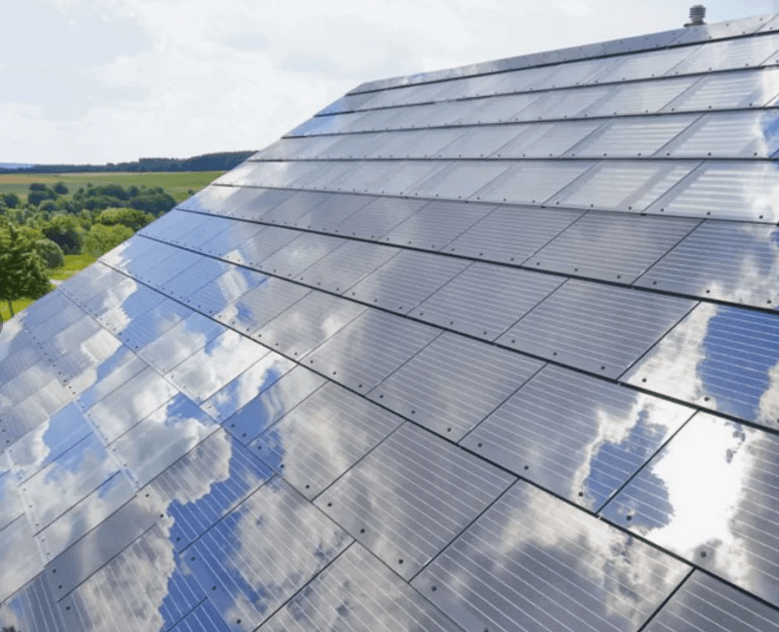

Tesla appears to have stopped selling its Solar Roof tiles, almost ten years after Elon Musk first showed them off. On August 20, American Home Contractors, a Tesla-certified Solar Roof installer, posted on X that Tesla was discontinuing the product and shifting its attention to its new in-house solar panels, Drive Tesla Canada reported. The post was later deleted.
Tesla has not formally announced the decision. But it has removed Solar Roof from the Energy menu on its website, and the product page now redirects to its solar panels page.
What Solar Roof was
Solar Roof is a form of building-integrated photovoltaics, or BIPV: instead of mounting solar panels on top of an existing roof, the roof itself generates electricity. Tesla’s version mixed glass tiles containing solar cells with similar-looking tiles that did not generate power, so the whole roof looked uniform.
Musk unveiled the product in October 2016, around the time Tesla acquired the solar installer SolarCity. Production began at Tesla’s factory in Buffalo, New York, in late 2017. Over the years Tesla changed the design and eventually offered 72-watt solar glass tiles alongside steel roofing tiles, backed by a 25-year warranty.
Why it never scaled
The product looked impressive, but it was hard to sell and hard to install. Unlike ordinary panels, a Solar Roof required replacing the entire roof, which made projects more complicated and much more expensive. Each house has a different roof shape and pitch, so installations were slow and labour-intensive.
The numbers show the gap between ambition and reality. Musk had talked of reaching 1,000 installations a week, but the research firm Wood Mackenzie found that Tesla installed only about 3,000 Solar Roofs before 2023, BGR reported. Tesla has not published Solar Roof sales or installation figures since 2024 and had stopped advertising the product. According to the electric vehicle site Electrek, Tesla concluded the programme was not making enough money.
Customers also had problems. In the early years Tesla raised prices for some buyers after they had signed contracts, which led to class-action lawsuits. Tesla paid about $6 million to settle them, BGR noted.
The shift to panels
The apparent decision comes as Tesla ramps up a new generation of conventional solar panels unveiled earlier this year. Engineered in California and assembled at Giga New York in Buffalo, the 420-watt panels use Tesla’s cascading cell technology, have an all-black appearance and a low-profile mounting system. They are designed to work with Powerwall, Tesla’s home battery.
This is a simpler business. Panels can be installed on most existing roofs in a day or two, by a much larger pool of installers, and they cost far less than a new roof. Tesla keeps its focus on appearance through the black design, without the cost of replacing whole roofs. Batteries are also where much of the innovation in home energy is happening, from Powerwall to research such as the quantum battery prototype.
What it means for owners
For the roughly 3,000 households with a Tesla Solar Roof, the main question is long-term support. The product carries a 25-year warranty, and Tesla has not said it will stop honouring it. But repairs to an integrated roof are more complicated than replacing a panel, and owners will want to know that spare tiles will remain available for decades.
Other companies, such as GAF Energy and SunStyle, still sell solar roofs. Tesla’s exit may make buyers more cautious about the whole category, at least for now.
Why it matters for businesses
For installers and building companies, the Solar Roof story is a lesson about depending on a single supplier’s proprietary product. Certified installers invested in training and equipment for a product that can now disappear with a website redirect. For homeowners and property developers, the takeaway is practical: standard panels are cheaper, faster to install and easier to service, and the gap in appearance has narrowed.
Our take
Solar Roof was a good idea that did not survive contact with real roofs. Turning a roof into a power plant is attractive, but every roof is different, and roofing is a local, labour-heavy trade that does not scale like a factory product. Tesla’s quiet exit, without a public statement, is the weakest part of the story: owners and installers deserve a clear commitment on long-term support. The broader lesson is that in home energy, simple and cheap usually beats elegant and complex.