


Google has released its third new AI model in six weeks, and this one is aimed at the part of the market where most of the money is: everyday work. Gemini 4 Hydrogen, announced on Thursday by Google DeepMind’s Koray Kavukcuoglu, is a faster and cheaper sibling of the flagship Gemini 4 Carbon and Gemini 4 Argon models. It is rolling out worldwide in the Gemini app, Google Search, the Gemini API and Google’s coding tool Antigravity, at $1.50 per million input tokens and $7.50 per million output tokens.
The pitch is simple: near top-tier intelligence for a fraction of the cost. An independent test by Artificial Analysis, published a few hours after the launch, mostly backs that up, with some important caveats.
What Hydrogen is
Google describes Hydrogen as the model for “everyday coding and agentic workflows,” meaning tasks where the AI acts on its own: running code, using tools, filling in spreadsheets. Carbon and Argon remain the models for long, deep reasoning. Google calls it a major upgrade over Gemini 3.8 Flash. On the Terminal-Bench coding test, Google reports a score of 57% for Hydrogen against 18.2% for 3.8 Flash, and says Hydrogen finishes tasks 2.5 times faster.
The model reads up to 1 million tokens at once, roughly 1,500 pages of text, and accepts text, images, video and speech. Price does not change across that window, which matters for anyone feeding it long documents. Cached input, text the model has already seen, gets a 95% discount, according to Artificial Analysis.
Hydrogen also brings a new setting. Gemini models used to have three “thinking levels” (low, medium and high). Hydrogen adds a fourth, xhigh, which lets the model spend more time reasoning before it answers.
How it stacks up
On the Artificial Analysis Intelligence Index, which combines many tests into one score, Gemini 4 Hydrogen at xhigh scores 54. That puts it 1 point behind Anthropic’s Claude Sonnet 5.5 and OpenAI’s GPT-6.1 Sol, both at their maximum settings, and 4 points ahead of Google’s own Gemini 4 Argon. At the default high setting it scores 51, the same level as Argon, for about 19% of Argon’s cost per task.
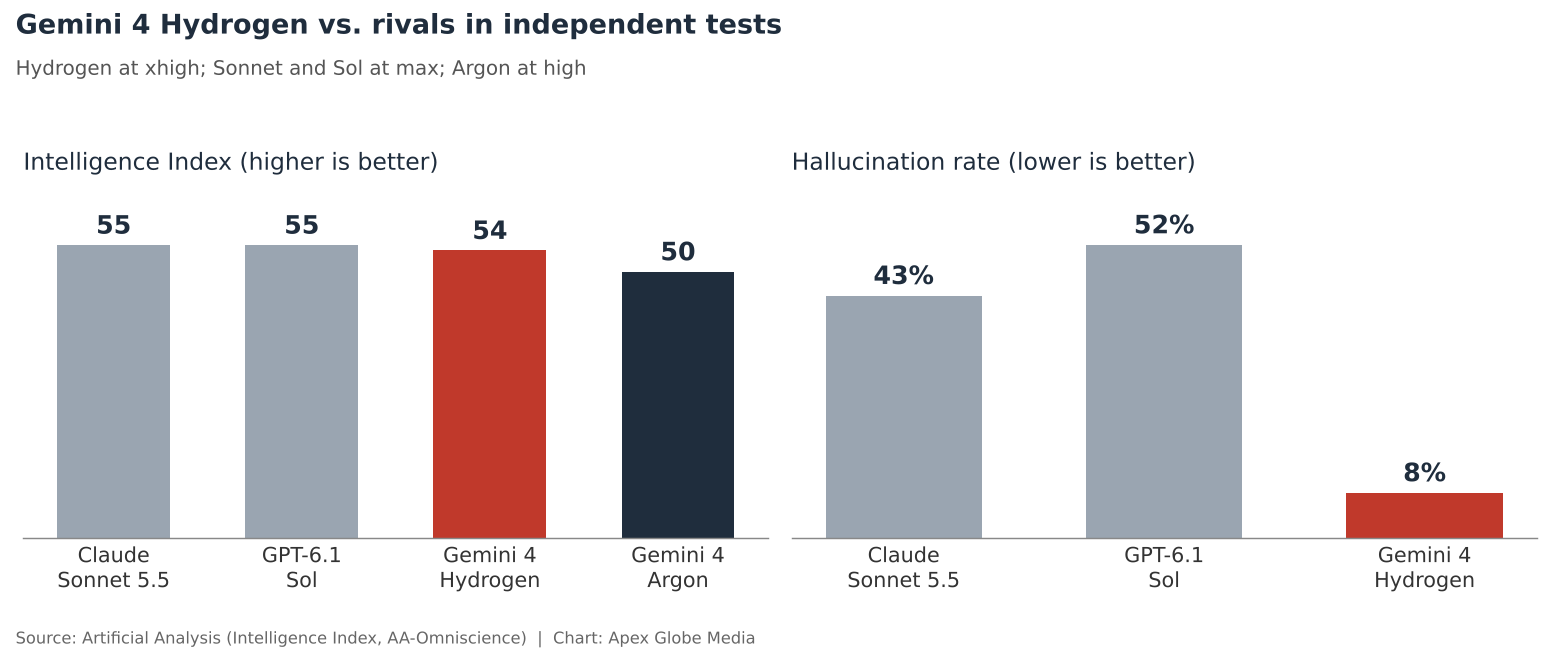
Cost is where the comparison gets interesting. Artificial Analysis found Hydrogen at xhigh costs about 32% as much per task as Claude Sonnet 5.5, for nearly the same intelligence. But it costs about 2.5 times as much as GPT-6.1 Sol. So Hydrogen is a bargain next to Anthropic and expensive next to OpenAI. The xhigh setting is also hungry: it nearly doubles the number of words the model generates for a 3-point gain, and raises the average cost per task from $1.87 to $3.16.
The standout number is about accuracy. On AA-Omniscience, a test that checks whether a model makes things up when it does not know the answer, Hydrogen had a hallucination rate of 8%. Claude Sonnet 5.5 scored 43% and GPT-6.1 Sol 52%. Google separately claims Hydrogen cuts fabricated claims by more than five times compared with 3.8 Flash.
Where it falls short
The weak spot is agentic work in a terminal, the command-line coding that tools like Claude Code and Codex do. Artificial Analysis measured 54% on Terminal-Bench 4.0, against 64% for Claude Sonnet 5.5 and 56% for GPT-6.1 Sol. Turning on xhigh did not help there at all: the score was 54% at both settings. On a newer science version of the test, xhigh did lift Hydrogen from 41% to 50%.
Google’s own 57% figure comes from Terminal-Bench 4.1, a different version, so the two numbers are not directly comparable. Google’s post also lists strong results on tax, legal research and multimodal agent benchmarks, which have not yet been checked independently.
Why Google is moving so fast
Hydrogen follows Gemini 4 Carbon, which we covered on October 30, and Argon in quick succession. The pace reflects a price war at the top of the AI market. Anthropic is heading into its IPO, OpenAI is chasing the same business customers, and Google is using Search, Sheets and Android to put its models in front of billions of users at once. Free Gemini app users will get Hydrogen automatically when the app decides a prompt suits it.
For developers the choice now depends on the job. If you need the cheapest model that is close to the frontier, GPT-6.1 Sol still wins on price. If you need answers you can trust on facts, Hydrogen’s low hallucination rate is a strong argument.
Our take
Hydrogen is a smart product, not a breakthrough. Google did not try to beat Claude or GPT at their best. It built a model that is almost as good, much less likely to invent facts, and plugged straight into tools people already use every day. That last part matters more than a single benchmark point. The gap between Google’s Terminal-Bench claim and the independent result is a reminder to wait for outside tests before trusting launch-day numbers.