


Three days after Jensen Huang resigned as Nvidia’s chief executive, a public campaign to reinstate Jensen Huang has become one of the largest shows of support for an ousted CEO in recent memory. An online open letter called “Stand with Jensen” had collected more than 115,000 signatures by Saturday afternoon, TechCrunch reported, and Tom’s Hardware put the count above 130,000 on Sunday. Elon Musk is among the signers. At the same time, two well-known Nvidia investors have asked the board not to rush into naming a permanent replacement.
The pressure is real, but it runs into a hard fact about how Nvidia is governed. Huang never held the kind of special voting shares that protect founders at companies like Meta or Google, and an online petition has no legal force at all. The decision sits with the same board that accepted his resignation on Thursday.
What the petition says and who signed it
The letter, published at standwithjensen.com, says its signers are “concerned that Jensen was removed without meaningful due process.” It asks the board to “bring him back while an independent investigation establishes the facts,” to make sure that investigation is fair, and to tell the public more. “Jensen deserves due process, not mob justice,” it says. Another passage, quoted by Tom’s Hardware, reads: “Suspicion or association alone is not a sufficient basis for ending Jensen’s leadership. The inquiry must establish the facts, not merely justify an outcome already imposed.”
According to figures on the petition site, cited by TechCrunch, the signers include 5,965 people who say they are current Nvidia employees, 1,108 former employees and 63,063 shareholders. Besides Musk, the publicly named supporters include Epic Games CEO Tim Sweeney, Replit CEO Amjad Masad and Y Combinator CEO Garry Tan. None of these numbers can be checked independently: anyone can type in a name and claim to work at Nvidia. The petition is also not an Nvidia initiative.
Not everyone inside the company is on board. Bryan Catanzaro, Nvidia’s vice president for applied deep learning research, wrote on X that a separate letter circulating online had used his name without permission. “There is a made-up letter circulating online asking NVIDIA’s board to reinstate Jensen, claiming my involvement. This letter is obviously fake, and even if it were real I would not sign it,” he wrote. “I am grief-stricken that Jensen is no longer with NVIDIA. At the same time, I fully support NVIDIA’s board and have confidence in their decisions.” He also backed interim CEO Colette Kress, calling her “an extraordinary leader.”
The investors’ letter is more careful
The more important document for the board may be a short letter from Brad Gerstner of Altimeter Capital and Gavin Baker of Atreides Management, which Gerstner posted on X on Saturday. According to CNBC, the two firms held more than 10 million Nvidia shares, worth about $2.13 billion, as of June 30.
Their letter does not demand Huang’s return. It asks the directors “to pursue a slow, measured, and deliberate process regarding the future of Nvidia that leaves all options on the table, including the potential return of Jensen Huang.” The two investors added that “the Founder and longtime incredible leader of this extraordinary company has earned the right for a deliberate process that avoids any needless rush to replace him before all the facts are known,” as The Motley Fool quoted it. They also said Kress is leading the company capably in the meantime.
That wording matters. A $2 billion position is large in absolute terms but small next to Nvidia’s market value of nearly $4 trillion. What Gerstner and Baker can realistically ask for is time, and time is exactly what the board may not want to give. Nvidia has said it is “in the process of selecting a search firm” and has “not formally engaged any potential candidates.” The Financial Times has reported that the board approached Arm CEO Rene Haas, who worked at Nvidia earlier in his career, and Tom’s Hardware says Apple hardware chief Johny Srouji has also been discussed.
Why a founder can lose his own company
Huang co-founded Nvidia in 1993 and ran it for more than three decades, but he owns only a few percent of its shares. As Forbes pointed out this week, he never had super-voting shares, the class of stock that lets founders like Mark Zuckerberg outvote every other shareholder. At Nvidia, one share means one vote, and the board answers to all of them. That is why directors could reportedly decide his fate in a single evening meeting, and why fans cannot vote him back in.
There is a path, but it is slow. Shareholders who want Huang back could try to replace the directors at the next annual meeting or through a proxy fight. That would take months and require support from the giant index funds that own a large share of Nvidia. Those funds have not said anything publicly, and they rarely back a CEO who is under several investigations.
And the investigations are the main obstacle. Huang has agreed to testify before Congress. The board’s own independent probe is still running. Reuters has reported that he misled several senior Nvidia leaders, including general counsel Tim Teter, about the nature of his relationship with Alice Huang, the Megaspeed executive US intelligence suspects of working for China, whom we covered in our report on Singapore’s eight-month investigation. At the same time, The Motley Fool notes that the US government has not formally determined that she is a spy. Until those questions are answered, any director who votes to bring Huang back would be taking a personal legal and political risk.
The stock, and Tuesday’s test
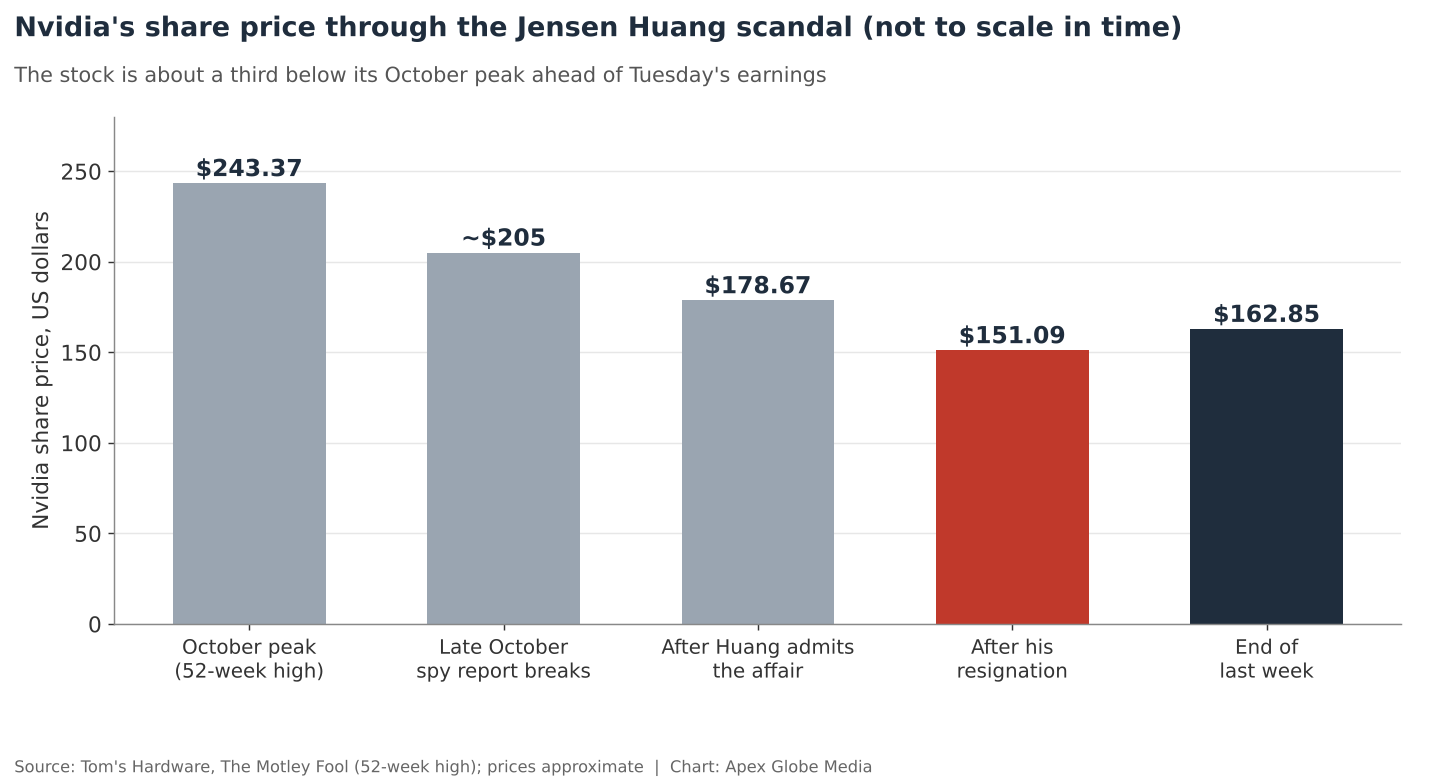
Investors have already voted with their money. Nvidia traded around $205 when the first spy report appeared in late October, fell to $178.67 after Huang admitted the affair and dropped to $151.09 after his resignation last Thursday, Tom’s Hardware calculated. It ended last week near $163, roughly a third below its October high.
The next real signal comes on Tuesday, November 17, when Nvidia reports third-quarter results with Kress presenting as interim CEO for the first time. If the numbers are strong and her guidance is confident, the argument that the company cannot work without its founder gets weaker. If customers or lenders show signs of hesitation, the “bring him back” camp will get louder. The New York Times has already reported that Nvidia’s $500 billion lending consortium is in flux after his exit.
Our take
The petition shows how much goodwill Huang built over 30 years, but goodwill is not a governance tool. The investors’ letter is the smarter move: it does not ask the board to ignore the investigations, only to avoid closing the door before they finish. We think a return in the next few months is very unlikely. Huang would need to be cleared on the national security questions first, and those inquiries, in Congress and inside the company, will take longer than any CEO search. The most useful thing Nvidia’s board can do now is publish what its own investigation finds, because “due process” is exactly what both the petitioners and the board’s critics are asking for.