

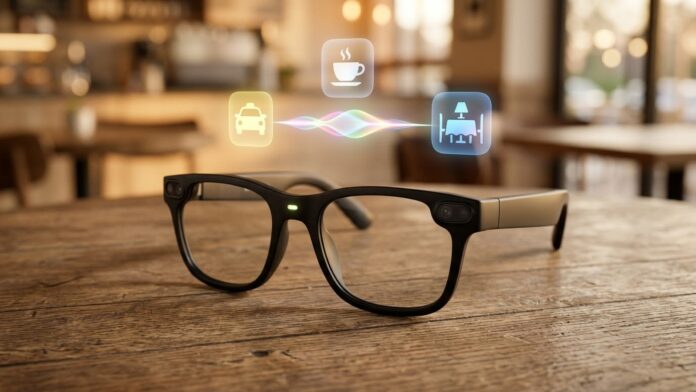

Apple has picked a date to show its answer to Meta’s Ray-Ban glasses, and a plan for how to beat it. According to Bloomberg’s Mark Gurman, Apple smart glasses will be unveiled at the company’s developer conference, WWDC, in June 2027 and should start shipping before the end of that year, Inquisitr reported on Sunday, citing his newsletter. The main selling point will not be the hardware. It will be Siri controlling the apps already installed on your iPhone, so you could book an Uber, reserve a table or order a coffee without taking the phone out of your pocket.
Apple has not confirmed the product, its name or its price. Everything below comes from Gurman’s reporting and the coverage of it, and Gurman himself warns that both dates could slip because the software is behind schedule.
Glasses without a screen
The first model will not be a small Vision Pro. It will have no display and no augmented reality graphics in front of your eyes. Instead, it follows the same formula as Meta’s Ray-Ban glasses and the Android XR glasses that Google and Samsung put on pre-order last week: cameras, microphones and speakers in an ordinary-looking frame, with an AI assistant as the main way to use them. Apple employees reportedly describe the idea as “AirPods for your face,” and the company is said to be paying special attention to sound quality for calls, music and FaceTime audio.
Prototypes carry the code name N50. According to the reports, they are slightly thinner than Meta’s second-generation Ray-Bans, run a stripped-down version of visionOS, and use a processor based on older Apple Watch chips. Test units have oval camera openings set flush into the frame and a small light on the front that shows when the glasses are in use or charging. Testers charge them through a flat three-pin magnetic connector “roughly the size of a Tic Tac” near the left arm, though it is not clear that this will reach the final product.
The cameras are mainly there to give Siri eyes, not to replace your phone’s camera. Apple’s Visual Intelligence feature would identify buildings, suggest meals based on what is in your fridge, translate signs and conversations, and help with directions. Gurman reports that much of the hardware is “largely finalized, but the software is running behind,” as quoted by iClarified.
The plan: your iPhone apps, controlled by voice
Here Apple wants to do something its rivals cannot easily copy. Third-party apps will not run on the glasses at all. They stay on a paired iPhone, and Siri reaches into them and runs specific actions on the user’s behalf. Developers do not need to build a separate glasses app. They only need to expose actions and content from their existing iPhone app through App Intents, the system Apple already uses to connect apps to Siri and Shortcuts.
Examples being discussed inside Apple include reserving a table through OpenTable, ordering a ride from Uber or Lyft, ordering at Starbucks, shopping on Amazon and buying movie tickets on Fandango, tbreak reported. Each one only works if the app’s developer adds support. Apple’s own apps would cover calls, messages, notifications, calendar, reminders, music, maps and smart home control.
The groundwork is already in public. The first beta of iOS 27.3 gives developers a way to test the more advanced Siri actions, The Apple Post noted. Apple’s own apps are due to get the expanded Siri controls in December, and the App Store should start accepting third-party apps that use them in spring 2027. That timeline would give developers a few months to get ready before the glasses are shown in June.
The catch: iPhone only, and Siri has slipped before
The glasses would need a recent iPhone and would not work with Android phones. Wi-Fi would let some functions keep working when the phone is out of range, but the glasses “will not function as a fully independent device,” according to the reporting. That is very much the Apple Watch approach of 2015, and it limits the market to people who already own a fairly new iPhone.
The bigger risk is Siri itself. Apple’s promised overhaul of its assistant has already been delayed more than once, and the whole product depends on Siri understanding a request and carrying it out correctly inside someone else’s app. Gurman ties the possible delays directly to that software work. If Siri is not ready, the glasses have little to offer beyond music, calls and photos, which Meta already does well.
Why Apple is going after Meta now
Meta, which sells its glasses through Ray-Ban owner EssilorLuxottica, is the clear leader in this small but fast-growing category, and it has spent the year adding new models. Google’s glasses with Samsung went on pre-order on November 12 at $395 and up, and they lean just as heavily on an assistant, in Google’s case Gemini. Meta has also had to answer criticism about cameras on people’s faces, as we wrote when it introduced camera-free smart glasses.
Apple’s argument is its App Store. Millions of developers already build for the iPhone, and if even the most popular services add Siri actions, Apple’s glasses could launch with more useful things to do than any rival. Google is trying a similar trick with its own Android developer base, so the next year will largely be a race to sign up app makers. Apple is also reportedly linking the glasses, a version of AirPods with cameras planned for late 2027, and its new HomeView smart display through the same Siri system.
Our take
The strategy makes sense. Glasses that are basically headphones with a camera are easy to copy, but a voice assistant that can safely use hundreds of popular apps is not, and Apple has the app ecosystem to try it. The problem is that this is exactly the part Apple has struggled with for years. Ordering a coffee by voice sounds simple until Siri picks the wrong store or the wrong card. We would watch the iOS 27.3 betas and the spring App Store rollout more closely than any hardware leak. If developers and Siri are not ready by June, a WWDC reveal could easily become a 2028 product.