

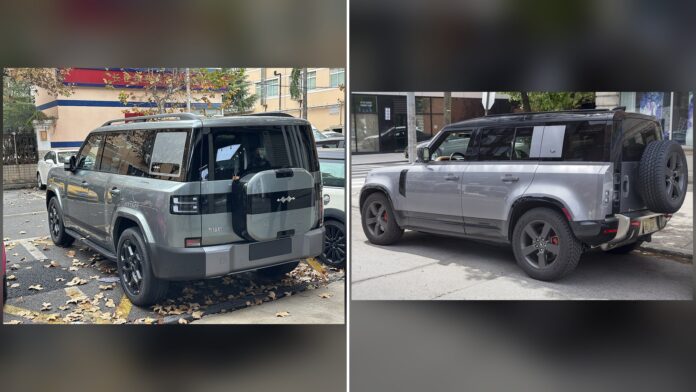

A court in the Netherlands has blocked China’s biggest carmaker from selling one of its new SUVs anywhere in the European Union because it looks too much like a Land Rover Defender. In a ruling on Friday, November 20, the preliminary relief judge at the District Court of The Hague found that the BYD Ti7 infringes Jaguar Land Rover’s registered EU design for the Defender, according to Reuters reporting carried by Business Standard. “The characteristic and distinctive elements of the design are reflected in the BYD Ti7,” the court said. The injunction also stops BYD from building the car at its new factory in Hungary. BYD says it “strongly disagrees” and will appeal.
Copycat accusations against Chinese cars are old. A European court ban that lands before the car has even gone on sale is not, and it shows a new tool that established carmakers can use as Chinese brands push into their home market.
What the court actually ordered
This was a summary proceeding, the fast-track procedure for urgent cases, so it is a provisional decision and not a final judgment on the merits. Even so, its reach is wide. According to autoevolution, the order covers imports, sales and advertising of the Ti7 in all 27 EU member states. Until the dispute is resolved, BYD also may not produce the car at its plant in Szeged, Hungary, which is due to begin mass production in early 2027.
The ban takes effect one week after the ruling. The court gave that delay because BYD “currently has no concrete plans to place the Ti7 on the market in the EU.” In other words, the injunction is meant to stop the car before it arrives, not to pull it off dealer forecourts.
The judge listed the design features that carried over. According to Torque Cafe, the court pointed to the Ti7’s panel on the C-pillar behind the rear doors, its rounded shoulders and corners, the wheel arches, the continuous band of glass along the side and the overall silhouette. Put the two cars side by side, as on the cover of this article, and the boxy, flat-roofed shape and the solid body-coloured panel behind the rear passenger door are the first things you notice.
The UK is outside the ruling
The case started in Britain, not in the EU. JLR, which is owned by India’s Tata Motors, went to court earlier this year after BYD listed the seven-seat Ti7 for order on its UK website, with deliveries planned from January 2027. The British price starts at £47,995, autoevolution reported, about £20,000 less than a Defender.
The Dutch judge ruled that the court has no jurisdiction over BYD’s UK affiliate, so British deliveries are not affected by this decision. Autoevolution reports that JLR is expected to file a separate design case in the UK before those deliveries begin. A second Dutch case, filed by JLR in Rotterdam and alleging copyright infringement and “slavish imitation,” continues on its own track.
A raid, an order to destroy evidence, then a win
The fight has been unusually aggressive for the car industry. In August, bailiffs appointed by JLR raided BYD’s Dutch offices in Schiedam and Hoofddorp and seized digital records, on suspicion that the Ti7 had been copied from the Defender, Torque Cafe reported, citing The Times. That part did not go well for JLR. On November 12 the same Hague court ordered it to destroy or return the seized material within 24 hours, with a penalty of €50,000 per hour for non-compliance, capped at €500,000. Dutch reports said the documents did not prove the copying claims.
Eight days later JLR won on a different basis: not on what BYD’s files showed, but on how the finished car looks against JLR’s registered design. That is the key point. A registered design protects the appearance of a product, and the holder does not need to prove that anyone copied it, only that the other product gives the same overall impression.
“We protect our intellectual property and take legal action when necessary,” JLR said. “Legal proceedings are ongoing, and we won’t be commenting further at this time.” BYD answered: “The BYD Ti 7 is the result of BYD’s own independent design work and infringes none of JLR’s rights. We will pursue every legal avenue to demonstrate that this decision is incorrect.”
Why this matters beyond one SUV
Western carmakers have complained about Chinese copies for twenty years, but they have rarely won. In 2005 General Motors settled with Chery over the Chery QQ, which GM said copied its Chevrolet Spark. JLR itself fought for years in China over the Landwind X7, a near-copy of the Range Rover Evoque sold at about a third of the price, before a Chinese court ruled in its favour in 2019. Closer to home, JLR failed to stop INEOS from building the Grenadier, a spiritual successor to the old Defender, in the UK. As Reuters noted, it is rare in Europe for major carmakers to go to court over design rights at all, and rarer still for a ruling to come this early in a case.
The stakes are now much higher than a single model. BYD’s sales in Europe more than doubled to over 280,000 vehicles in the first nine months of 2026, according to ACEA data cited by Reuters, putting it ahead of Ford, Tesla and Nissan. Its Hungarian plant will let it build cars inside the EU for the first time. For the Defender, the stakes are just as clear: it is JLR’s best-selling model, with more than 100,000 sold worldwide in 2025.
The ruling also adds to the pressure on Europe’s car industry, which is already under “enormous pressure” from cheaper Chinese rivals. Tariffs and subsidy probes are slow political tools. A registered design is a private one that any company can use, and this case shows that a court will act on it fast when a launch is coming.
Our take
This is a temporary ruling, and BYD may yet win on appeal, but the message to Chinese carmakers entering Europe is already clear: a design that looks this close to a famous European model is a legal risk, not just a marketing shortcut. BYD does not need the Ti7 to succeed in Europe, which is why the bigger story is the method. JLR lost when it tried to prove copying from seized files and won when it simply put the two cars next to each other in front of a judge. Expect other European brands with iconic shapes to register and enforce their designs more aggressively, and expect Chinese brands to spend more on looking different, which would be good news for buyers on both sides.