

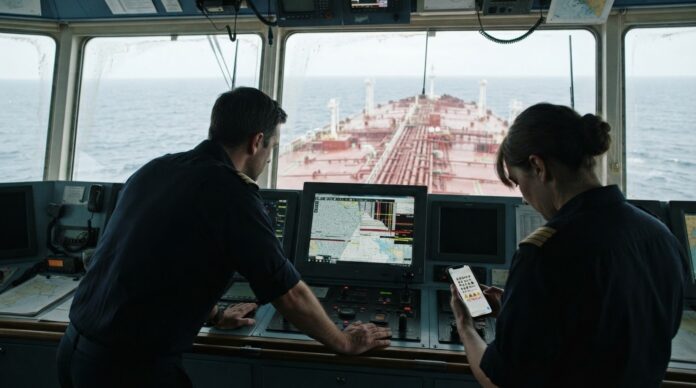

Hackers have broken into the computer networks of as many as 50 ships carrying oil, liquefied gas, chemicals and other explosive cargo, and US investigators suspect Iran is behind the tanker cyberattacks, The Wall Street Journal reported on Monday, as summarised by The Jerusalem Post, citing US officials and others familiar with the probe. Some crews have received bomb threats on their phones. One message, shown to the paper by a European shipowner, read: “traitor ships will burn in hell.” The attackers are said to be getting in through a flaw in Fortinet routers, network boxes that are common across the shipping industry.
Iran is the main suspect, but Russia has not been ruled out, and one government official stressed that there is so far no evidence of Iranian involvement, heise reported, summarising the Journal’s story. The 50-ship figure comes from anonymous sources and has not been confirmed officially. What has been confirmed is that the US Coast Guard has already sent cyber teams onto ships heading for American ports.
What happened on board
The reported cases go back several months and are spread across routes to Europe, Asia and the US. Two tankers bound for Texas, the VL Prosperity and the Kohaku, were among the targets, according to the Daily Wire’s account of the Journal report. A ransom letter addressed to the captain of the Prosperity, a Liberian-flagged supertanker carrying about 2.3 million barrels of oil, called the operation a “planned execution” and accused the ship of carrying Saudi oil to America. The letter was posted on a Russian-language Telegram channel, and the Journal could not confirm who wrote it. The ship’s manager says it passed a federal cyber inspection and was cleared to operate normally.
Another tanker, the Vivit Africa, was hit while carrying American liquefied natural gas to Italy, and tracking data showed it sailing erratically as it approached the Italian coast. On one vessel, hackers reportedly reached the propulsion and navigation systems and disrupted communications for about 30 hours, forcing the crew to switch to manual procedures, Fox News reported. Other crews received warnings in Farsi not to load American goods, and messages such as “there is no ceasefire” and “we will hunt you down all over the world”.
The Coast Guard confirmed part of the picture. A spokesperson told Fox News that teams of Coast Guard cyber specialists, a vessel inspector and FBI cyber agents boarded two foreign-flagged commercial ships in the Gulf of America on August 21 and 24, “following indications that the networks of both vessels were compromised by foreign cyber actors.” The threats were dealt with before the ships reached port, and no disruption, danger to crews or environmental damage was reported. Other reports put the number of boardings in recent weeks at four or more.
Why a router is the weak spot
A modern tanker is a floating office joined to an industrial plant. The bridge, the engine room, cargo pumps, ballast tanks and satellite internet all sit on linked networks, and a router or firewall at the edge is often what connects them to the shore. Fortinet’s FortiGate devices are widely used for that job. In September, the Coast Guard’s cyber command and the FBI warned that state-backed attackers were exploiting vulnerabilities in FortiGate equipment, heise noted. A ship cannot be patched at the dock overnight the way an office can. Many vessels spend weeks at sea with slow, expensive satellite links, and updates often wait until the next port call.
“What we’re seeing in 2026 is that ships are no longer collateral damage in cyber campaigns; they’re deliberate targets,” Alon Ayalon, co-founder of the Israeli maritime security firm Cydome, told the Journal. “The uncomfortable truth is that most vessels sailing today have less cyber protection than a midsize office.”
The threat is not new. In early October there were reports that the FBI and the Coast Guard had found evidence that intruders had reached the propulsion system of an oil supertanker, though it was unclear what they could do with that access. Ports are under pressure too: the Port of Los Angeles logged 120 million thwarted attempts in August alone, nearly double its 2023 monthly average, the Financial Times reported this week.
Can hackers really blow up a ship?
Experts disagree on how dangerous this is. Lars Jensen, a Copenhagen-based shipping analyst, told the Journal that the idea of hackers taking over a ship and steering it into a bridge, or blowing it up in a port, is a Hollywood scenario, because a ship can always be steered by hand. But he said attackers can still knock out systems on board, demand ransom and cause delays that cost millions. The Journal also wrote that remote attackers can cause damage and even trigger explosions, so the risk to crews is real.
For the cargo on these ships, a delay is not trivial. A tanker carrying liquefied gas or volatile chemicals depends on pumps, valves, pressure and temperature controls. Those are exactly the systems that crews do not want to run by hand for 30 hours in open sea.
The wider war at sea
The cyber campaign comes as Iran keeps attacking ships around the Strait of Hormuz, where the UN maritime chief has said about 6,000 sailors are trapped. Director of National Intelligence Jay Clayton recently told House lawmakers that Iranian threats have risen sharply. Hackers offer Tehran, or whoever is behind this, a way to hit ships far from the Gulf, off Texas or Italy, without firing a missile. We have covered the other side of that pressure before, in Iran’s threat to the undersea internet cables that run through Hormuz.
Our take
The scary scenario of a hacked tanker ramming a bridge is probably the least likely one. The real damage is quieter: frightened crews, ships stuck waiting for cyber inspections, insurers raising premiums and buyers in Europe and Asia paying more for every cargo of American gas. That alone is a win for whoever is behind it, whether that is Iran, Russia, or both pretending to be the other. The fix is boring and overdue. Shipping companies need to treat a router on a tanker like a router at a bank, with fast patching and monitoring, and regulators should require it, not just recommend it. Until then, the cheapest weapon in this war is an unpatched network box.