

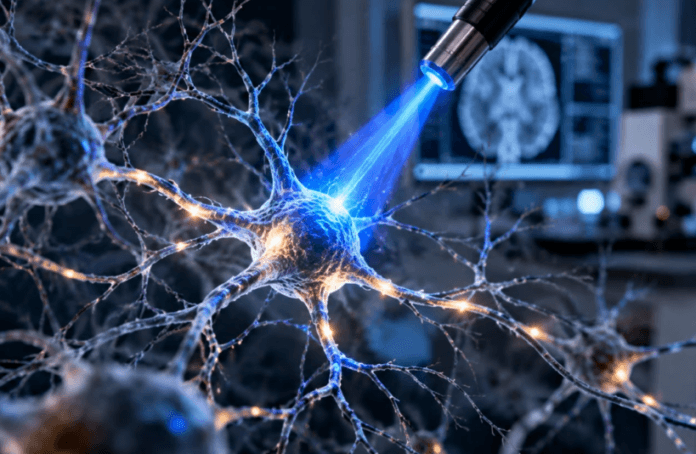

A single-celled alga that swims toward light has just won three scientists the 2026 Nobel Prize in Physiology or Medicine. On October 5, the Nobel Assembly at Karolinska Institutet named Karl Deisseroth, Peter Hegemann and Georg Nagel as the laureates “for their discoveries concerning light-gated ion channels and optogenetics.” The method lets researchers switch individual nerve cells on or off inside a living brain, using nothing more than light.
What is optogenetics?
Nerve cells talk to each other with electrical signals. Optogenetics gives scientists a way to control those signals. Researchers insert the gene for a light-sensitive protein into chosen cells, then shine light on them: the cells fire, or go quiet, on command.
That turned neuroscience from watching the brain into steering it. According to the Nobel committee, the method has revealed the neural circuits behind specific memories, feelings and behaviours that matter for neurological and psychiatric disorders. Labs around the world use it to study learning, fear, addiction and movement.
From a swimming alga to a brain tool
The story begins with Peter Hegemann’s curiosity in the early 1990s. He wanted to know how the green alga Chlamydomonas reacts to light in half a millisecond, and he suspected that a single protein both captured the light and acted as an ion channel.
Working with Georg Nagel at the Max Planck Institute of Biophysics in Frankfurt, he found the answer: channelrhodopsin, a protein on the cell surface that opens when light hits it. Nagel put the gene into frog egg cells and showed that the protein is a light-gated ion channel that responds strongly and quickly to a pulse of light. They published the result for channelrhodopsin-2 in 2003.
Karl Deisseroth then wrote to Nagel and asked for the DNA. In 2005 he introduced the gene into rat nerve cells, making them respond to light. The technique was named optogenetics a year later.
Is optogenetics used in patients?
Partly, and the field is still early. Clinical trials are testing the method as a way to restore vision in people with retinitis pigmentosa, a disease that destroys the rods and cones in the retina but leaves other cells healthy. A light-sensitive protein makes those healthy cells respond to light, and in one reported case a blind patient regained some vision. Researchers also hope it could improve cochlear implants.
Thomas Perlmann, secretary of the Nobel Assembly, was careful, though: optogenetics is primarily a tool for basic research. This prize rewards a method that changed how science studies the brain, not a finished therapy.
The scientists who weren’t on stage
Nobel rules allow at most three laureates per prize, and the choice has drawn comment. Ed Boyden, the first author of Deisseroth’s landmark 2005 paper and then a PhD student in his lab, is not among the winners, and many commentators noted it. The committee’s background material also mentions Gero Miesenböck, who in 2002 made nerve cells respond to light using a different light-sensitive system, and Zhuo-Hua Pan, who in 2004 tested channelrhodopsin in retinal cells. Boyden and Miesenböck shared other major awards with the laureates, including the 2019 Warren Alpert Prize.
Why the optogenetics Nobel Prize matters beyond biology
The timeline is the lesson. A question about how an alga finds sunlight in the early 1990s led to a protein in 2002 and 2003, to neurons in 2005, and to a Nobel Prize 21 years after that. Nobody was building a brain tool at the start. The most useful technologies sometimes come from questions that have no obvious application.
For readers who follow technology, optogenetics also shows a pattern: put a gene into a cell, and light becomes the control signal. That idea sits at the edge of biology and engineering, and it explains why the method keeps expanding into new areas of medicine.
Nobel Week: what comes next
The medicine prize opens this year’s announcements. Physics follows on Tuesday, October 6, chemistry on Wednesday, October 7, literature on Thursday, October 8, peace on Friday, October 9, and economic sciences on Monday, October 12. The three medicine laureates share 12 million Swedish kronor, about $1.2 million, and receive the prize at the ceremony in December.
Optogenetics Nobel Prize: quick answers
Who won the 2026 Nobel Prize in Physiology or Medicine? Karl Deisseroth (Stanford and the Howard Hughes Medical Institute), Peter Hegemann (Humboldt University of Berlin) and Georg Nagel (University of Würzburg).
What is optogenetics used for? Mostly to study the brain: which cells drive memories, emotions and behaviour. In medicine, it is in clinical trials for vision loss.
Why did the discovery start with algae? Chlamydomonas swims toward light, and its light-sensing protein, channelrhodopsin, turned out to be a ready-made switch that scientists could place in other cells.