

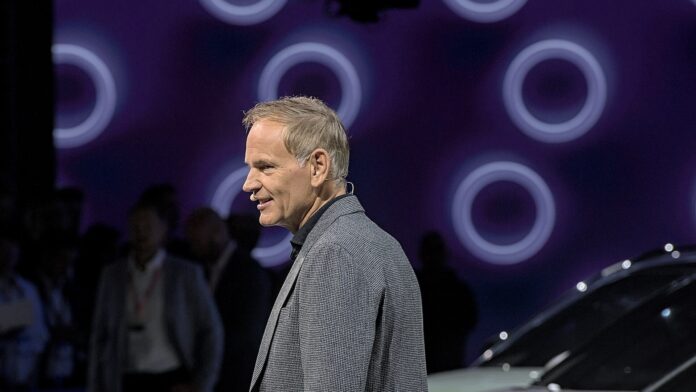

European carmakers are being squeezed from two sides, and the head of Europe’s biggest car group is now saying so in public. Volkswagen chief executive Oliver Blume told the Paris Automotive Summit, held alongside the Paris Motor Show on October 13, that the business model of Europe’s mass-market carmakers is under “enormous pressure” from Chinese competition and a fast-changing market, Híbridos y Eléctricos reported. He called again for more competitiveness, cheaper energy and support for production in Europe.
“We cannot build our future on export profits alone”
Blume’s central point was that European businesses must be profitable on their own. “We cannot build our future on export profits alone,” he said, according to Motor.es. For decades, German carmakers earned a large share of their profits by exporting premium cars to China and the US. Both markets have become harder: China’s own brands now dominate its market, and US tariffs have raised the cost of imports.
Mass-market brands such as Volkswagen, Stellantis and Renault are the most exposed. They sell large volumes at thin margins, the segment where cheap imports do the most damage. Chinese brands now hold about a tenth of the European car market and arrived in Paris in force, looking for growth as demand at home slows. At the same time, European carmakers must deliver affordable electric models without losing control of costs. At home, Blume is pushing through the biggest restructuring in Volkswagen’s history, with tens of thousands of job cuts planned and unions resisting.
Paris: Europe fights back with nostalgia
The show itself suggested European brands are not giving up. Electrive described it as a comeback after a weak 2024 edition, with refreshed line-ups across the board. Citroën, part of Stellantis, previewed a revived electric 2CV concept, due to weigh under a tonne, go into production in 2028 and cost around €15,000. Volkswagen showed electric models under its “authentic Volkswagen” design strategy, and Renault displayed prototypes including an electric Espace. Retro design is a clear trend: brands are using familiar names to win over buyers who are wary of EVs.
What the sales numbers show
Fresh figures the same day showed where the pressure is. BMW’s global deliveries fell 6.3% in the third quarter to 551,072 vehicles, Just Auto reported. China did the damage, with deliveries there down 24.8% to 114,355, while Europe rose 2.7% and the US 2.5%. Battery-electric deliveries grew 7.2%.
Stellantis shipped about 1.3 million vehicles, down 1%, according to its filing with US regulators. North America fell 12% after planned downtime hit Jeep production, while Europe rose 10%, helped by electric cars from its own brands and from Leapmotor, its Chinese partner. That detail shows how tangled the competition has become: a European carmaker asking for protection is also growing by selling cars from a Chinese partner.
Brussels and Beijing strike a deal on hybrids
Four days earlier, on October 9, EU trade commissioner Maroš Šefčovič said China had agreed to a deal that would roughly halve its exports of hybrid and plug-in hybrid cars to the bloc. EU officials later said imports would be capped at 350,000 a year from 2027 for four years, rising 6% a year from the second year, with cars made in Europe by Chinese companies excluded, Vision Mobility reported. The two sides describe it differently: the EU compares the cap with up to 800,000 hybrids expected this year, while Beijing notes it is above the 302,000 shipped in 2025, CnEVPost reported.
Hybrids matter because of earlier tariffs. In 2024 the EU imposed extra duties on Chinese electric cars but spared hybrids, so Chinese exporters shifted their push there. Hybrid demand is strong elsewhere too: in the US, buyers are rushing to hybrids while Detroit has few to sell.
What it means for the industry
A hybrid cap buys European carmakers time, but it does not close the cost gap with Chinese rivals, which build cars more cheaply thanks to scale, battery supply chains and lower labour costs. The exemption for cars made in Europe will also encourage Chinese brands to build factories inside the EU, which brings jobs but keeps the competition. For suppliers and workers, the restructuring at Volkswagen and others is likely to mean further plant closures and job losses.
Our take
Blume is right that Europe’s mass-market carmakers can no longer rely on export profits, and the BMW and Stellantis numbers show China’s market slipping away. Trade deals like the hybrid cap are a temporary shield, not a strategy. The real test is whether models like the electric 2CV can be built profitably at European costs. If they can, the industry has a future; if not, protection will only slow the decline.