



U.S. intelligence officials believe an executive at a Singapore data center company that buys Nvidia chips was working for Chinese intelligence, and that she built a close relationship with Nvidia’s chief executive, Jensen Huang, according to a New York Times report published on October 28. Nvidia says the contacts were ordinary business. The report matters well beyond one company: it shows how the fight over AI chips has moved from factories and customs posts into data centers, cloud contracts and personal access.
What the report says
The executive is Alice Huang, also known as Huang Le, a Chinese citizen and managing director of Megaspeed, a Singapore-based company that builds data centers and rents computing power to customers including Chinese firms such as Alibaba. She is not related to Jensen Huang. According to Implicator, which summarised the Times report, U.S. officials concluded that she was a Chinese intelligence asset passing commercial information to Beijing. The surveillance began as an investigation into suspected smuggling of Nvidia chips to China and showed that she had developed a close relationship with Nvidia’s chief. Officials do not believe Jensen Huang knew about her alleged intelligence work, and as of the report he had not received a defensive briefing, the warning the U.S. government gives people it believes are being targeted.
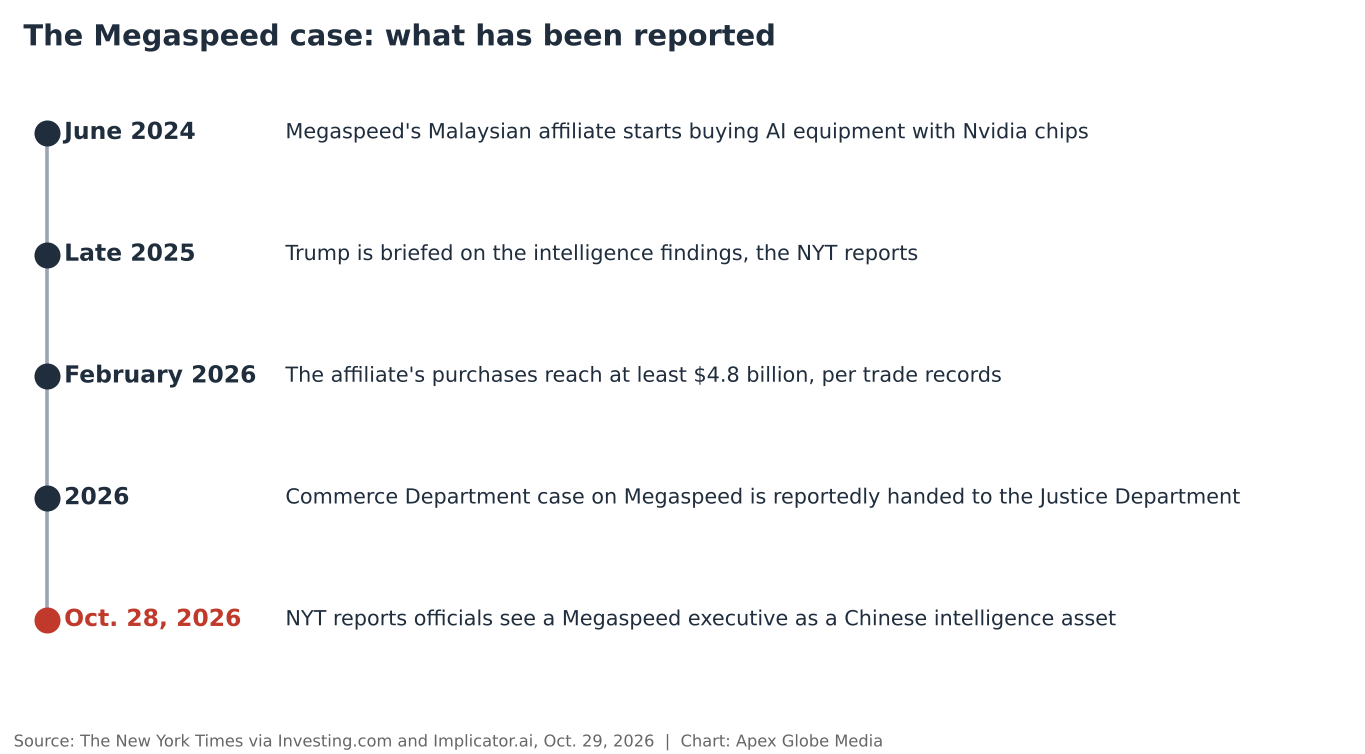
The commercial side of the case is large. Trade records cited by the Times show that Megaspeed’s Malaysian affiliate bought at least $4.8 billion of AI equipment containing Nvidia chips between June 2024 and February 2026, Investing.com reported. A Commerce Department visit to Megaspeed’s Malaysian data center reportedly found Nvidia equipment still in its boxes, which raised suspicions that it was about to be moved. The Times reports that President Trump was briefed on the findings about a year ago and chose not to act, and that a Commerce investigation of Megaspeed was handed to the Justice Department this year.
What Nvidia and China say
Nvidia rejects any suggestion of wrongdoing. “Jensen’s interactions with Ms. Huang are not unusual or unexpected,” the company said, adding that allegations of chip diversion by Megaspeed had been investigated and debunked last year, and that customers like Megaspeed receive only ordinary business information, nothing relevant to national security. Nvidia has repeatedly said there is no evidence its chips are being smuggled into China. The Chinese embassy in Washington called the claims “groundless smears and slanders.”
It is important to be clear about what is and is not alleged. The reporting does not say that Jensen Huang knowingly helped Chinese intelligence or shared confidential information. The concern is access: Huang has appeared alongside Trump at state dinners, AI summits and on foreign trips while lobbying for permission to sell more advanced chips in China, so anyone close to him could learn a great deal about both Nvidia’s plans and Washington’s China policy.
Follow-up: on November 6 the New York Times reported that US intelligence believes Alice Huang was recruited by China’s Ministry of State Security. Read who Alice Huang is and the full timeline.
The loophole: renting instead of buying
The case highlights a gap in U.S. export controls. The rules restrict shipping advanced AI chips to China, but a Chinese company can rent computing power on those chips in a data center elsewhere, for example in Malaysia or Singapore, and train its models remotely. Officials suspect Megaspeed and its affiliates helped Chinese companies gain access to advanced computing this way, and the administration is reportedly considering tighter rules for offshore data centers that serve Chinese customers.
The politics of chip exports have already been unstable this year. The U.S. cleared Nvidia’s H200 for sale to China earlier in 2026, only for Chinese regulators to block the imports, and Nvidia wrote off about $4.5 billion of China-specific chips last year. We have tracked how Washington’s tech restrictions are playing out in practice in our analysis of the U.S. ban on Chinese technology.
The news also landed on a bad day for AI stocks. Alphabet fell sharply after reporting negative free cash flow from its AI spending, and the Nasdaq was down about 1.6% during trading on October 29 as investors weighed both stories.
Our take
If the reporting is accurate, the Megaspeed case is less a story about one executive than about how export controls were designed for a world of shipping containers. Chips can be sold legally to a data center in Southeast Asia and then rented to anyone, and personal relationships at the top of the industry are a far softer target than any customs check. Washington now has to decide whether to regulate where computing power is used, not just where chips are shipped, and Nvidia, which depends on both governments, will be under pressure to show it knows who its customers really serve.