


Mistral AI has released the weights of Mistral Large 4, a model with about one trillion parameters that anyone can download, run on their own servers and modify. The French company, nicknamed the model “Le Chonk” and says it was trained from scratch on European infrastructure. It puts a European open model in the same size class as the biggest American and Chinese releases, and is a direct challenge to the Chinese labs that have dominated open AI models for the past two years.
What Mistral released
According to Mistral’s announcement, Large 4 is a “mixture of experts” model: only a fraction of its parameters, the numerical weights that encode what it has learned, is used for any given word, which makes a very large model cheaper to run. It accepts text and images and offers three levels of reasoning effort. Mistral first showed the model as a paid preview on October 6 and promised the weights by the end of the month.
Even the basic numbers have needed care. the tech site Mixed noticed in October that Mistral’s launch post put the active parameters at 49 billion while its documentation said 52 billion, with 1.05 trillion in total and a context window of one million tokens. The published checkpoint’s name, 1T-A52B, points to 52 billion. Mistral says the model was trained on about 3,800 Nvidia Grace Blackwell chips in its own European data centers.
Through its API, Large 4 costs $0.70 per million input tokens and $2.10 per million output tokens. Self-hosting is free under what Mistral calls a modified MIT licence, which permits commercial use and fine-tuning. The one restriction is that companies selling the model as a hosted service to others need a separate commercial licence from Mistral, a change from the more permissive Apache 2.0 licence used for its previous large model.
How good is it?
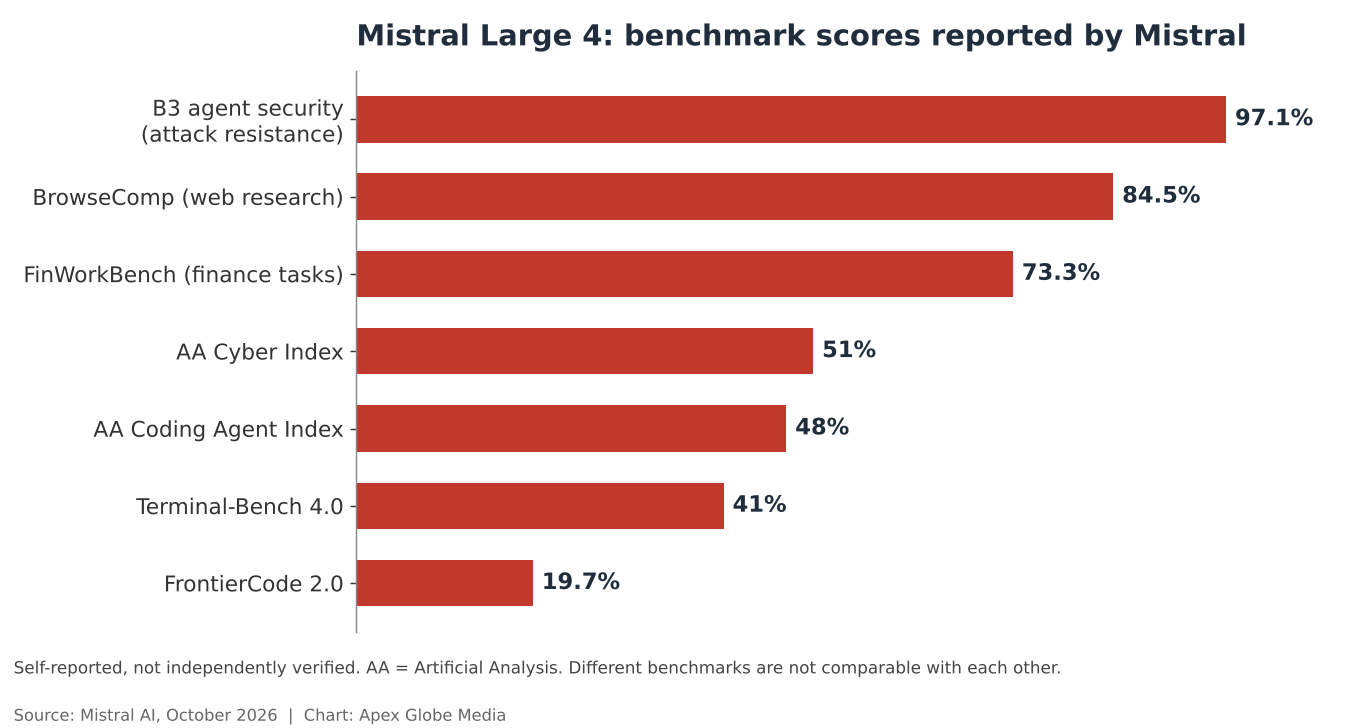
Mistral’s figures put Large 4 near the top of open models rather than ahead of the closed frontier. On the Artificial Analysis Coding Agent Index it scores 48%, effectively tied with China’s GLM-5.3 but using 47% fewer tokens per task, which lowers cost. It scores 41% on Terminal-Bench 4.0, a test of working in a command line, 13 points higher than the preview, and 19.7% on Cognition’s private FrontierCode test. In a human preference test for code, Mistral says reviewers preferred it to GLM-5.3, Kimi K3 and DeepSeek V4.1 Flash, and ranked it behind only Anthropic’s Claude Opus 5.5.
All of these numbers come from Mistral or from tests it chose to report, and independent evaluations are only beginning. Running the full model is also not a hobby project: serving a trillion-parameter checkpoint requires a multi-GPU server, so in practice “open” means open to companies and governments with serious hardware, not to individual laptops.
Why it matters for Europe
The release lands in a debate about who controls AI. Mistral explicitly sells Large 4 as a foundation for “sovereign AI”, models that European banks, governments and agencies can inspect, host and adapt without sending data to American or Chinese providers. It names ABN AMRO, Belfius, Crédit Agricole and ENISA, the EU’s cybersecurity agency, among early users or testers. Mistral also stresses safety: it says Large 4 refused 96.6% of malicious cyber requests in its tests, the best it measured among open models.
That framing has a ready audience. This week the Dutch government said it wants to cut 25,000 civil service jobs with the help of AI while relying mainly on European suppliers, a condition that is hard to meet without capable European models. At the same time, open weights cannot be recalled once released, which is why safety researchers watch frontier-scale open models closely; the same month, Anthropic showed that an unreleased model could build working exploits against major operating systems.
Our take
Large 4 is the first time a European lab has shipped an open model at the scale of the American and Chinese frontier, and that alone changes the options for European institutions that want AI they can own and audit. But the benchmarks are self-reported, the licence is less open than Mistral’s previous one, and the hardware needed to run it limits who can benefit in practice. The real test is whether European companies actually build on it, or keep paying for American APIs while praising sovereignty in speeches.