

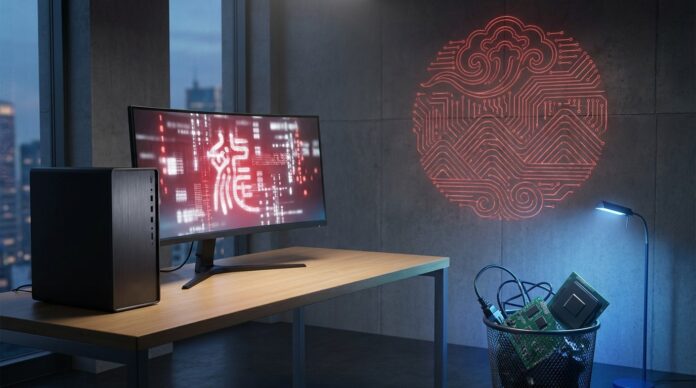

Huawei has launched the Qingyun HM650, a HarmonyOS desktop computer with no Intel chip, no Qualcomm chip and no Windows. The HM650, unveiled on November 5 at a HarmonyOS office industry summit in Wuhan, is the first desktop in China certified as “100% domestic,” according to Huawei, with everything from the processor to the memory modules made in China. The Huawei Qingyun HM650 is aimed at government offices and state companies, and it is the clearest sign yet that Beijing’s push to replace Western technology has reached the most ordinary machine in any office: the desktop PC.
What is inside the Qingyun HM650
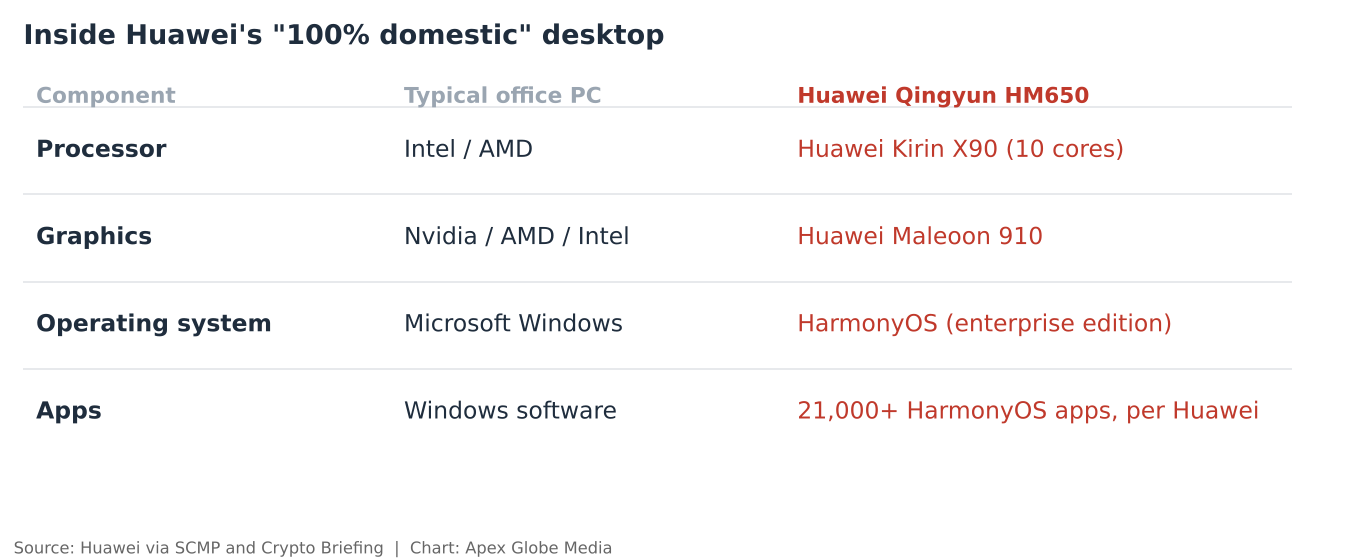
The HM650 runs on Huawei’s own Kirin X90 processor, a 10-core chip that supports 20 threads, paired with a Huawei Maleoon 910 graphics chip, the South China Morning Post and Crypto Briefing reported. It runs an enterprise version of HarmonyOS, Huawei’s own operating system. Huawei claims the tight pairing of its chips and software improves overall performance by 15%, a figure that has not been independently tested.
There are two versions: the HM650 for businesses, and the HM650G for government users, with extra security and management features for institutions such as banks and energy companies. The machines are sold only through corporate and government channels in China, with no retail or international launch announced and no public price.
The “100% domestic” claim
The certification is the headline, but its scope is unclear. Huawei has not published a full list of parts, so outside experts cannot check where every component, from power chips to connectors, comes from, the SCMP noted. Chinese chipmaking also still relies heavily on foreign manufacturing equipment, even when the chip itself is designed and made in China. So “100% domestic” most likely means that the main components are made by Chinese companies, not that no foreign technology was used anywhere in the supply chain.
Even so, the achievement is real. In 2019 and 2020, US sanctions cut Huawei off from advanced chips and from Google’s version of Android. Today it designs its own processors, graphics chips and operating systems for phones, laptops and now desktops. We saw the same pattern with the Mate XT2 foldable phone. Huawei says HarmonyOS PCs, including laptops and desktops, passed 1 million units shipped in their first year, and that more than 21,000 apps are now compatible with the platform.
Why governments are the target
China has spent years on a programme to replace foreign IT in government and state-owned companies with domestic alternatives, driven by fears that US technology could be cut off or used for surveillance. Desktop PCs, which run on Intel or AMD chips and Microsoft Windows almost everywhere, have been one of the hardest parts to replace. The HM650 gives state buyers an option that does not depend on any American company.
It fits a wider trend this month. Beijing has held back approval for 600,000 Nvidia H200 chips to push its tech giants towards local processors, and it blocked SoftBank’s purchase of ABB’s robotics business. The message is consistent: China wants to depend less on Western technology, even at some cost in performance.
What it means for Intel, AMD and Microsoft
In the short term, little. Chinese government PCs are a small share of global sales, and many Chinese businesses will keep using Windows because of the software they need. The bigger question is the long term. If HarmonyOS becomes the standard in Chinese government and state companies, software makers will build for it, and Chinese consumers may follow. China is one of the largest PC markets in the world, and losing even part of it would hurt Intel, AMD and Microsoft at a time when the PC industry is already squeezed by rising memory prices.
Our take
The HM650 is not a threat to the Mac or Windows PC in global stores. It is a government computer, with an unverified performance claim and an operating system that most of the world’s software does not support. But it matters because of what it proves. A Chinese company can now ship a full office computer, from chip to operating system, without American parts, six years after sanctions were meant to stop exactly that.
The real test will be software. An office PC is only useful if it runs the accounting, design and industry tools that people need. Watch whether major Chinese software companies and banks move their systems to HarmonyOS. If they do, the desktop could become the next front in the technology split between China and the West, after smartphones and AI chips.