



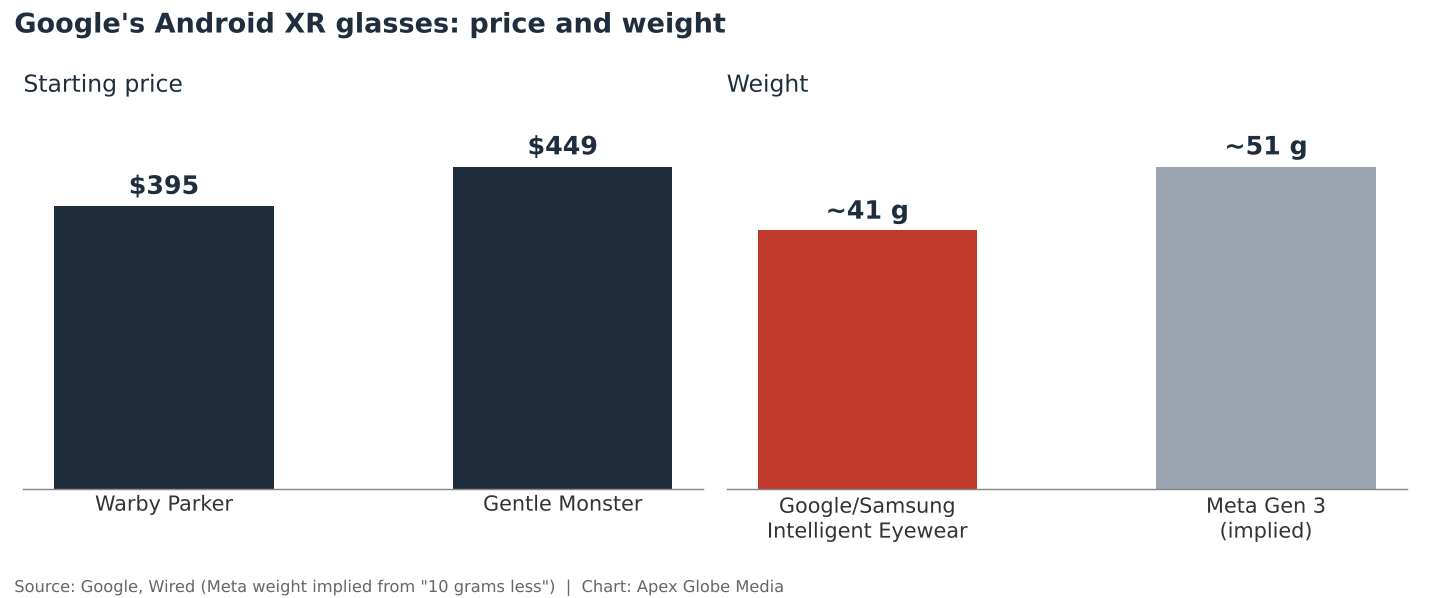
Google is back in the smart glasses business, more than a decade after Google Glass, and this time it is borrowing Meta’s playbook. The Android XR smart glasses that Google built with Samsung, sold under the name “Intelligent Eyewear,” went up for pre-order on Thursday through Warby Parker and Gentle Monster, Google announced on its blog. Warby Parker frames start at $395 and Gentle Monster frames at $449. Sales in stores and online begin December 10.
The glasses have no display. Like Meta’s Ray-Ban glasses, they are a camera, speakers and microphones in an ordinary-looking frame, with Google’s Gemini assistant as the main way to use them. “We felt that these are a Gemini-forward device,” Juston Payne, Google’s senior director of product management for XR, told Wired. “You’re not talking to Google, you’re talking to Gemini.”
What you get for $395
The hardware is the same in every frame, and Samsung makes it. According to 9to5Google, the glasses run on a Qualcomm Snapdragon AR1 Gen 1 chip with 2GB of RAM and 64GB of storage. They have a 12-megapixel ultra-wide camera that shoots photos and video up to 3K, four microphones, two open-ear speakers, and IPX4 splash resistance.
Google says the frames weigh about 41 grams and last up to nine hours on a charge, and the case can recharge them up to seven times. Wired notes that is 10 grams lighter than Meta’s new third-generation glasses. You wake Gemini by saying “Hey Gemini” or by tapping the arm of the frame, and swipe along it to change the volume.
Warby Parker offers three styles, Alden, Reid and Wren, as optical glasses or sunglasses, with demos in more than 360 of its stores. Gentle Monster has six bolder designs in colors such as dark red, pink and yellow. Prescription lenses are available for most frames. Both brands handle sales and customer service, the same way Meta works through Ray-Ban maker EssilorLuxottica.
What Gemini can do through them
Most features depend on the assistant. You can ask Gemini about what you are looking at, such as a page in a book or ingredients on a counter, get turn-by-turn directions from Google Maps through the speakers, play music from YouTube Music, Spotify, Apple Music or Audible, and dictate messages and reminders. Google Translate works in real time in more than 70 languages. Wired’s reviewer found the translation “worked remarkably well” in controlled demos, but you have to look at the person speaking, and noise affects quality.
There is also Guided Vision, which describes surroundings to people with impaired vision, and a link to Aira, a service that streams the camera view to a human interpreter. Google says both are Android-only at launch.
The catch: phones and countries
The glasses work only with a short list of phones: a Pixel 7 or newer, Samsung Galaxy S, Z Fold and Z Flip models running One UI 9.0 or higher, and the iPhone 13 Pro or newer. Google told Wired it will say more about support for other Android phones in 2027. On the iPhone, a companion app saves photos and videos to Apple Photos, and Gemini can send iMessages, 9to5Google reports. Google’s announcement says the glasses require a Google account for users over 18 and are available only in the US and South Korea.
Learning from the “Glasshole” years
Google clearly remembers why Glass failed. “We learned through Glass that you can make people uncomfortable if you’re not clearly communicating,” Payne told Wired. In a separate post on privacy, Google lists the safeguards. A white light on the front turns on when the camera records, and if the light is covered or tampered with, sensors are designed to detect that and block capture. Faces of bystanders are automatically blurred before images go to Gemini. Google says camera visuals “aren’t used for AI training or ad targeting” and are not saved to Gemini History. There is also a physical switch that turns the glasses off.
That is a direct response to the backlash against Meta’s glasses, which has produced the nickname “Meta creep” and pushed Meta to try camera-free designs. Google’s safeguards are promises in software, however, and the face blurring applies to what Gemini sees, not necessarily to every photo the wearer takes.
Our take
These glasses are not a breakthrough. They are a careful copy of what already works for Meta: no display, fashion partners, an assistant in your ear, a price around $400. What Google adds is Gemini, translation in 70-plus languages and the most detailed privacy rules any big glasses maker has published. The weak points are the short phone list and the two-country launch, which limit how many people can buy them this year. The display version, which Google says is still on its roadmap, is the product that would really compete. Until then, this is Google’s way of getting into the market before Meta owns it completely.