



The Microsoft 365 outage that began on Thursday, November 12, is finally over. On Saturday, Microsoft said it had “completed our efforts to address the underlying issue” and “restored service to the remaining impacted customers and regions,” Digital Trends reported. For roughly a day, Outlook, Teams, SharePoint and Copilot were largely unusable for businesses, hospitals and governments around the world. Microsoft blamed a mistake made during “an earlier network capacity upgrade,” not hackers and not AI.
The fix ends the disruption, but not the bill. Microsoft’s business contracts promise a level of uptime, and an outage this long blows far past it. Many companies are now owed money back, but only if they ask for it.
How the outage unfolded
Problems started with Exchange Online, the service behind business email in Outlook, at around 11:17 a.m. Eastern on Thursday, and spread into a wider Microsoft 365 failure at 1:26 p.m., according to Digital Trends. Microsoft first suspected unusually high traffic. Engineers then found that several backend servers had unexpectedly dropped out, leaving the rest overloaded. Servers that were restarted came back, then stopped responding again as soon as traffic returned.
On Thursday afternoon Microsoft said it had “validated an alternative service health check method” that brought some servers back, CNBC reported. By Friday morning, email queues were nearing normal, and Microsoft extended the retry window for delayed messages to 48 hours so that mail stuck in transit would not be lost. The final repair was a patch to an authentication and routing component, followed by a slow, step-by-step return of traffic.
In a statement on X, quoted in full by Windows Central, the company said: “This was a technical issue not related to cyber or AI / agents. The incident was introduced by an issue during an earlier network capacity upgrade that surfaced following a recent network change.” It added: “We are deeply sorry for the disruption this incident has caused our customers and partners.” Explaining the slow recovery, Microsoft said it “restored services gradually, validating stability at each stage. While this took longer, it helped ensure a stable restoration.” A full post-incident report is promised once its review is complete.
Hospitals, airlines and a fax machine
Downdetector logged more than 7.4 million outage reports worldwide, according to Digital Trends, though that counts complaints, not individual users. The UK’s National Health Service lost email and Teams for much of the day and fell back on other systems. Air India, IndiGo and Akasa Air reported problems with email support, and a Taiwanese financial firm confirmed trades by fax.
Companies felt it in their schedules too. Luxury group Richemont’s earnings release was slightly delayed, and Workhorse Group moved its third-quarter results from November 12 to November 16, CNBC reported. US Representative Josh Gottheimer asked Microsoft for a briefing, and Australia’s Home Affairs Minister Tony Burke compared the event to the faulty CrowdStrike update that crashed Windows computers at airlines and banks in 2024.
The refund most companies will not get automatically
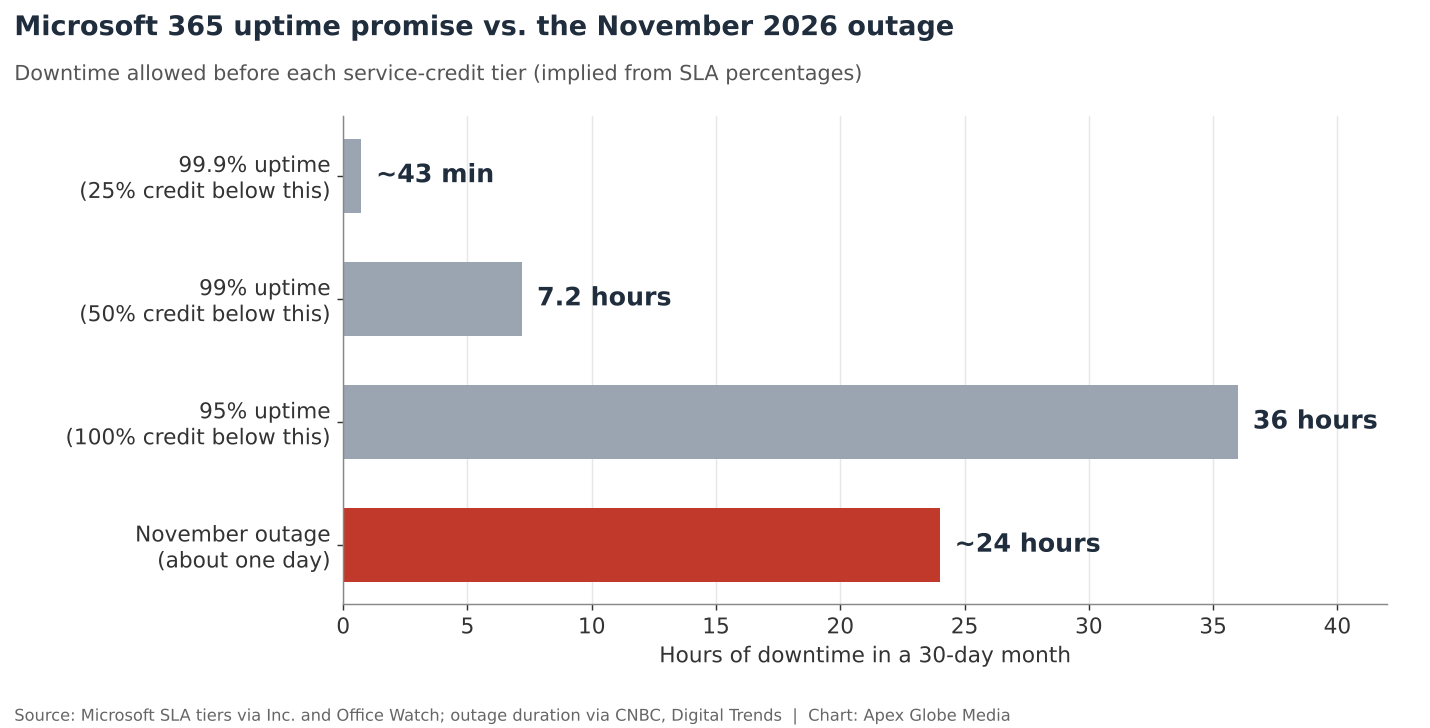
Microsoft’s service level agreement (SLA), the contract that defines how much downtime is acceptable, promises business customers 99.9% monthly uptime for services like Exchange Online and Teams. If availability falls below that, customers can claim a credit: 25% of the affected service’s monthly fee below 99.9%, 50% below 99%, and 100% below 95%, Inc. reported.
In a 30-day month like November, those thresholds are tight. 99.9% allows about 43 minutes of downtime. 99% allows about 7.2 hours, and 95% allows 36 hours. A business that lost its services for a full day sits at roughly 96.7% uptime for the month, which is the 50% tier. A tenant that was hit from Thursday morning until the last fixes on Saturday could come close to the 100% tier.
The catch is that Microsoft does not pay these credits on its own. An administrator or IT provider has to file a claim, usually from the Microsoft 365 admin center, citing the incident (Microsoft lists it as MO1550821) and the affected users, and Microsoft decides whether to approve it. Claims are due by the end of the calendar month after the outage, so the end of December in this case, according to Office Watch. Consumer plans such as Microsoft 365 Personal and Family are not covered. And the credit applies only to the fee for the service that failed, not the whole bill, so for most firms it will be small next to the cost of a lost working day.
A planned change, again
This was the second big infrastructure failure in two days caused by routine maintenance rather than an attack. On Friday, the FAA grounded every departing flight in the US after an update to its communications network reportedly crashed it. In both cases the weak point was the plumbing that everything else depends on.
Microsoft’s own explanation also shows why the repair took so long. The fault was introduced during one upgrade and only appeared after a later change, which makes it hard to simply roll back. When the servers were restarted, demand from millions of waiting clients knocked them over again.
Our take
Microsoft deserves some credit for saying plainly what went wrong and for protecting delayed email instead of rushing a restart. But a company that sells “99.9%” should not need a day and a half to recover from its own network upgrade, and its customers should not have to hunt for a form to get their contractual refund. If Microsoft wants to rebuild trust, the simplest step is to issue the credits automatically. The bigger lesson is for its customers: when email, chat, files and the AI assistant all come from one vendor, one bad change can stop an entire organization, and a backup channel is no longer optional.