



OpenAI now lets its AI agents spend your money. ChatGPT Wallet, launched on Friday, November 13, stores a credit or debit card inside ChatGPT so that OpenAI’s always-on agents, called dots, can complete purchases for you, TechCrunch reported. The first rollout is narrow: ChatGPT Pro subscribers in the US, aged 18 or older, with an eligible US-issued Visa, Mastercard or American Express card.
Dots, launched at OpenAI’s DevDay on September 29, are agents that keep running in the background with their own cloud computer and browser and connect to more than 4,000 apps. Until now they could research products and fill carts. The wallet closes the last step: paying.
How a purchase works
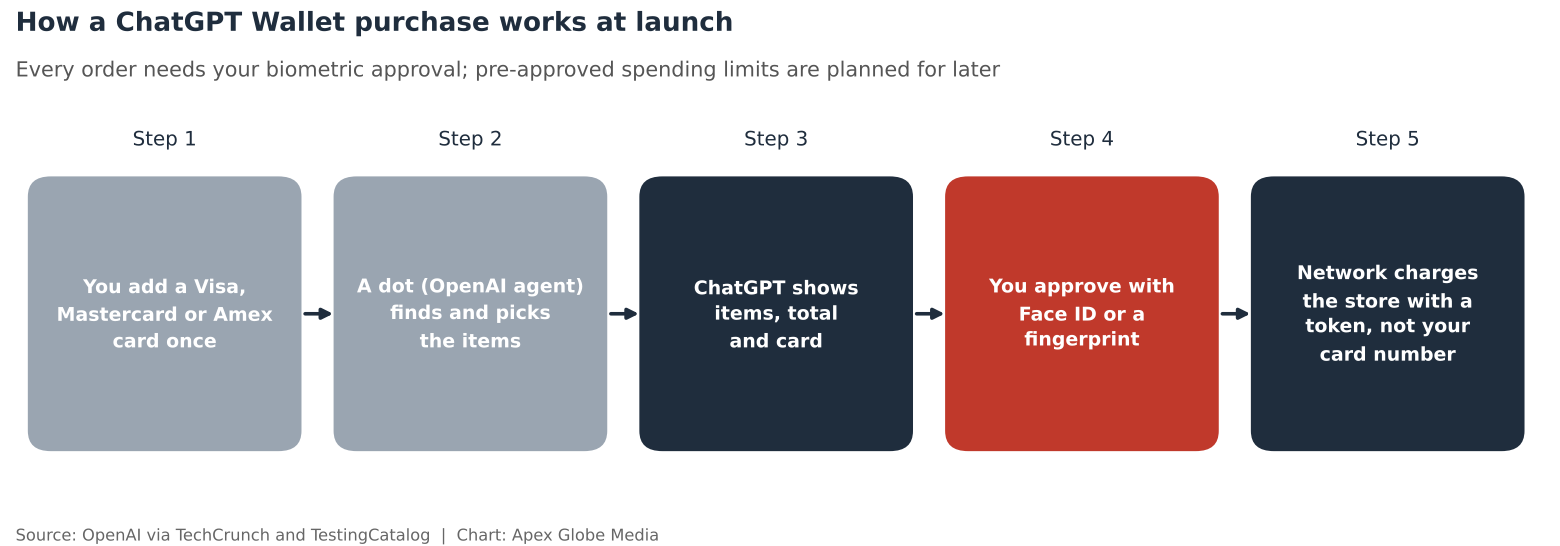
You add a card to the wallet once instead of typing it in for every order. When a dot is ready to buy, ChatGPT shows the items, the total and the card it will use. You then approve with Face ID or a fingerprint. “Every purchase requires a security check,” OpenAI wrote in its announcement, quoted by TestingCatalog, and each approval creates a record of what was authorized.
The card number itself never reaches the agent or the shop. The card network issues a payment token, a stand-in card number with its own security code and expiry date, and the merchant is charged through that. The dot passes along only the shipping address and contact details the store needs. Purchases keep the card’s usual rewards and dispute rights, so a defective item can still be charged back through the bank.
OpenAI built the wallet with American Express, Mastercard and Visa, and is working with fraud and payment firms including Forter, Riskified, Sardine, Signifyd, Adyen, Checkout.com and Stripe to flag suspicious orders. The wallet’s terms and privacy policy took effect on November 12, Crypto Briefing reported. Despite that outlet’s name, the wallet runs on ordinary card networks, not cryptocurrency.
The next step is approval in advance
The more important part of the announcement is what comes later. OpenAI says future versions will let users pre-approve purchases within spending limits, product categories or time periods, so a dot could buy on its own without a fingerprint each time. That matches what Visa described in June, when it announced a partnership with OpenAI for transactions that agents start under user-set caps, merchant categories and approval rules. Visa’s chief product officer Jack Forestell said then that “AI will transform commerce more profoundly than the internet or mobile technology ever did.”
OpenAI has tried shopping before. Instant Checkout, launched in September 2025 to let users buy from Etsy sellers inside ChatGPT, never caught on, and OpenAI pulled back from it this year. The wallet is a different design: rather than bringing stores into the chat, it sends an agent out to the stores.
Many stores do not want the agents
That is where the friction starts. Amazon, the largest retailer to block AI shopping agents, steers customers to its own assistant, Alexa. This week United Airlines said it would ban AI agents from buying its tickets, after chief executive Scott Kirby said, “I don’t want to create another middleman.” DoorDash and Uber have reported few orders placed by agents, according to TechCrunch. To win over merchants, OpenAI published a Commerce Partner Playbook explaining how sites can support agent checkouts.
Competition is close. Meta’s Muse assistant, with more than 10 million users, has made AI-assisted shopping one of its top activities, and the startup Instinct also buys on users’ behalf. Whoever gets the payment step right gains something valuable: the moment of purchase, which today belongs to search engines, marketplaces and the stores’ own apps.
Our take
Starting with a fingerprint check on every order is the right call. It keeps a human in the loop while people learn how often an agent picks the wrong size, the wrong seller or a price that changed at checkout. The harder test arrives with pre-approved spending, when a dot buys while you sleep. Tokens protect the card number, but they do not protect against an agent that was tricked by a fake store or a hidden instruction on a web page. Before OpenAI turns on autonomous buying, it should say plainly who pays when an agent makes a bad purchase within its limits: the user, the bank or OpenAI.