


Mercedes-Benz is about to put its rival to Tesla’s Full Self-Driving into the hands of American customers. MB.Drive Assist Pro, a system that steers, brakes and turns through city traffic from a parking spot to a destination, will reach some drivers in California through an early access program starting next month, Ars Technica reports after testing it in San Francisco. A wider rollout follows in the first half of 2027.
The first hands-on reviews, published on November 16 by Ars Technica, Engadget, The Drive and others, were unusually positive about the city driving and noticeably cooler about the highway part. That split says a lot about where driver assistance really stands.
What the system does
MB.Drive Assist Pro is a “Level 2” system, which means the car can steer, accelerate and brake by itself, but the driver remains responsible and must watch the road at all times. It is often described as “Level 2++” because it works on ordinary streets, not just highways. The driver enters a destination in the navigation system and the car handles the turns, traffic lights, stop signs, roundabouts, pedestrians and double-parked cars along the way.
Under the skin, the car uses 10 cameras, five radars and 12 ultrasonic sensors. They feed a central computer built on Nvidia’s Orin chips that Mercedes says delivers 254 trillion operations per second. According to Ars, driving decisions come from Nvidia’s Alpamayo, an “end-to-end” AI model that picks the car’s path directly from sensor data, while a separate rule-based system runs alongside it as a safety check. Germany’s testing body TÜV has certified Nvidia’s software stack, Ars notes.
The system is described as collaborative. The driver can steer or press the accelerator without switching it off, but touching the brake ends the automation. In the city, Mercedes requires at least some contact with the steering wheel. Engadget wrote that “you don’t have to exactly be locked in at ten-and-two,” but constant contact is needed.
How it handled San Francisco
The reviews of the city mode read more like reviews of a robotaxi. Engadget’s tester drove for nearly an hour through downtown San Francisco in a GLC SUV and intervened once, tapping the accelerator when the car sat too long at an intersection. The only oddity was the car sometimes stopping, creeping forward and stopping again at junctions. Mercedes told Engadget it is considering an “aggression slider” that would let owners make the car drive more boldly.
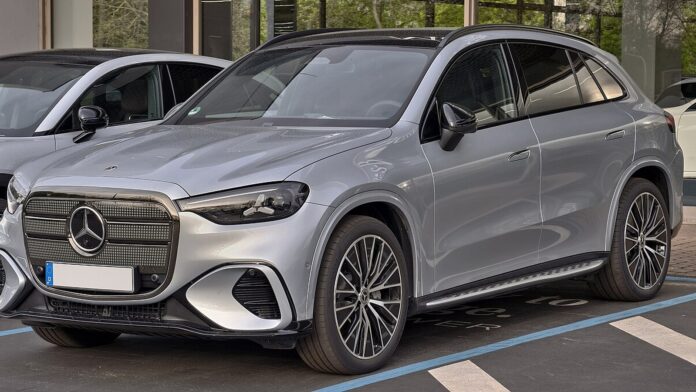
The Drive took a US-spec 2027 GLC 400 Electric up and down the city’s steep hills for about an hour. Its editor had to act only when a built-in timer checked that he was still alert, and once when a Tesla Model 3 cut into his lane to parallel park. Ars wrote that the electric GLC accelerated and braked as smoothly as the Waymo robotaxi it had ridden in the day before, waited patiently for an oncoming bus before passing a double-parked car, and stopped for pedestrians in a crosswalk while turning left.
The highway is the weak spot
Alongside the city system, Mercedes is adding Hands-Free Highway Assist, which lets drivers take their hands off the wheel on approved divided highways at up to 85 mph, while a camera checks that their eyes are on the road. This is the same category as GM’s Super Cruise, Ford’s BlueCruise and BMW’s Highway Assistant, and here the reviews were less kind.
Engadget counted at least half a dozen disengagements during a 45-minute loop across the Bay Bridge in an S-Class, with the car handing control back even when little was happening. In a GLS, the system once tried to change lanes into the path of a fast-approaching car, and the tester had to grab the wheel. After any override, it took 10 to 20 seconds before hands-free mode was available again. Engadget concluded the highway feature is “well behind” rivals from BMW, Ford and GM, even before its release. Mercedes told the reviewers the system is deliberately conservative at first. The Drive also found lane changes slow, though its highway test was in rush-hour traffic at 25 to 30 mph.
Which cars get it, and when
Ars says some customers in Germany and California will join early access from next month. The wider rollout in the first half of 2027 covers model-year 2026 CLAs and the 2027 CLA, GLC Electric, GLE, GLS and S-Class, with more models in 2028. The system is already available in China. All of these cars run MB.OS, Mercedes’ new in-house operating system, and eligible cars can receive the feature by over-the-air update.
Hands-Free Highway Assist arrives in spring 2027, standard on the 2027 S-Class and AMG GT 4-Door Coupé and optional on the 2027 CLA, GLB, C-Class, GLC and GLE. The Drive reports that California drivers will be able to choose multi-year, one-year or monthly subscriptions. US pricing has not been announced. When Mercedes first presented the system at CES in January, it said the US launch would come later in 2026 and quoted $3,950 for a three-year subscription, Carscoops reported at the time. The timeline has since slipped, and the price may change too.
Nvidia and Tesla in the background
The launch is also a test for Nvidia’s car business. Alpamayo and the Orin computers are Nvidia’s main pitch to carmakers that do not want to build their own driving AI, and Mercedes is its most prominent showcase. That pitch now has to work without Jensen Huang, who resigned as Nvidia’s CEO last week.
For Tesla, the comparison is direct. Its FSD (Supervised) does the same point-to-point job and has been on the road for years, while Tesla is now trying to sell owners on a robotaxi future with the Cybercab, as we analysed on Saturday. Engadget’s tester wrote that the Mercedes system worked “with an ease and assurance often lacking in a certain other point-to-point driving system with a misleading name.”
Our take
Mercedes is late, and it admits caution is the point. But the reviews suggest that a traditional carmaker, using a supplier’s AI rather than its own, can now match the city driving that once looked like Tesla’s exclusive advantage. The bigger question is price. Drivers have shown they will pay for a feature that saves them stress every day, but a subscription of several thousand dollars for a system that still needs a hand on the wheel is a hard sell. If Mercedes can fix the jumpy highway mode before spring and keep the price reasonable, it will have a real alternative to FSD. If not, the best part of the system will be a demo that impressed journalists in San Francisco.