


Shanghai authorities have fired the scientist who led an experimental gene-editing trial in which a six-year-old girl died, and found that his team ignored a warning from monkey studies before treating her. Neuroscientist Qiu Zilong of Shanghai Jiao Tong University School of Medicine and a second researcher, Yang Kan of Xinhua Hospital, were dismissed and barred from science programmes for five years, Nature reported on November 16, citing an investigation by the Shanghai municipal government released on November 13.
The report also says the girl’s family paid researchers about 1.06 million yuan in cash and gifts on top of the roughly $800,000 they donated to fund the work, that the consent form did not clearly warn of death, and that the hospital’s ethics committee approved the study without the safety data it had itself asked for. For a country that wants to lead the world in gene and cell therapy, it is an unusually blunt official account of how an experiment went wrong.
A father’s search for a cure
The girl, known in earlier reporting as Mei, had Snijders Blok–Campeau syndrome, a rare neurodevelopmental disorder caused by a mutation in a single gene. Her case came to light in July, when the journal Science and the website Retraction Watch jointly reported that she had died after receiving an experimental treatment designed in Qiu’s lab.
The therapy used a base editor, a more precise form of the CRISPR gene-editing tool that changes a single letter of DNA instead of cutting the strand. The goal was to correct one wrong base in the girl’s brain cells. Modified viruses were used to carry the editor’s instructions, and they were injected into her spinal fluid so that they could travel to the brain.
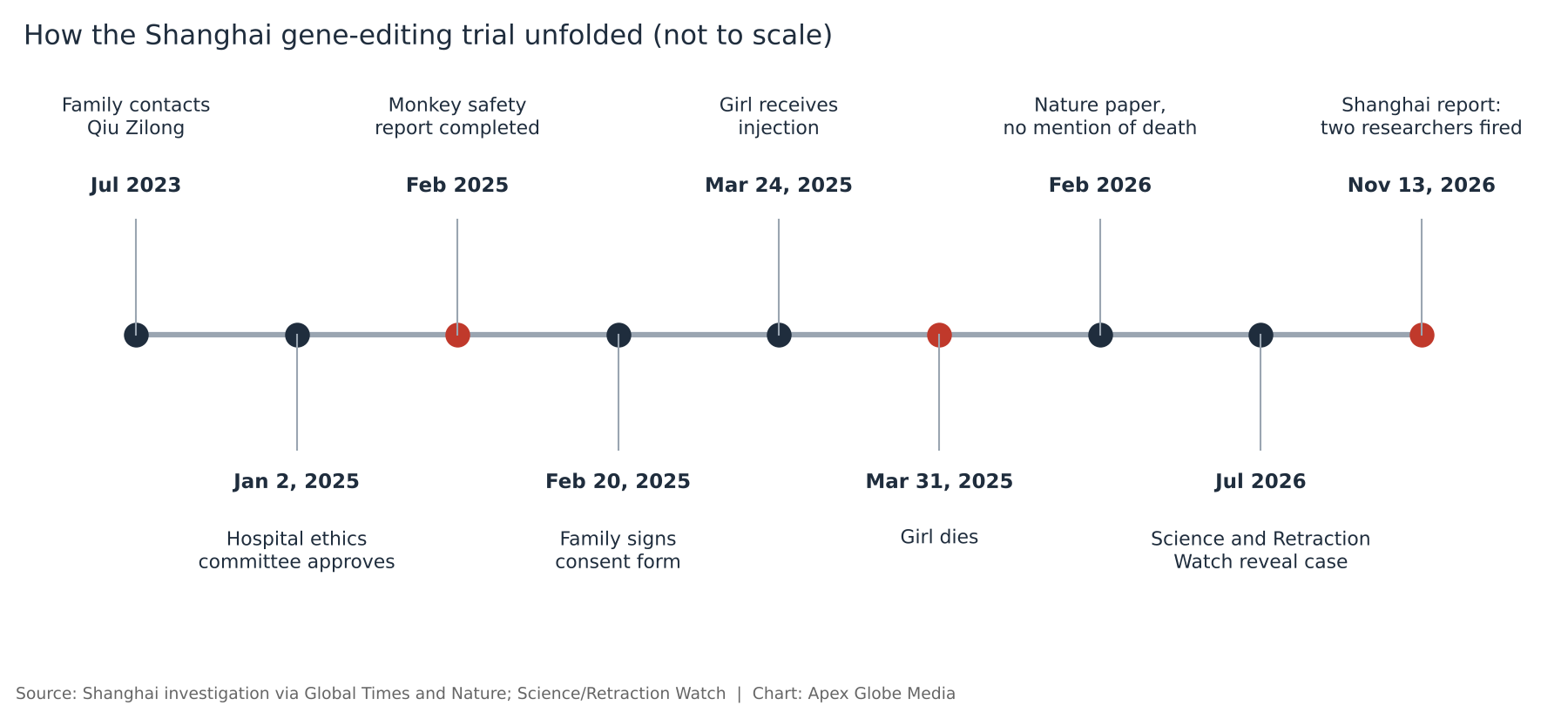
According to the official findings as reported by Global Times, the family first contacted Qiu in July 2023. Xinhua Hospital’s ethics committee approved the clinical study on January 2, 2025, the family signed the consent form on February 20, and the girl received the injection on March 24. She died on March 31 despite resuscitation. At an emergency review on April 2, the ethics committee attributed the death to thrombotic microangiopathy, a known complication of gene therapy in which small blood clots damage blood vessels and organs, and ordered the study stopped. Her death was never announced.
The warning that never reached the clinic
The central finding is about a safety report. In February 2025, about a month before the injection, Qiu’s team received results from a toxicology study in monkeys. Science and Retraction Watch had reported that the animals sustained liver damage. The investigators found that Qiu’s team did not inform the doctor in charge of the clinical study at Xinhua Hospital in time, so “the early warning signal” in the safety report was not “given high attention,” Nature quotes the statement as saying.
The hospital’s own checks failed too. Its ethics committee asked the researchers for more material because the safety evidence was thin, then approved the study without receiving it. The hospital did not carry out its own proper assessment of the science. And the consent form the family signed mentioned serious complications and adverse events, but did not spell out that the child could die, Sixth Tone reported.
“I expect the action to send a big warning to research institutes and hospitals across the country,” Jiayou Shi, a lawyer at the National Research Center for Civil and Commercial Law at Renmin University of China, told Nature. He says the trial should not have gone ahead at all if the therapy had shown harm in animals.
Money, gifts and a Nature paper
The family contributed 5.337 million yuan, about $800,000, in research funding through donations. Separately, according to the investigation, they gave cash and gifts worth about 1.06 million yuan to several people involved in the research. Sixth Tone, citing the report, says Qiu received expensive liquor and electronics worth about 100,000 yuan, while Yang received 900,000 yuan and expensive liquor, and two other team members received 30,000 yuan each. Investigators say the money and gifts have been returned or handed over under the rules.
In February 2026, Qiu’s team published its animal research in Nature, with Yang as first and corresponding author. The paper reported monkey tests suggesting the approach could be used in people but did not mention the girl’s death or the primate safety report. Science and Retraction Watch later found that it also left out evidence of liver and kidney damage from the animal safety tests. The investigators found no fabricated data, but they did find irregularities: methods that differed from those described in the paper, and data from the same batch reused at different stages without explanation. Nature added an editor’s note to the paper in July.
Who was punished
- Qiu Zilong was dismissed as deputy director of the Songjiang Research Institute, which is affiliated with the medical school.
- Yang Kan, an associate researcher at Xinhua Hospital, was also dismissed.
- Both are barred for five years from leading or joining science and technology programmes and from receiving awards, and both were added to a national database of serious research-integrity violations.
- The doctor who led the clinical study, named only by the surname Yu, was removed as head of the hospital’s research department and demoted. The head of the ethics committee office was also removed and demoted, and other officials were disciplined.
- Xinhua Hospital received an administrative penalty, and the institutions involved were ordered to correct their practices.
Qiu, the medical school and Xinhua Hospital did not respond to Nature’s questions about the report. The Shanghai Municipal Health Commission says it will launch special inspections of clinical research using new biomedical technologies such as cell and gene therapies.
China’s fast track under pressure
The trial ran under China’s investigator-initiated trial (IIT) route, which lets researchers test therapies in hospitals quickly, without supervision from the national drug regulator. That speed is one reason China has become a major source of early gene and cell therapy data, and Western drug companies now license many Chinese candidates. The government tightened oversight of these trials in May, a change Shi says should prevent similar cases.
Lizzi Lee of the Asia Society Policy Institute told Nature the case is “a cautionary tale” for China’s fast-growing biotech industry, where clinical oversight has not always kept pace with the momentum. “The investigation is quite candid about what went wrong,” she added.
Gene editing inside the body is close to becoming routine medicine elsewhere. We have covered a one-dose CRISPR treatment for high cholesterol and new approaches to genetic disease. The Shanghai case shows what happens when the same technology is pushed into a child’s brain on the strength of a family’s hope and a lab’s ambition, without the checks that slow regulated trials down.
Our take
The firings are the right outcome, and the Shanghai report deserves credit for naming the failures plainly instead of hiding them. But almost every step that went wrong was a step that a proper regulator exists to catch: a worrying animal result, a thin safety file, a consent form that did not say the word “death,” and money changing hands between a desperate family and the scientists treating their child. China’s investigator-initiated route was built for speed, and speed is exactly what killed the warning signal here. The most important part of the response is not the five-year bans but the promise of inspections; how strict they turn out to be will tell us whether this was a lesson or just a scandal.