



A once-a-day pill called daraxonrasib made tumours disappear from scans in about one in 12 patients with advanced pancreatic cancer when it was given together with chemotherapy, according to trial results presented this week in Barcelona. The lead investigator, Dr Wungki Park of Memorial Sloan Kettering Cancer Center in New York, called it “the closest to cure”, and the head of Cancer Research UK described it as “the biggest leap forward we’ve seen in decades” for the disease, RTÉ reported from the Press Association.
Pancreatic cancer is one of the deadliest cancers there is. Half of patients die within three months of diagnosis, and among those whose cancer has already spread, only about 3% are alive five years later, The Telegraph noted. That is why a result like this travels fast. It is also why it is worth reading carefully: this was a small, early study of 61 people, and the big trial that can prove the benefit is still running.
What the new study found
The results come from a phase 1/2 trial, the early stage of testing that looks at safety and gives a first estimate of how well a drug works. All 61 patients had metastatic pancreatic cancer, meaning it had spread beyond the pancreas, and all received daraxonrasib plus chemotherapy. The findings were presented at a cancer research meeting held by the European Organisation for Research and Treatment of Cancer (EORTC) in Barcelona, with a typical follow-up of 18 months.
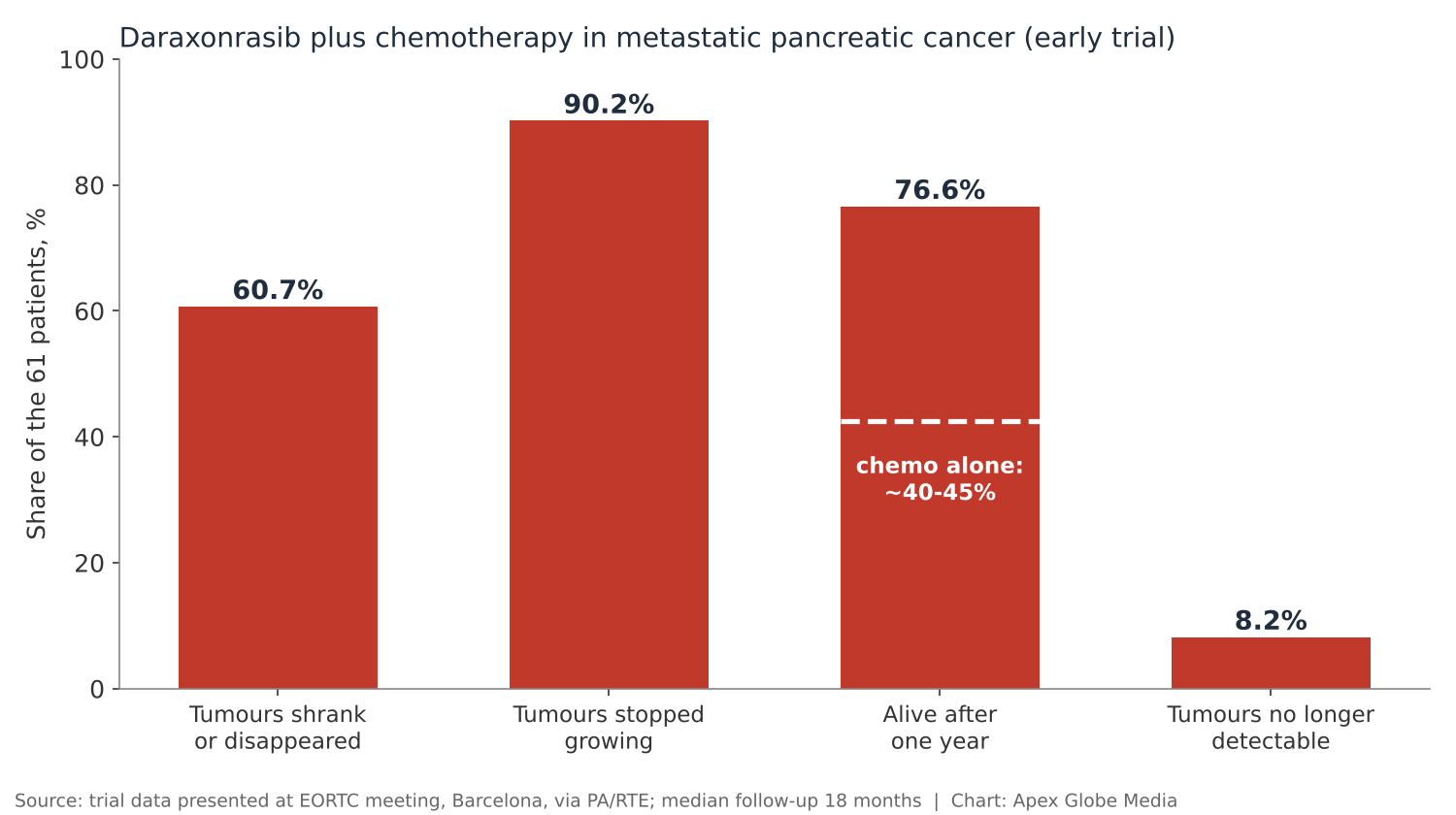
- Tumours shrank or disappeared in 60.7% of patients.
- In 8.2%, roughly one in 12, the tumours were no longer detectable on scans, what doctors call a complete response.
- The disease stopped growing in 90.2% of patients.
- 76.6% of patients were alive one year after starting treatment. With chemotherapy alone, the figure is usually around 40% to 45%.
- On average it took 12.8 months for the cancer to start growing again.
- Fewer than 5% of patients stopped treatment, which is regarded as low.
“In about one in 12 patients, it completely disappeared,” Park told the Press Association. “And then with such a long follow-up, this is real. We’ve never seen such a thing.” Asked whether those patients could be called cured, he answered: “This is the closest to cure. This is almost at the discovery level, we have never seen 8% complete response in metastatic pancreatic cancer, you don’t see that.”
How the pill works
Daraxonrasib, made by the US company Revolution Medicines, goes after a gene called KRAS. In more than nine out of 10 pancreatic tumours, KRAS carries a mutation that leaves it stuck in the “on” position, constantly telling cancer cells to grow and divide. For decades KRAS was considered “undruggable” because its protein has no obvious pocket for a drug to latch onto.
Daraxonrasib is what its maker calls a RAS(ON) inhibitor: it binds to the active form of the protein and switches off the growth signal. Unlike the first KRAS drugs, which only work against one specific mutation found mostly in lung cancer, it is designed to block several of the RAS mutations that drive pancreatic tumours. Cancer often finds ways around targeted drugs over time, and Park said combining the pill with chemotherapy is meant to delay that resistance “as much as possible”.
Already approved, now aiming earlier
This is not the drug’s first big result. In May, the phase 3 RASolute 302 trial showed that in patients whose cancer had come back after earlier treatment, daraxonrasib on its own roughly doubled survival compared with chemotherapy: a median of 13.2 months against 6.6 months in patients with the most common RAS mutations. On August 26, the US Food and Drug Administration approved it under the brand name Rasonque for metastatic pancreatic cancer in patients who had already received treatment, CancerNetwork reported. The European Medicines Agency began a phased review, a faster assessment process, in July.
The new Barcelona data point to the next step: using the pill earlier, together with chemotherapy, instead of waiting until chemotherapy has failed. A global phase 3 trial, RASolute 303, is testing daraxonrasib as a first treatment for metastatic disease, and RASolute 304 is testing it after surgery in patients whose tumours were removed. Park said the US part of the final phase 3 study has already enrolled enough patients, while some European sites may still have places.
Why doctors are still careful
The enthusiasm is genuine, but the experts quoted alongside the results all added caveats. “This is a small, initial study,” said Dr Madina Kara, head of research at the charity Pancreatic Cancer UK, though she called the results encouraging and “part of a growing body of evidence that offers real hope to people with advanced pancreatic cancer”. Cancer Research UK’s chief executive Michelle Mitchell said more trials were needed before the treatment could be assessed for use on the NHS, and that “despite this advance, pancreatic cancer survival is still very low.”
There are three reasons to hold back on the word “cure”. First, the study had no comparison group of its own: the 40% to 45% one-year survival figure for chemotherapy comes from earlier trials, and patients who join early studies are often fitter than average. Second, a tumour that cannot be seen on a CT scan is not the same as a cancer that is gone for good, and 18 months is not long enough to know how many patients stay well. Third, the results were presented at a conference, and as far as we can tell they have not yet appeared in a peer-reviewed journal.
Daraxonrasib also no longer has the field to itself. STAT News reported this week on early results for a KRAS drug from Alterome in pancreatic, lung and colon cancer, and on data from Erasca that add competitive pressure on Revolution Medicines. That is good news for patients: several companies are now chasing the same target that was out of reach for 40 years.
The disease is a long way behind most other cancers. In the UK alone, more than 11,000 people are diagnosed each year and more than 10,000 die from it. We wrote earlier about efforts to catch pancreatic cancer before it starts, because by the time most people get symptoms, it has already spread.
Our take
The word “cure” in the headlines is premature, and the doctors who used it were careful to say “closest to”. But the numbers are unusual for this disease: in metastatic pancreatic cancer, tumours vanishing from scans in one in 12 patients and three in four still alive after a year would have sounded like fantasy five years ago. The drug is already approved in the US, which means the main question is no longer whether it works, but how early it can be used and how long it holds the cancer back. The phase 3 results from RASolute 303 will answer that, and they are the ones to watch.