

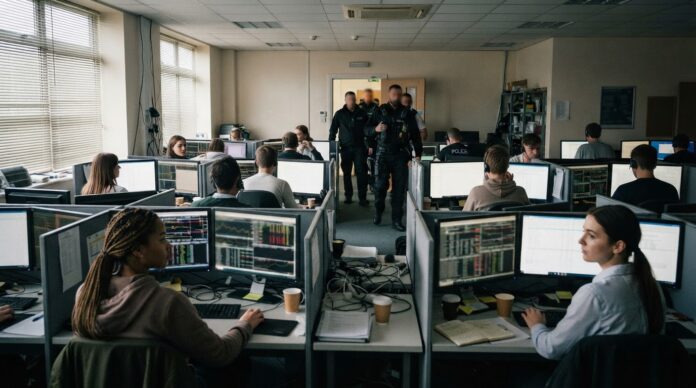

Ukrainian scam call centres that target Estonia went silent in August and were back within weeks, apparently the same operations reading the same scripts, the head of Estonia’s National Centre for Fraud Prevention, Jaagup Toompuu, told Ukraine’s Ekonomichna Pravda on November 16. The pause and the comeback make sense once you look at the other story running in Kyiv this autumn: a corruption case codenamed “Carthage”, in which anti-corruption investigators say officials of the Prosecutor General’s Office, the SBU security service and the National Police took money to keep these call centres open.
This article explains how the industry works, step by step, from the teenager hired on TikTok to the crypto mixer at the end of the money trail, and who has been named in the case so far.
An industry bigger than drugs
The most detailed study is “Kyiv Calling”, published in April 2026 by the Global Initiative Against Transnational Organized Crime (GI-TOC), a Geneva-based research group. The report is based on interviews with former employees, police, an MP who sat on a parliamentary commission on call centres, and a representative of EMA, a Ukrainian anti-fraud association.
- Ukraine had an estimated 1,000 to 2,000 scam call centres in mid-2023. A crackdown cut that by about a third, leaving roughly 1,000.
- A medium-sized “office” makes about $1 million a month and a large one up to $3 million, according to the MP. Multiplied out, that is a potential market of about $1 billion a month.
- About 60,000 people work in the industry. At its peak, the report says, it employed roughly two-thirds as many people as Ukraine’s entire banking sector. In late 2024, 30,000 were reportedly working in “offices” in Dnipro alone.
- The report calls scam call centres “arguably a more profitable illicit venture than drugs”.
The model did not start in Ukraine. GI-TOC traces it to Israel’s “binary options” boiler rooms of the 2000s, which moved to Georgia after Israel banned them in 2017 and then to Ukraine. Early Ukrainian centres mostly targeted Russians, which gave them a patriotic cover story. That ended long ago: according to Ukraine’s cyber police, cited in the report, calls to Russia were never more than 10 to 15 per cent of the total in 2022 and 2023. The main victims in 2023 were Ukrainians, including people displaced by the war. Today the big networks focus on the EU, the UK and the US.
Inside an “office”: who does what
A scam call centre is organised like a sales company, with a strict hierarchy, according to GI-TOC:
- “Colders” (kholodniki) make cold calls from lists of phone numbers. One former employee described calling 200 to 300 people a day; about a third talked, and around seven were “closed”. Some centres make up to 5,000 calls a day.
- Closers take over promising targets, called “mammoths” in office slang, and walk them through the transfers. They earn the most and find it hardest to leave.
- IT staff run the IP telephony, the software and the fake websites, apps and documents.
- HR recruits. Security controls the door and internal discipline.
- Administrators handle accounting and the money flow and deal with the owners, the “tower”, whom ordinary workers rarely see.
Owners often hold stakes in many offices across several cities, forming a “grid”. “All call centres belong to several groups. There aren’t that many owners – it’s like a mycelium,” one former worker told GI-TOC. Two of the three biggest grids are reportedly run by traditional organised crime: the Dnipro networks, including a group known as the Nines (Devyatky), and Khimprom, a synthetic-drug trafficking organisation. Offices can hold 250 to 300 people at once in Kyiv, Dnipro, Odesa and Lviv.
The technology behind the calls
This is where call centres stop being an old-fashioned con and become a cybersecurity problem. The tools GI-TOC and police describe include:
- Victim databases. Lists are bought on the dark web, including people known to gamble online, take loans or trade stocks. Until Russian authorities shut it down in March 2025, a Telegram bot called God’s Eye was widely used to build detailed profiles from social media, search engines and leaked data, sometimes including card details and passwords.
- VoIP and caller ID spoofing. Internet telephony makes international calls almost free, and spoofing changes the number shown on the victim’s screen so the call appears to come from a local bank or police station.
- Fake documents in seconds. Admin panels generate realistic bank letters with the victim’s account details, stamps and signatures. There is even a convincing fake copy of Diia, Ukraine’s official state services app.
- Remote access. Victims are talked into installing AnyDesk, TeamViewer or misused accessibility apps, which hand the scammers control of the computer and the banking app. Others are persuaded to install a “new” banking app or move their number to another SIM card.
- AI. Voice cloning and deepfakes imitate relatives or advisers; AI translation removes the language barrier; AI helps fool identity checks.
- Office security that mirrors corporate IT. Hard drives are encrypted with VeraCrypt, passwords are 20 to 30 characters long, and the customer relationship management (CRM) software only opens from approved IP addresses. Phones stay at the door.
- Crime as a service. According to GI-TOC, about $5,000 buys a basic call-centre kit: scripts, a CRM subscription and manuals for hiring staff. Victim databases and money-laundering services are sold off the shelf.
The scripts: four ways the money is taken
1. The “safe account”. The caller poses as a bank’s security team or the police and says the victim’s account has been hacked. The victim is told to move money to a “safe” account, which belongs to the network, or to install remote-access software. A network with offices in Kyiv, Dnipro and Ivano-Frankivsk, dismantled in December 2025 by Czech, Latvian, Lithuanian and Ukrainian police, took at least $11.7 million from more than 400 known victims this way, The Record reported. It recruited about 100 people from across Europe and paid callers commissions of up to 7 per cent.
2. Fake investments. Victims see a trading dashboard showing profits, make a small “test” deposit, and then either keep paying in or have their crypto wallet emptied by malware known as a drainer. A Kyiv ring exposed by Czech police and the SBU in December 2025 built fake investment websites with fabricated reviews and caused nearly $2 million in losses to at least 138 known victims.
3. “Recovering lost money”. People who have already been robbed get a second call promising to recover their losses. A call centre in Kharkiv, closed on May 26, 2026 by Latvian and Ukrainian police, targeted older victims this way, sold them new fake investments and took out loans in their names, according to Eurojust.
4. Romance and impostor scams. GI-TOC lists romance fraud as a third core theme alongside investment and impostor fraud. One recruit told the researchers she realised the job was a scam when she found she would be working through the dating app Badoo.
Where the money goes
Stolen money moves through “drops”, bank accounts of third parties that receive, move and cash out funds, and then through cryptocurrency wallets, exchanges and mixers that blend tainted coins with clean ones to hide the trail, GI-TOC says. The structure is designed so that no low-level worker knows anything useful about the real owners.
The workers: recruited on TikTok, kept by fear
Adverts on TikTok, Telegram and job sites such as work.ua and robota.ua promise “high salary for no-experience role”, often under a “customer relations” or “crypto trading” label. One former employee told GI-TOC he was approached at 15. Pay rarely matches the promise: one recruit was offered $800 to $1,000 a month and earned about $250. Shifts can run 12 hours a day, six or seven days a week, with fines for being late or mispronouncing words. Leaving is dangerous for good closers. “They beat them with wire until they bled, and people were shown a photo,” a former HR manager said.
The “roof”: why raids did not work
The report’s central finding is protection, known in Ukraine as a krysha, or “roof”. Call centres pay law enforcement a monthly fee, cited at $10,000 to $15,000, to be left alone. If a raid becomes unavoidable, they get a warning or a staged raid. “The employees got a day off – the next day everything went back to business,” one former worker said. An MP on the parliamentary commission said call centres in a region would go quiet for two or three days whenever the commission was about to visit: “Law enforcement agencies were warned … So, it’s obvious where the leaks came from.”
That matches what Estonia saw. Toompuu said Estonian police would pass Ukrainian colleagues the address of a call centre, and by the time anyone arrived, nobody was there. He said he could not prove it but considered it highly likely that requests from Estonia and other countries “ended up in the hands of criminals”. After a big operation in August closed 94 call centres together with German police, calls to Estonia stopped from early August, Estonian-language calls returned on September 15 and 16, Russian-language ones at the end of October, and by October 21 everything was back to the level before August.
Operation Carthage: the names
On September 4 and 5, Ukraine’s National Anti-Corruption Bureau (NABU) and the Specialised Anti-Corruption Prosecutor’s Office (SAPO) announced that they had exposed a criminal organisation that “systematically received illicit payments from scam call centers and laundered the money”, citing NABU. On November 4 the case was expanded. NABU says the documented illicit payments exceed 1 billion hryvnias, and SAPO head Oleksandr Klymenko said investigators had identified about 505 call centres under the group’s control, 112 Ukraine reported. According to The Record, investigators say the network also dealt in drugs, counterfeit cigarettes and fake currency and organised kidnappings and assaults, and a senior SBU official threatened to use a firearm to stop one search.
All the people below are suspects or have been searched. None has been convicted.
| Name | Position and role, per investigators and media | Status |
|---|---|---|
| Serhii Kropyva | Deputy head of the Prosecutor General’s Office department for international legal cooperation, the unit that handles legal requests from abroad. Named as the organiser | In custody since September 6. Bail set at 120 million hryvnias, cut to 93 million on October 30 (Interfax-Ukraine) |
| Yelyzaveta Ivakhnenko (“Muza”) | Kropyva’s partner | In custody, bail cut from 20 million to 15 million hryvnias |
| Unnamed lawyer | Kropyva’s trustee | In custody, bail cut from 15 million to 11.6 million hryvnias |
| Serhii Duka (“Akym”) | SBU major general, former first deputy head of the department for protection of national statehood. Allegedly helped “solve issues” in the SBU and prosecutor’s office | Remanded on November 6 for 60 days, bail 65 million hryvnias. Denies the charges and calls the case NABU’s revenge |
| Andrii Osipov (“Kriminal”, per Gordon) | NABU and SAPO call “Kriminal” the founder and leader of the organisation; Ukrainska Pravda’s law-enforcement sources say this is Osipov | Held without bail until January 16, 2027. Already in custody in a separate $1 million extortion case |
| Anton Kravchuk | Head of the SBU’s Main Directorate of Internal Security | Searched on November 4 (Ekonomichna Pravda) |
| Oleksandr Kovalchuk | First deputy head of a main directorate of the SBU’s department for protection of national statehood | Searched on November 4 (Ekonomichna Pravda) |
| Yehor Burkin (“Meksykanets”), Volodymyr Tsenov (“Prais”), Oleksandr Demyanchuk (“Konsultant”) | Named by Gordon as main figures of the second stage; Tsenov and Demyanchuk are linked to the National Police | Custody status not reported in the sources we read |
| Ruslan Kravchenko | Prosecutor General from June 2025. Searches were carried out in offices he used; NABU did not directly accuse him | Resigned in September, dismissed by parliament on September 15. Denies involvement, called the case “political revenge”, and left Ukraine saying he was on official business |
SBU chief Oleksandr Poklad dismissed two senior officers on November 4 without naming them and said the SBU “expects a transparent, objective and impartial investigation”.
How the prosecutor general left the country
Kravchenko crossed the border on the night of September 14, a day before parliament voted to dismiss him. According to the Anti-Corruption Action Centre and other Ukrainian outlets, he left through the Shehyni–Medyka checkpoint into Poland on papers for an official trip. The destination differs by source: Censor.NET’s sources said Brussels, others said a session of the Parliamentary Assembly of the Council of Europe in Paris. The State Border Guard Service says the crossing was legal and that he showed business-trip documents.
Ukrainska Pravda reported a different picture: border guards took his passport and held it because of a flag from anti-corruption agencies, and he was allowed through only after a “call from Kyiv”. The border service called that report fake, Slovo i Dilo reported. No source has said who, if anyone, made that call. Journalists later found that Kravchenko and his wife had registered in Vienna, Focus reported, citing Ukrainska Pravda. He has not returned.
A law, finally
President Volodymyr Zelensky submitted a bill on September 2, and in mid-September parliament approved it, The Record reports. It creates specific crimes for setting up, running, working at or recruiting for a fraudulent call centre, with seven to 12 years for organisers, and covers fraud using stolen personal and banking data. Until now these cases were prosecuted under general fraud laws, which GI-TOC says made them hard to build.
For readers, the defence is the same as ever. A bank or police officer will never ask you to move money to a “safe account” or install AnyDesk. Hang up and call the number on your card. We have also written about how criminals use AI voice cloning to impersonate executives, the same technique now spreading to these call centres.
Our take
There is an uncomfortable detail in the GI-TOC report. In April it praised Prosecutor General Ruslan Kravchenko, appointed in June 2025 on President Zelensky’s nomination, for leading “a renewed wave against scam call centres”. Five months later investigators said one of his own department heads was running the protection racket, Kravchenko resigned, and he left the country. So the questions have to be asked directly. How could a president who chose the country’s chief prosecutor and proposes its security chiefs not see that an industry of 60,000 people and a billion dollars a month was operating under their protection? Why did a prosecutor general appointed by Zelensky leave Ukraine before answering a single question in court? Who signed the business-trip papers that let a man whose offices had just been searched cross the border in wartime, when most Ukrainian men of his age cannot leave at all? If his passport really was flagged by anti-corruption agencies, who made the “call from Kyiv” that reportedly got it back, and who told him it was time to go? And if the border service is right that everything was legal, why has nobody in government explained how that can be? Why, two and a half months after the case broke, has not one official been convicted, while the court has already lowered bail for three suspects? And why did it take foreign police and journalists, not Kyiv, to keep saying that the tips sent to Ukraine kept disappearing? Until the President’s Office answers those questions, and until someone is actually punished, the promise to shut the call centres down will sound to their victims in Estonia and across Europe a lot like one of the scammers’ own scripts.