

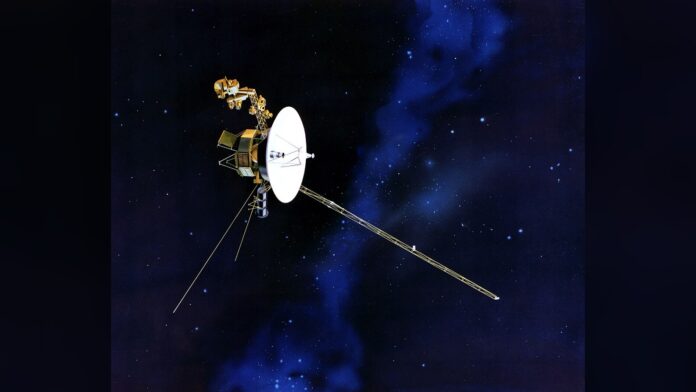

For the first time, something built by people is so far away that light needs a full day to reach it. Voyager 1, launched by NASA in 1977, crossed one light-day from Earth at 5:16:07 a.m. Eastern time (10:16:07 UTC) on Wednesday, November 18, Spaceflight Now reports, citing NASA’s Jet Propulsion Laboratory (JPL). The distance is about 16.1 billion miles, or 25.9 billion kilometres, roughly 173 times the distance between Earth and the Sun.
“It has never happened before. It may never happen again,” said Kareem Badaruddin, the Voyager interstellar mission manager at JPL. The trip took 49 years, 2 months and 11 days, according to EarthSky. Nothing on the spacecraft changed at that moment. What changed is how hard it is to talk to it.
A two-day conversation
Radio signals move at the speed of light. So a command sent from Earth now takes 24 hours to reach Voyager 1, and the reply takes another 24 hours to come back. Even NASA could not confirm the exact moment of crossing until the probe’s signal arrived a day later, Engadget notes.
This is not just a fun fact. It is the working reality for the small team that keeps the spacecraft alive. Badaruddin is one of only three full-time team members, according to Spaceflight Now. When something goes wrong, engineers send a fix and learn whether it worked two days later. The probe talks back with a transmitter about as powerful as a 23-watt light bulb, through an antenna 12 feet (3.7 metres) wide, and NASA’s Deep Space Network of giant dish antennas has to pick that faint signal out of the noise.
The team had a reminder of how fragile this is only a month ago. On October 18 and 19 the Deep Space Network failed to detect Voyager 1 on two attempts 24 hours apart. Contact came back on October 20. Engineers found that one group of thrusters, the small jets that keep the antenna pointed at Earth, had gone offline, and the spacecraft’s fault protection had switched to backups by itself. “This is the first time we’ve seen the spacecraft do something like this,” Badaruddin said. As of JPL’s October 29 update, the cause was still under investigation.
Running on a shrinking power supply
Voyager 1 has no solar panels. It runs on three radioisotope thermoelectric generators, which turn heat from decaying plutonium into electricity. Their output drops by about 4 watts every year, JPL says, so the team keeps switching things off to save power.
Only two science instruments are still working: the magnetometer, which measures magnetic fields, and the plasma wave instrument, which listens to charged particles around the probe. The Cosmic Ray Subsystem was turned off on February 25, 2025, and the Low-Energy Charged Particle instrument on April 17, 2026. In early September engineers swapped three power-hungry devices for lower-power ones, an operation the team nicknamed the “Big Bang.” Without it, another instrument might have had to shut down as early as summer 2027. JPL now believes there is enough power to keep communicating until about the early 2030s.
The cameras have been off much longer. On February 14, 1990, Voyager 1 took its last pictures, a “family portrait” of the planets that included the famous “Pale Blue Dot” image of Earth, an idea proposed by astronomer Carl Sagan. After that the cameras were switched off to save power and memory.
Why the engineers celebrate, and the scientists shrug
Alan Cummings, a senior research scientist at Caltech who has worked on Voyager’s Cosmic Ray Subsystem since before the 1977 launch, put the milestone in its place. “It is an engineering milestone, though,” he said, calling it “not a scientific milestone.” There is no boundary in space at one light-day. It is a round number that shows how far the probe has gone.
The science happened at other borders. In 2012 Voyager 1 crossed the heliopause, the edge of the bubble of particles blown out by the Sun, at about 122 times the Earth-Sun distance. It became the first spacecraft in interstellar space. A 2013 paper in Science reported that, at the crossing, low-energy particles from inside the bubble “soon completely disappeared” while cosmic rays from the galaxy “abruptly increased.” Cummings says Voyager measured the spectrum of those cosmic rays directly, something that “cannot be determined or deduced from any observations near Earth.”
One puzzle from that crossing is still open. Scientists expected the magnetic field outside the bubble to point in a new, interstellar direction. Instead it ran parallel to the Sun’s field. Recent data shows the direction slowly starting to turn, and a 2026 study by the magnetometer team suggests full alignment may take hundreds of times the Earth-Sun distance, according to Spaceflight Now. That is one reason the remaining two instruments still matter.
What comes next
The light-day count will keep changing with Earth’s position. EarthSky lists February 4, 2027 as the date when Voyager 1 will also be one light-day from the Sun, because Earth moves around the Sun during the year. Its twin, Voyager 2, launched 16 days before Voyager 1 and took a longer route past Uranus and Neptune. It is now more than 13.4 billion miles away, with messages taking about 20 hours, and should reach one light-day from Earth in November 2035, if it is still alive.
Both probes carry a Golden Record, a 12-inch gold-plated copper disk with 115 images, greetings in 55 languages, natural sounds and about 90 minutes of music. Voyager 1 is heading in the direction of the star Gliese 445, about 17 light-years away, and will pass within about 1.7 light-years of it in roughly 40,000 years, according to Engadget.
Today’s rockets are far more capable than the Titan-Centaur that launched Voyager, as this week’s news about SpaceX catching Starship’s upper stage shows. But no mission now planned will overtake Voyager 1 soon. It is moving at nearly 38,000 mph, and it has a 49-year head start.
Our take
The light-day milestone is symbolic, and the scientists are right to say so. But symbols are useful when they make a hard idea concrete, and this one does: humanity’s most distant machine is now a full day away at the speed of light, and a team of three full-time staff still coaxes it along with commands that take two days to answer. Voyager was built with 1970s electronics. It has lasted almost half a century because its designers built in spare capacity and its team keeps finding clever ways to use less power. With power running out in the early 2030s, the best way to mark this day is to keep funding that small team until the last watt is gone.